Swiss internship pay: minimum wage, holidays and rights

The short answer
In Swiss law, an internship is almost always a fixed-term employment contract. There's no general minimum wage for interns. But if you're mainly there to work for the company, you're owed the usual pay. And five cantons and the city of Lucerne have a minimum wage that exempts only internships that genuinely train you.
Whether yours is one of them usually comes down to a single question: are you doing it during your studies because your school requires it, or after you've graduated? The minimum wage laws leave plenty of room for compulsory internships. An internship after your degree falls under the minimum wage in Geneva and Jura. In Neuchâtel, Ticino, Basel-Stadt and Lucerne it's only exempt if it really trains you and stays within a time limit: six months in Neuchâtel, Basel and Lucerne, the first year after graduating in Ticino. We go through the rules place by place, what internships actually pay, and your rights on holidays, sick pay, ending early and insurance.
Is an internship an employment contract?
Almost always, yes. The Swiss Code of Obligations (CO) has no separate rules for internships. You have an employment contract when you work for an employer and are paid for it (CO art. 319; our links go to the German text, as the current English version isn't published yet). The contract exists even if pay was never discussed: if a business accepts work that, in the circumstances, you'd only expect to do for pay, it owes you a salary (art. 320 para. 2). How much is set by art. 322: what was agreed or is customary, or what a collective labour agreement lays down. A collective labour agreement (CLA, or GAV in German) is a contract between unions and employers that sets pay and working hours for a whole industry.
The Federal Supreme Court showed where the line runs in a real case in 2023. A trained accountant from Romania worked part-time without pay for just over 14 months at a fiduciary firm in Vaud, on what was called a "stage", French for internship. After it ended, she claimed about CHF 44,560 in wages, worked out at CHF 40 an hour. She lost at every level (ruling 4A_150/2023). The rule the court applied: an internship only falls outside employment law if it's mainly in the intern's interest, meaning it serves to gain practical experience. If the business has an objective interest in the intern's work, it's an employment contract with a right to pay.
Details tipped the balance. She had little experience of Swiss bookkeeping, a colleague testified that her work was no more demanding than other interns', and she only asked for pay after it had ended. So an unpaid internship isn't automatically unlawful. But the more you're put to work like regular staff, the stronger your claim. Keep a record of what you do, and bring up pay early. How often internships go unpaid at all depends heavily on when you do them.
During or after your studies: the difference that counts
Unpaid internships are mostly short and required by the school. That's what the Federal Statistical Office (FSO) survey on student life shows. In 2020, 38 percent of students had done at least one internship since starting their degree, and as many as 83 percent at universities of teacher education (FSO report on internships, in German). The most common type was a compulsory internship of a month or less without pay.
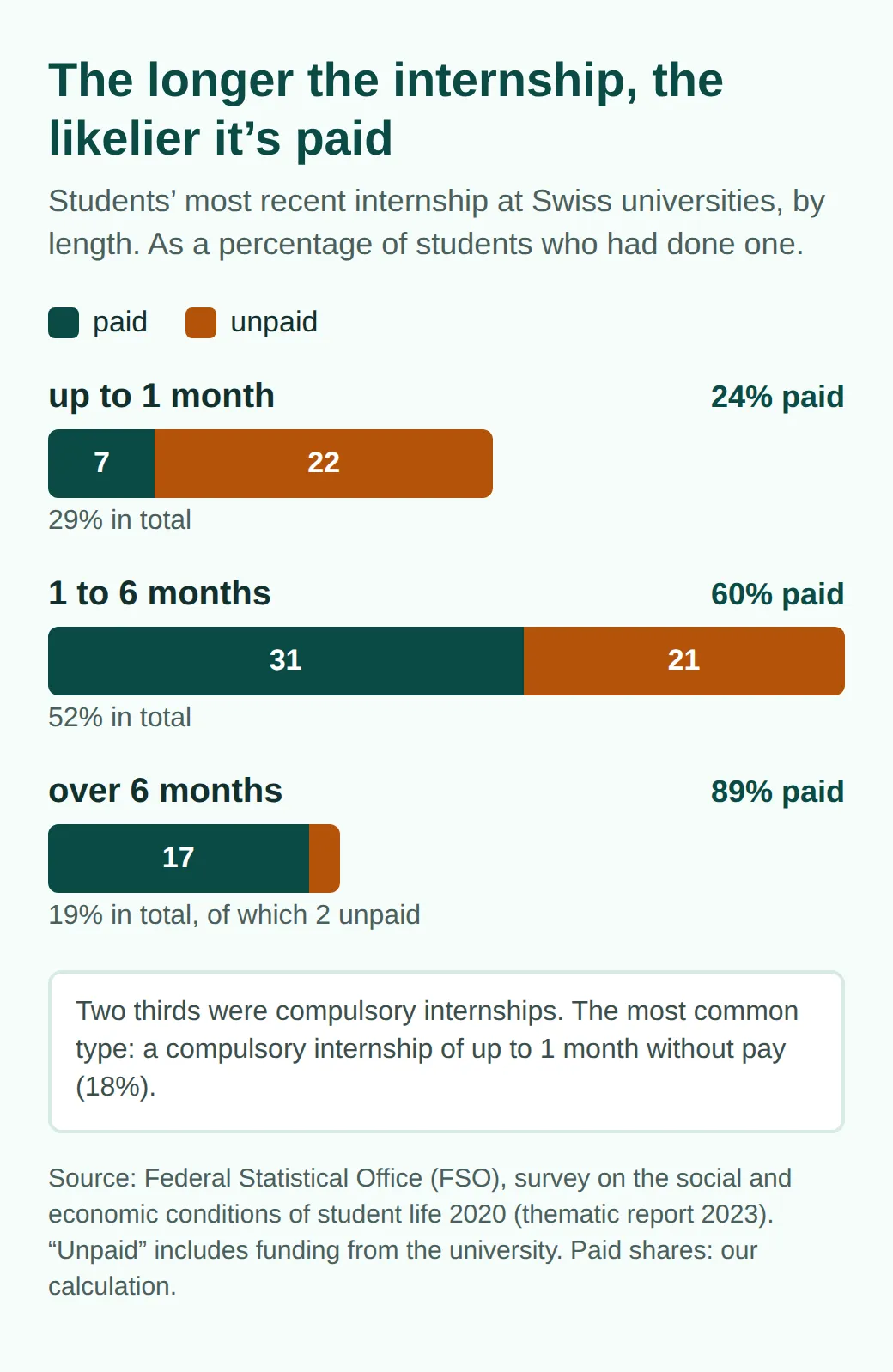
The longer an internship lasts, the more likely it's paid. By our calculation from the FSO figures, only a quarter of internships of up to a month were paid, against almost nine in ten of those over six months. More than half a year without pay is the rare exception, and that's exactly where the question from the Supreme Court case comes up.
After graduation, the picture changes. Of university graduates from the 2016 and 2018 cohorts, 23 percent did an internship within five years; among master's graduates of universities it was 36 percent, and in law 80 percent (FSO, internships after graduation, in German). Few of these were unpaid: 4 percent of all graduates did at least one unpaid internship after their studies. One finding belongs in every decision: graduates who did an internship tended to be worse off five years later, especially in income, in how well their job matched their subject and in reaching management roles. According to the FSO, the data don't show cause and effect.
The minimum wage laws draw their line in the same place: between internships during and after your education.
Does the minimum wage apply to interns?
Only five cantons and the city of Lucerne have a statutory minimum wage, and all of them exempt some internships. How far they go varies a lot. The overview shows the rules for the two most common cases.
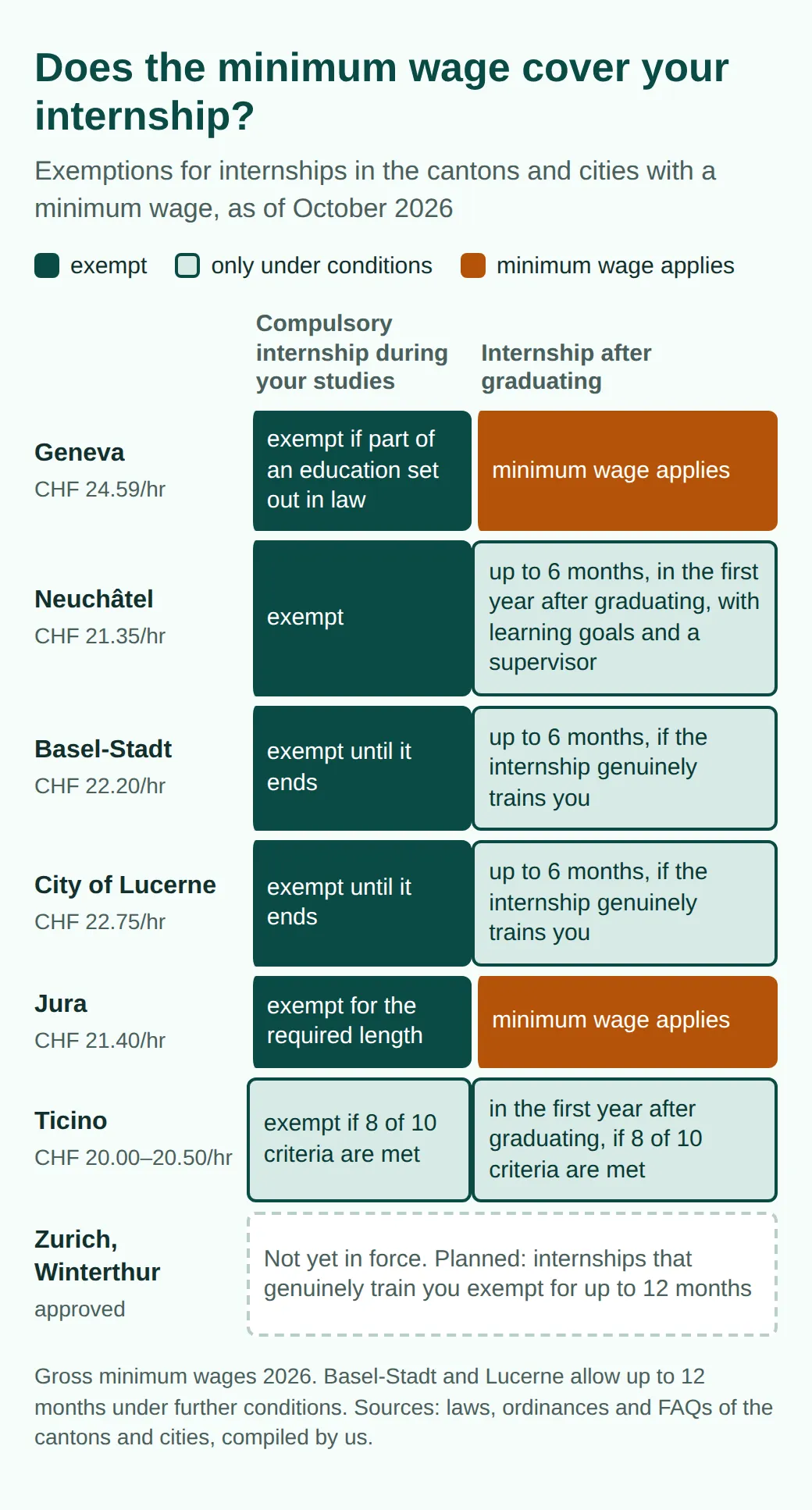
The idea behind it is the same everywhere: an internship that mainly trains you may cost the business less, but a job that's merely called an "internship" may not. Basel-Stadt and the city of Lucerne spell this out.
Geneva: strict, and the Supreme Court backs it
Geneva has the highest minimum wage, CHF 24.59 an hour, which at 40 hours a week comes to CHF 4,262.27 a month (ge.ch, in French). The only internships exempt are those that are part of a school or vocational education governed by law (LIRT art. 39J). An internship after your master's isn't one of them.
A ruling from March 2025 shows how seriously this is meant. A company running medical institutes employed people in Geneva on "stage formation" (training internship) contracts or as temps. The cantonal labour inspectorate found that between November 2020 and November 2022, 23 of 67 employees had been paid below the minimum wage, with shortfalls totalling around CHF 471,700. The company couldn't show that the people it called interns were doing their internship as part of their education. The Federal Supreme Court upheld the fine of CHF 25,000 (ruling 2C_431/2024). According to the court, a three-way internship agreement with the school is needed in every case, and the internship must be part of the education, whether compulsory or optional.
Neuchâtel: six months after graduating
Neuchâtel (CHF 21.35 an hour) has explicit rules for internships after graduation, much like Ticino. A "stage de fin d’études", or graduate internship, can be exempt from the minimum wage if it takes place in the year after you finish full-time education and lasts no more than six months (RSalMin, annex, in French). It must also meet six of seven conditions: written learning objectives before you start, a named supervisor, scheduled progress reviews, a certificate of what you learned at the end, no repetitive work, overtime only made up with time off, and no more interns than the business can properly supervise. If more than one is missing, it doesn't count as an internship for the exemption.
Basel-Stadt and the city of Lucerne: six months
Basel-Stadt (CHF 22.20) and the city of Lucerne (CHF 22.75) draw the line at six months. An internship that genuinely trains you is exempt up to that length (Basel FAQ, in German). Going longer, up to twelve months at most, is only possible with proof of your next step. In Basel that means a signed apprenticeship contract or admission to a university or to higher vocational education, and the proof must be in place before the seventh month. In Lucerne, an offer of a permanent job at the minimum wage afterwards also counts (regulation, art. 2, in German). In both places, compulsory internships with a set curriculum are exempt until they end, even if they last longer. Basel gives the legal traineeship required for the bar exam as an example.
Jura: only during your education
In Jura (CHF 21.40), an internship is exempt in only five cases (jura.ch, in French). The 2022 ordinance lists them: taster internships before starting a course (two weeks at most), required pre-course internships, compulsory internships during training, internships in a recognised exchange programme (six months at most) and internships to help people back into work. An internship after graduation isn't among them. The ordinance even states that the first job of someone trained for that job is not an internship.
Ticino: one year after graduating, with ten criteria
Ticino (CHF 20.00 to 20.50 depending on the sector) exempts people on internships and in training, provided the training leads to a recognised qualification (law, art. 3, in Italian). What counts as an internship is set out in the annex to the regulation. There has to be a reason, such as a three-way agreement with the school, a school requirement, a return to your profession or an internship in the year after graduating ("stage di fine studio"). The internship must also meet eight of ten conditions, including written learning objectives before you start, a supervisor, a certificate at the end and no repetitive work. Two of the ten aren't on Neuchâtel's list: your work shouldn't make the business a profit, and you mustn't have been promised a permanent job when you start. So in Ticino an internship after your degree can be exempt in the first year, but only if it really trains you. If in doubt, ask the canton before you sign.
Zurich and Winterthur: approved, not yet in force
In the cities of Zurich and Winterthur, voters approved minimum wages of CHF 23.90 and CHF 23 an hour. The Federal Supreme Court upheld both on 12 May 2026, but there's no start date yet (City of Zurich, Winterthur, both in German). Both cities plan to exempt internships that genuinely train you for up to twelve months. Zurich would also exempt employees under 25 who don't hold at least a Federal VET Certificate (EBA), the two-year vocational qualification. Until then, and in all other cantons, what counts is your contract and any CLA.
When a CLA applies: the hospitality example
A CLA can set its own rules for internships, whatever the canton. The clearest example is the national collective labour agreement for the hotel and restaurant industry (L-GAV), which covers hotels, restaurants and bars across Switzerland. It has its own minimum wage for interns: CHF 2,390 gross a month in 2026 and CHF 2,404 from 2027 (L-GAV art. 11, in German). But it only applies to students doing the internship as part of their course at a recognised hotel school, a university of applied sciences or a foreign school with a valid cooperation agreement. Deducting money from their pay for the school is banned.
The L-GAV treats all other interns as regular employees. If you're working on reception as an "intern" after your Matura or your degree, you're entitled to at least CHF 3,713 a month full-time, the minimum wage for staff without an apprenticeship (L-GAV art. 10). During an induction period, that pay can be up to 8 percent lower if this is agreed in writing. Whether and how other CLAs deal with internships differs from one agreement to the next. SECO keeps a list of generally binding CLAs (in German), meaning those that apply to every business in an industry.
How much do interns earn in Switzerland?
There are no official statistics on internship pay. Measured against everyone in work, internships are rare: in 2023, according to the FSO, fewer than one percent of employed people were on a paid internship. Reliable benchmarks come from employers and associations that publish their rates. At the State Secretariat for Economic Affairs (SECO), the federal government shows what it considers fair pay:
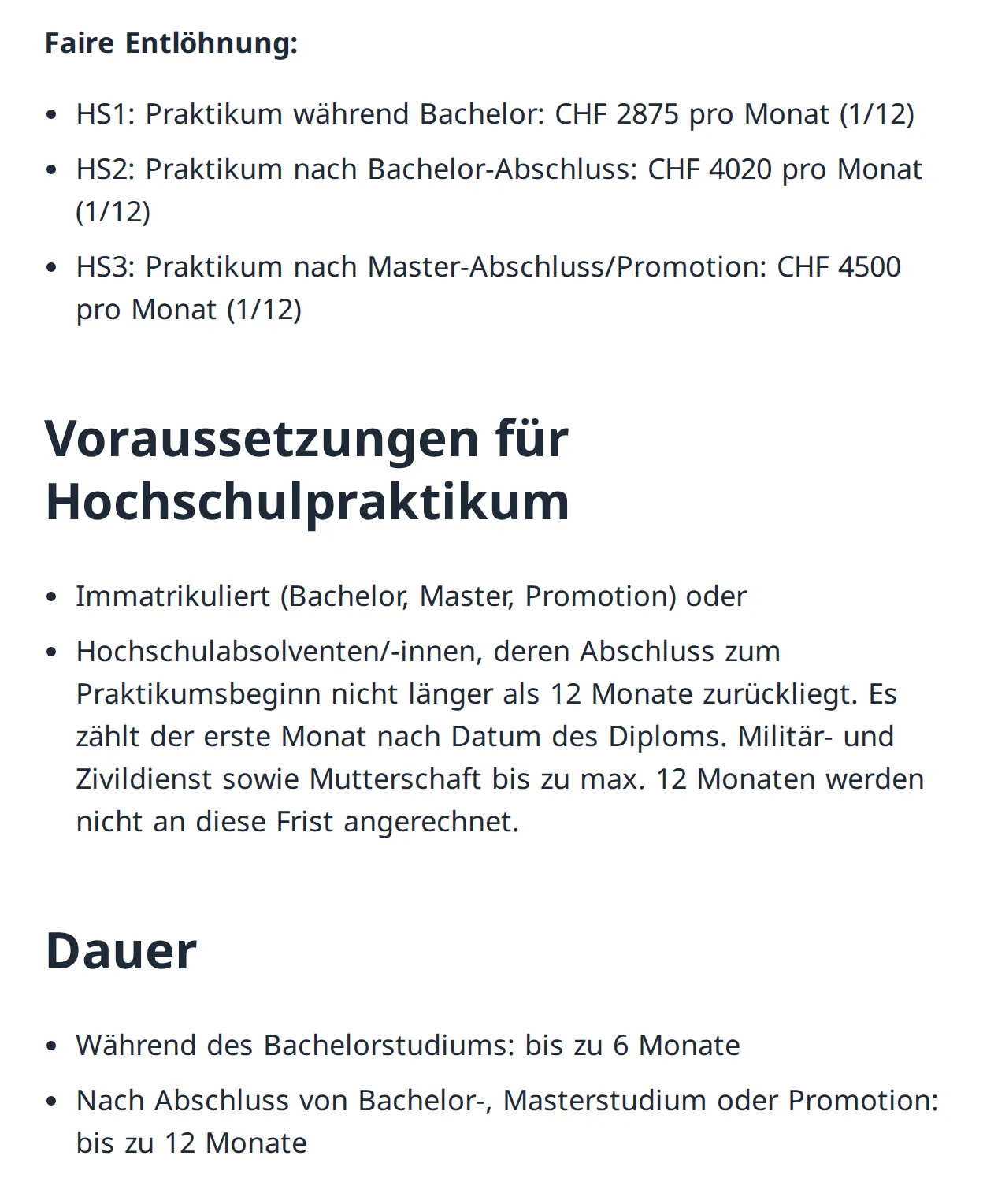
The "1/12" means twelve monthly salaries, so CHF 34,500 a year during a bachelor's, CHF 48,240 after a bachelor's and CHF 54,000 after a master's. The Kaufmännischer Verband, the Swiss association of commercial and office employees, recommends these minimum salaries in its guide to types of internship (in German), each paid 13 times a year:
| Internship | Per month | Per year (×13) |
|---|---|---|
| After the Matura | CHF 2,100 | CHF 27,300 |
| In the 1st year of a bachelor's | CHF 2,100 | CHF 27,300 |
| In the 2nd year of a bachelor's | CHF 2,400 | CHF 31,200 |
| In the 3rd year of a bachelor's | CHF 2,700 | CHF 35,100 |
| With a bachelor's degree | CHF 3,400 | CHF 44,200 |
| With a master's, e.g. as a traineeship | CHF 4,000 | CHF 52,000 |
For a career change after an apprenticeship, the association recommends an internship of six months at most, paying at least CHF 2,100 in the first three months and CHF 2,700 in the next three.
Set these next to the minimum wages and you see why the exemptions matter so much. Geneva's minimum wage comes to CHF 51,147 a year at 40 hours a week. An internship with a bachelor's degree paid as the association recommends, at CHF 44,200, would be well below that, and in Geneva that's only allowed if it falls under the exemption for training internships. SECO's internship after a master's, on the other hand, is above it.
How long can an internship last?
The Code of Obligations sets no maximum length. An internship is a fixed-term contract and ends on the agreed date by itself, without notice (art. 334). If you simply carry on working after that date, it becomes an open-ended employment contract with normal notice periods.
The limits come from elsewhere. There are the minimum wage laws above: six months in Basel-Stadt and Lucerne and after graduation in Neuchâtel, and the first year after graduation in Ticino. And there are employers' own rules, such as SECO's six months during a bachelor's and twelve after it. Law internships last longest. According to the FSO, admission to the bar exam usually requires three internships at a law firm, a court or a public administration, totalling 18 months. As a result, 61 percent of law master's graduates did internships totalling more than twelve months after their studies.
Young professionals from abroad have a cap of their own. If you're from one of the 15 countries that have a young professionals agreement with Switzerland, including the USA, Canada, Japan and Australia, you can work here for up to 18 months, provided you have at least a bachelor's degree or a two-year apprenticeship (SEM). Your pay must be in line with local and industry rates, at least at the level of someone starting out in the career, and part-time work isn't allowed.
Holidays, sick pay and ending early
As an intern, you have the same basic rights as any other employee. For holidays, that's at least four weeks a year, five until you turn 20, and a pro rata share if you're employed for less than a year (art. 329a). For a six-month internship at 22, that's two weeks, or ten working days on a five-day week. At 19 it would be two and a half weeks.
If you fall ill, your employer must keep paying you for three weeks in your first year of service, provided the job has lasted more than three months or was agreed for more than three months (art. 324a). On a six-month internship that applies from day one; on one of exactly three months, never. Daily sickness benefits insurance taken out by your employer can replace this rule if it's agreed in writing and at least as good for you.
A fixed-term internship can end early, with immediate effect, for good cause, meaning when it can no longer reasonably be expected to continue (art. 337). Otherwise, under the prevailing legal view, as set out by the specialist publisher WEKA (in German), it can only end by mutual agreement or if the contract allows either side to give notice. Whether there's a probation period at all is disputed: WEKA says a fixed-term contract has none unless one is agreed, while the consumer programme SRF Kassensturz (in German) says it's the first month. What's clear is this: if your contract includes a probation period, either side can give seven days' notice during it, unless something else was agreed in writing, and it can't be longer than three months (art. 335b).
Your employer must also give you two things in writing. If your internship lasts more than a month, you must be told in writing within a month of starting who the parties to the contract are, when you started, what your role is, what you're paid and how many hours a week you work (art. 330b). And you can ask for a reference (Arbeitszeugnis) at any time, even during the internship (art. 330a). What comes off your payslip is the next question.
Insurance: what comes off an intern's pay
Social security contributions come off internship pay too. In 2026 you pay 5.3 percent for AHV/IV/EO (old-age, disability and loss-of-earnings insurance) and 1.1 percent for unemployment insurance, and your employer pays the same again on top (federal contributions table, in German). You have to pay from 1 January after your 17th birthday. If you earn no more than CHF 2,500 in a calendar year from one employer, contributions are only collected if you ask for them (leaflet 2.01).
Interns and volunteers are explicitly covered by compulsory accident insurance (Accident Insurance Act, art. 1a). That holds for an unpaid internship too: your employer still has to arrange your accident cover, as SRF Kassensturz points out. Your employer pays the premium for accidents at work. If you work at least eight hours a week for the same employer, you're also covered for accidents outside work (ordinance, art. 13), and that premium is usually yours to pay.
For the pension fund, length is what decides. Employment contracts of three months or less are exempt from compulsory occupational pension cover (BVV 2 art. 1j). If your internship lasts longer, you're insured if your pay, scaled up to a full year, is more than CHF 22,680 (BVG art. 2, FSIO key figures, in German). On twelve monthly salaries, the threshold is CHF 1,890 a month. A six-month hotel school internship under the L-GAV at CHF 2,390 is therefore above it. You only start saving for retirement from 1 January after your 24th birthday, though; until then the fund only covers death and disability. If a contract is extended beyond three months, you're insured from the day the extension was agreed.
Before you sign
Almost everything in this article is settled before your first day: by where you work, how long you stay and whether the internship really trains you. So ask for a written contract before you say yes. A short message is enough:
Hello, and thank you for the offer. Before I sign, could you please send me the written contract with the start and end dates, the gross monthly salary and number of monthly payments, the weekly hours, the number of days of holiday, the learning objectives and the name of my supervisor? Is the position covered by a collective labour agreement? Kind regards
With that, you can size up any offer in a few minutes. Work out the annual salary, put it next to the SECO and Kaufmännischer Verband rates, and check the overview above to see whether a minimum wage applies where you'll work. If an offer falls short, you now have the sources to ask about it. You can browse open internships on our site by location, for example in Bern, Lausanne, the canton of Aargau or the canton of St. Gallen.
Common questions
- Can I claim unpaid wages after my internship ends?
- Yes. Claims from an employment relationship only become time-barred after five years, so you can still ask for pay once the internship is over. In case 4A_150/2023, though, the Federal Supreme Court took into account that the intern had never asked for pay during the whole internship. So raise the subject early and in writing.
- Do interns in Switzerland get a 13th-month salary?
- Only if your contract or a collective labour agreement provides for one; the law doesn't require it. The Kaufmännischer Verband recommends paying internship salaries 13 times a year, while SECO pays its university interns twelve times. So always compare offers by the annual salary.
- Do the same rules apply to a part-time internship?
- Yes. You get the same number of weeks of holiday as full-time staff. If you work fewer days a week, that means proportionally fewer days off. A cantonal minimum wage applies per hour. But your employer's insurance only covers accidents outside work if you work there at least eight hours a week.
- What happens if I keep working after my internship's end date?
- The fixed-term internship then becomes an open-ended employment contract with normal notice periods. In Basel-Stadt and the city of Lucerne, the minimum wage exemption also ends after six months unless one of the conditions for an extension is met. So always put an extension in writing.