Graduate starting salary in Switzerland 2026, by field

The short answer
One year after graduating, university master's graduates working in Switzerland earn a median of CHF 85,000 gross a year, bachelor's graduates of universities of applied sciences (UAS) CHF 82,000, and graduates of universities of teacher education CHF 99,000. That is for a full-time job. By field, university master's and UAS bachelor's degrees range from CHF 60,000 in UAS design to CHF 90,000 in economics and in medicine and pharmacy.
The figures come from the Swiss Graduate Survey run by the Federal Statistical Office (FSO), 2024 graduating cohort, published in August 2026. Search for "starting salary after university" and you mostly find articles that copy a single chart from it, often from an older cohort and without saying who is counted. We opened the tables ourselves. They show that the best-known figure, CHF 80,500 for university master's graduates, also includes people working abroad, and that the low figures in some fields mostly reflect internships and doctoral posts. Both change which number you should take into a salary negotiation.
What the FSO figure measures
The FSO calls the figure "standardised gross earned income". It asks for gross income from your main job, before social security (AHV) and pension fund contributions. Part-time pay is scaled up to 100 percent: CHF 60,000 at an 80 percent workload counts as CHF 75,000. That lets you compare fields where many people work part-time with fields where few do.
The figure shown is the median, the value in the middle: half earn more, half earn less. The FSO also gives the lower and upper quartile. The middle half of all salaries lies between those two values, and that range is more useful to you than the median alone. The survey covers everyone who graduated from a Swiss higher education institution in an even-numbered year, one year and five years later. Taking part is voluntary, so the FSO weights the answers by institution, field, degree and gender (FSO tables and methodology, in German).
Three rules from the definitions are worth knowing. First, bachelor's graduates who went on to a master's are left out. The figure for a university bachelor's therefore describes only those who stopped after the bachelor's. Second, any paid job counts, including an internship or a doctoral post. Third, every figure exists twice: for all work locations and for Switzerland only. The figures on the FSO's overview page are for all work locations, and pay abroad pulls them down: university master's graduates working abroad earn a median of just CHF 43,800. The FSO itself considers the figures for abroad unreliable, as they rest on few cases from very different countries. For a job in Switzerland, use the "Switzerland" column. This post uses it throughout unless it says otherwise.
University, UAS or teacher education: starting salary by degree
Your type of degree explains less than you might think: university master's and UAS bachelor's graduates are only CHF 3,000 apart. The difference is in the spread. Among university master's graduates, a quarter earn less than CHF 65,000; among UAS bachelor's graduates, less than CHF 72,000. A university degree more often leads first to an internship or a post at an institute: one year after graduating, 11 percent of university master's graduates work as interns and 15 percent in an assistant or doctoral post, while just 4 percent of UAS bachelor's graduates are interns (all work locations).
| Degree | Lower quartile | Median | Upper quartile |
|---|---|---|---|
| University bachelor's | 53,800 | 74,100 | 90,000 |
| University master's | 65,000 | 85,000 | 96,000 |
| Doctorate | 91,300 | 101,700 | 120,000 |
| UAS bachelor's | 72,000 | 82,000 | 92,300 |
| UAS master's | 78,000 | 93,000 | 109,200 |
| Teaching diploma | 84,000 | 99,000 | 116,000 |
Figures in CHF per year at 100 percent, work location Switzerland, one year after graduating in 2024 (FSO, table TA3E61-1).
Universities of teacher education come out on top, and within them the FSO shows big differences: teachers trained for kindergarten and primary school earn CHF 86,600, at lower secondary level CHF 100,000 and at upper secondary level CHF 116,800 (FSO, earned income, in German). The FSO puts this down to age and work experience: upper secondary teaching requires a university degree first, so people starting out there are older.
Over time, starting pay has barely moved. Adjusted for inflation, the median for university master's graduates across all work locations has stayed between CHF 79,100 and CHF 85,600 for every cohort since 2002. The FSO itself points out that changes to the questionnaire and method break the series several times. Even so, the figures show no big move up or down. The differences between fields are larger.
Starting salary by field at university
Among university master's graduates, economics, medicine and pharmacy lead with CHF 90,000 each, and law comes last with CHF 70,000. In between are the exact and natural sciences at CHF 78,300, the humanities and social sciences at CHF 83,000 and the technical sciences at CHF 84,500. That is the ranking you also see in the media.
But the ranking says little about what a company pays a new graduate. The FSO also breaks pay down by occupational status, and if you take only employees without management duties, the typical first job, the fields bunch together at CHF 87,000 to CHF 93,000. Law jumps from last place to first.
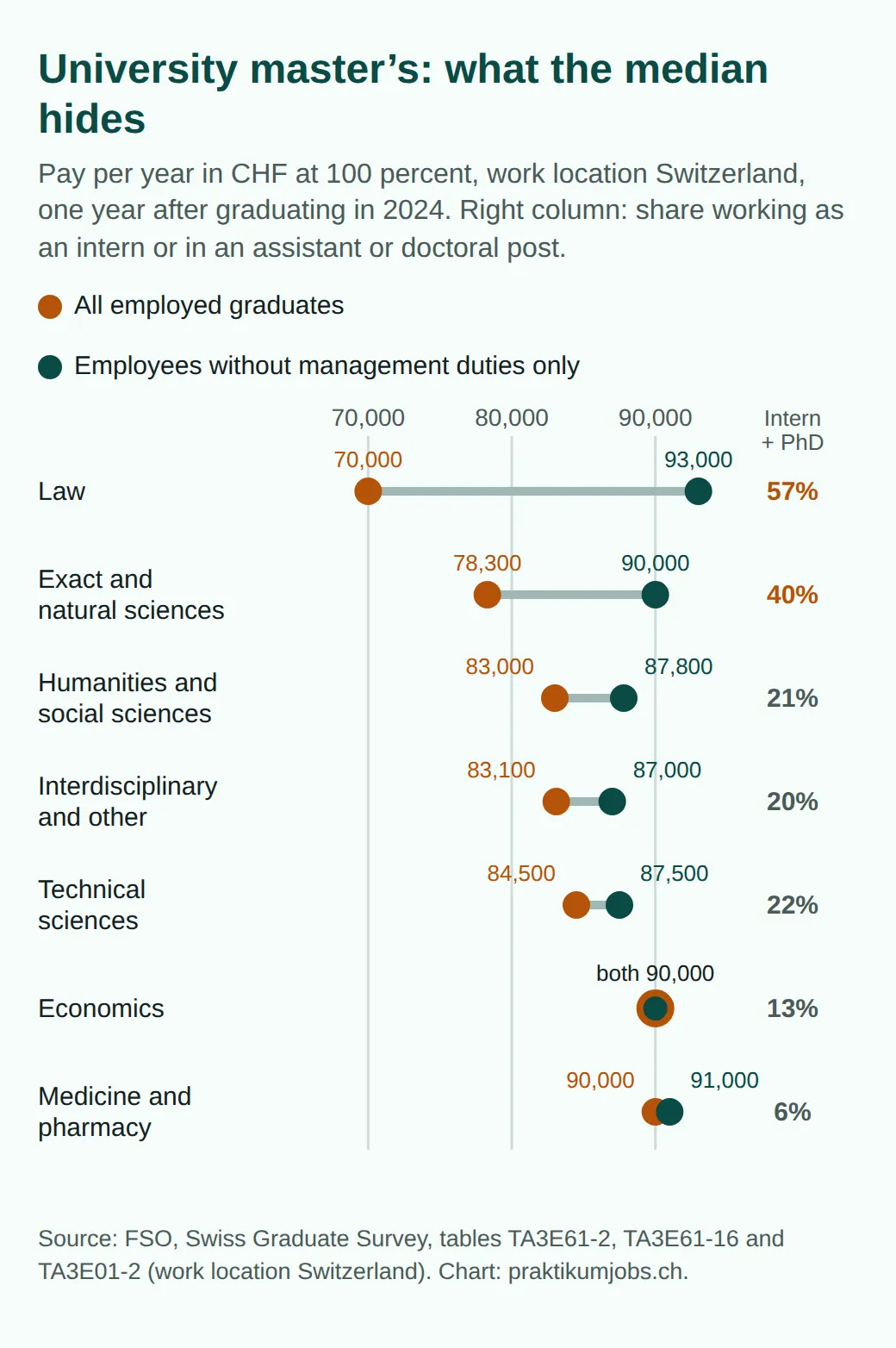
The reason is the mix. In law, more than half work as interns one year after their master's; in the exact and natural sciences, 30 percent hold an assistant or doctoral post. These positions pull the median down, even though they have little to do with the pay for a permanent job.
Law: low in year one, ahead after five
Law graduates start with the lowest median of all university master's graduates, and the FSO names the reason itself: the usual legal traineeship after the degree (Anwaltspraktikum) and its low pay.
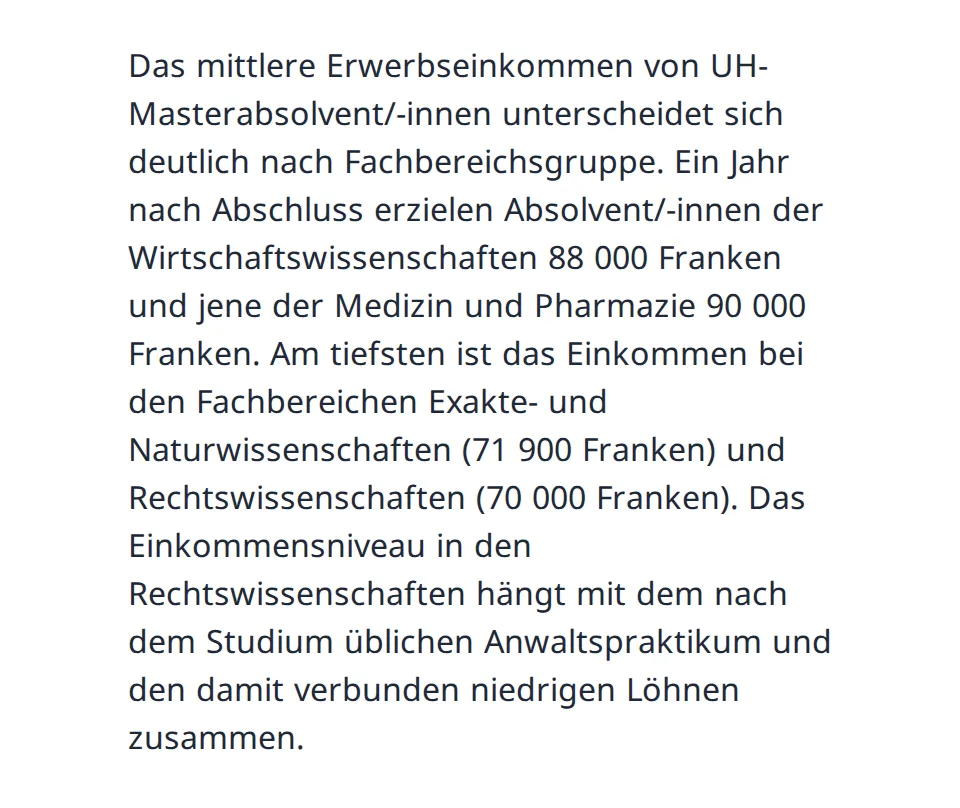
In numbers: just under 52 percent of law master's graduates working in Switzerland are trainees one year after graduating, with a median of CHF 48,000. Law graduates who already have a permanent job without management duties earn CHF 93,000. Five years after graduating, law has caught up with every other field. For the 2020 cohort, the median for university master's graduates in law, across all work locations, rose from CHF 65,900 after one year to CHF 109,000 after five, the biggest jump of any field. And law graduates with a doctorate start on CHF 130,000, the highest median of any field and degree at university.
For your salary expectations, this means: if you apply for a permanent job, CHF 70,000 is the wrong anchor. Use the figure for employees. For a legal traineeship, on the other hand, the median for trainees is the more honest comparison: CHF 48,000.
Medicine: why the bachelor's figure shows so little
According to the FSO, a university bachelor's in medicine and pharmacy brings in CHF 50,000 a year, the master's in medicine and pharmacy CHF 90,000. The low figure says little about doctors. You register for the federal licensing examination only shortly before completing your master's, and only that exam opens the way to residency in a hospital (University of Fribourg on the federal examination). And anyone who carries on with a master's after the bachelor's is missing from the bachelor's figure, as described above.
What remains is a small group who left after the bachelor's. Just over 40 percent of them work as interns, and the FSO flags the figure with a coefficient of variation of 17 percent, which means it is highly uncertain. The technical sciences show the same pattern: CHF 39,000 for bachelor's graduates in Switzerland, with 42 percent in internships. At university the bachelor's is often a stepping stone; at a university of applied sciences it is the usual degree for starting work. That is why the figures there look quite different.
Universities of applied sciences: engineering and IT ahead, design behind
Among UAS bachelor's graduates, engineering and IT leads with CHF 88,000, followed by social work at CHF 85,700 and business and services at CHF 85,000. At the bottom are design at CHF 60,000 and music, theatre and other arts at CHF 62,400.
The spread within fields is narrower at universities of applied sciences than at universities. In engineering and IT, the middle half lies between CHF 80,000 and CHF 97,500; in health, only between CHF 71,500 and CHF 81,600. So if you studied nursing or physiotherapy, for example, you will rarely earn much more than the median of CHF 74,800, but rarely much less either. Design is a different story. A quarter of graduates there earn less than CHF 43,500. Music, theatre and other arts are similarly low, and here the FSO explains that the bachelor's often does not lead straight into work: many only start their careers after the master's.
A UAS master's brings a median of CHF 93,000, about CHF 11,000 more than a UAS bachelor's. In business and services it is CHF 100,000, in applied psychology also CHF 100,000 and in social work CHF 99,900. Age plays a part here too: UAS master's graduates aged 31 to 35 earn CHF 99,800, those aged 25 or under CHF 83,000.
Zurich vs Geneva and Ticino: starting salary by region
Where you work can make a difference of up to CHF 26,000 a year in starting pay. University master's graduates working in Central Switzerland or Zurich earn a median of CHF 91,000 and CHF 89,600 respectively. In the Lake Geneva region, made up of the cantons of Geneva, Vaud and Valais, it is CHF 77,900, and in Ticino CHF 65,000. The picture is almost the same for UAS bachelor's graduates: CHF 88,500 in Zurich, CHF 73,900 in the Lake Geneva region and CHF 65,000 in Ticino.
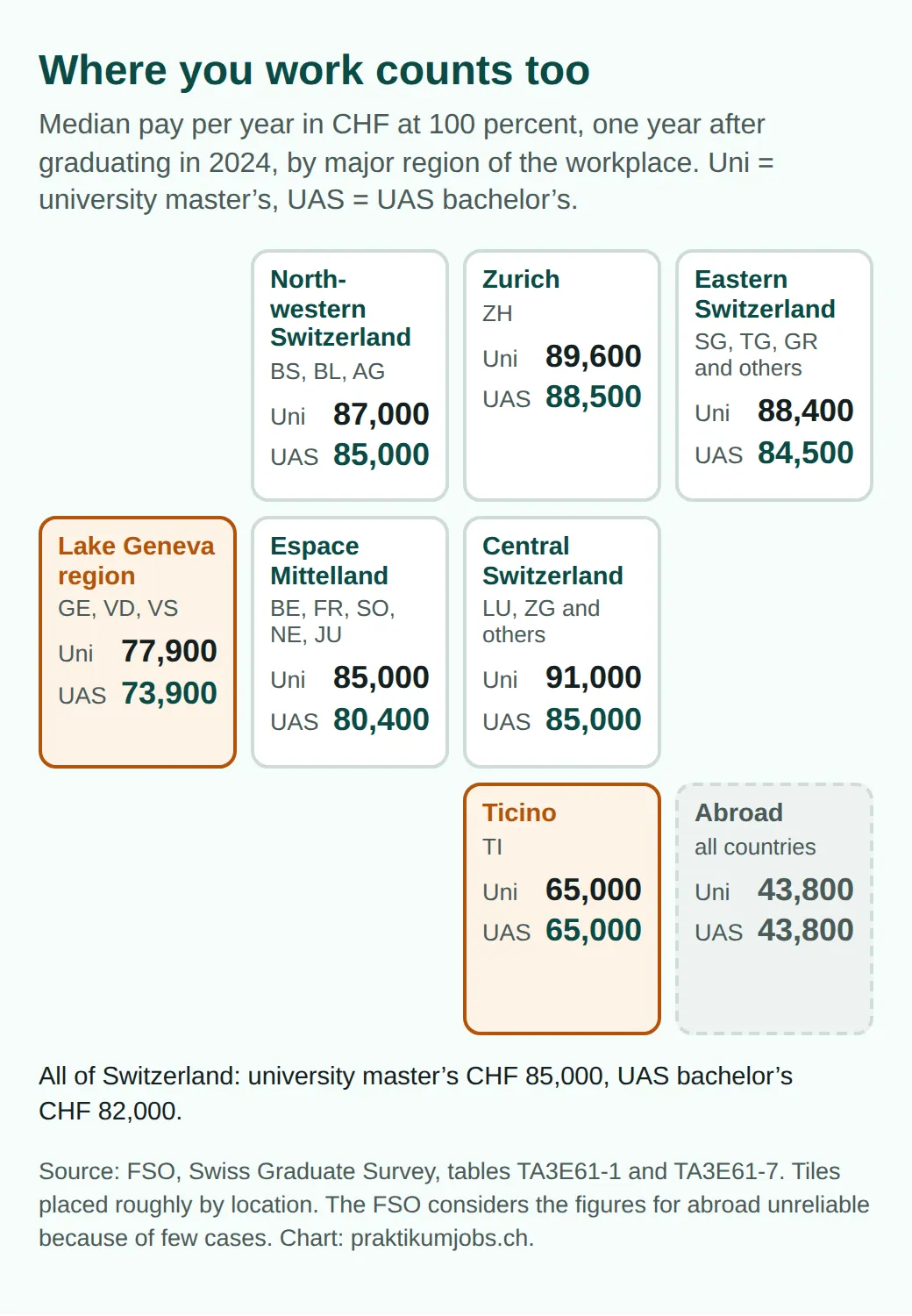
The FSO's major regions are not language regions, but they come close: apart from Upper Valais, the Lake Geneva region is French-speaking, and Ticino is Italian-speaking. The FSO gives no reasons for the gap in these tables. It also shows up between institutions, here across all work locations. Master's graduates of the universities of Geneva and Lausanne earn a median of CHF 75,700 and CHF 77,900, master's graduates of the Università della Svizzera italiana CHF 57,000, those of the University of Zurich CHF 88,400 and those of the University of St. Gallen CHF 92,000.
In French-speaking Switzerland, there is a further hurdle that doesn't show in the pay. The Career Services of the bilingual University of Fribourg analysed the FSO's raw data for their own graduates from the 2016 and 2018 surveys. Graduates who spoke only French had an unemployment rate of 6.7 percent one year after their studies; those who spoke Swiss German and German, 1.3 percent (University of Fribourg, Career Services figures). The figures are older, but the direction is clear: speaking German opens up more jobs to you, and more of them are in the regions with higher pay.
What your university reports
If your university quotes its own figure, check where it comes from. The FSO publishes income by individual institution directly, across all work locations. These figures depend heavily on which fields an institution offers and where its graduates go on to work.
ETH Zurich is a case in point. Its master's graduates earn a median of CHF 80,000, less than those of the University of Zurich at CHF 88,400. But almost 29 percent of ETH master's graduates work as assistants or doctoral students one year after graduating, against just under 4 percent at the University of St. Gallen. At EPFL it is 20 percent, and its median is CHF 72,000. Among the large universities of applied sciences, FHNW leads with CHF 87,000, and ZHAW and the Lucerne University of Applied Sciences and Arts follow with CHF 86,000 each, while HES-SO at CHF 73,700 and SUPSI at CHF 72,500 come last, matching the map above. Only two smaller schools are higher: the HWZ University of Applied Sciences in Business Administration Zurich at CHF 97,000 and Kalaidos University of Applied Sciences at CHF 100,000. Zurich University of the Arts comes in at CHF 65,000, in line with the low figures for design and music.
The University of Fribourg, for instance, analyses the raw data from the same survey itself and arrives at a median of CHF 77,500 for its master's graduates from the 2016 and 2018 surveys. Figures like these are good for comparisons within one institution. For your own salary expectations, the combination of field, position and region remains the more precise basis.
How to work out your salary expectations
Five steps take you from the table to a number you can quote. We work through them with a master's graduate in economics applying for a permanent job in Zurich.
First, take the figure for your field in the "Switzerland" column: CHF 90,000, with the middle half between CHF 80,000 and CHF 100,000. Next, check whether the job is a permanent position. In economics it makes no difference, as employees without management duties are also at CHF 90,000. In law or the natural sciences the jump would be large, as the chart above shows. Third, look at the region. University master's graduates in Zurich are about 5 percent above the Swiss figure across all fields, those in the Lake Geneva region about 8 percent below. There is no table for field and region combined, so you can only adjust roughly.
Fourth, convert to monthly pay. With 13 monthly salaries, CHF 90,000 becomes about CHF 6,900 a month; with 12, CHF 7,500. If a job ad states a monthly wage, always work out the annual salary first. Fifth, give a range whose lower end you would accept, and say what it refers to. In an application, it might look like this:
My salary expectations are CHF 88,000 to 95,000 gross a year, for a 100 percent workload.
One point argues against aiming at the top end. The job market for graduates has become tighter: in 2025, 6.4 percent of university master's graduates were unemployed one year after graduating, up from 3.9 percent in 2023. In economics, the rate rose from 3.5 to 8.5 percent, and 44 percent of all university master's graduates said it was hard to find a suitable job (FSO press release of 27 August 2026, full text in German). An offer around the median is therefore within the usual range. You'll find entry-level jobs and internships in finance and accounting here:
The calculation does not apply in two cases. A trainee programme has its own pay, often published, which we compared in our post on trainee programmes. And an internship after your degree pays far less: university master's graduates in internships earn a median of CHF 48,000 across all work locations, UAS bachelor's graduates CHF 43,200. Your rights in an internship are covered in our post on internship pay and rights.
Salaries five years after graduating
Your starting salary is a beginning, not a verdict on your field. For the 2020 cohort, the median for university master's graduates across all work locations rose from CHF 82,900 after one year to CHF 100,000 after five years, for UAS bachelor's graduates from CHF 82,900 to CHF 91,500, and for graduates of universities of teacher education from CHF 96,600 to CHF 105,300. The fields where many start with an internship or a doctoral post caught up the most: law from CHF 65,900 to CHF 109,000, the exact and natural sciences from CHF 74,400 to CHF 92,500. Five years after graduating, internships are the exception among graduates, according to the FSO.
Pay grows more slowly for UAS bachelor's graduates. Health rose from CHF 75,800 to CHF 83,000 in five years, engineering and IT from CHF 87,800 to CHF 96,800. If you start with a UAS degree, you begin at about the same level as a university master's graduate, but with less room to grow.
So whether an internship or an assistant post after your degree is worth it depends less on its pay in the first year than on whether it leads to the job you want in five years. You can find open entry-level jobs and internships with us in Zurich, Lausanne or the canton of Ticino, for example.
Common questions
- Do women earn less than men after graduating in Switzerland?
- Among university master's graduates, hardly: one year after graduating, the median in Switzerland is CHF 85,500 for men and CHF 84,000 for women. Among UAS bachelor's graduates the gap is wider, CHF 85,200 against CHF 78,600. The table does not control for field, so part of the difference comes from women and men choosing different subjects.
- Does the FSO salary figure include a 13th-month salary?
- The FSO does not mention the 13th-month salary as such, but it asks for gross income over the year. If you receive a 13th salary, it is part of that annual figure. So divide the annual amount by as many monthly salaries as your contract provides before you compare it with a monthly wage.
- I studied part-time while working and I'm over 30. Which salary figure applies to me?
- Probably a higher one. Among UAS bachelor's graduates working in Switzerland, the median is CHF 76,000 for graduates aged up to 25 and CHF 88,400 for those aged 31 to 35. Your work experience counts, and the FSO publishes this split by age in a table of its own.
- When will new graduate salary figures for Switzerland be published?
- The FSO surveys every cohort that graduates in an even-numbered year, one year and five years after graduation. The figures in this post are for the 2024 cohort, surveyed in 2025 and published in August 2026. The next cohort is 2026, which will be surveyed in 2027.
More posts
All posts
Swiss trainee programmes 2027: pay, length, deadlines
Graduate trainee programmes in Switzerland compared: what SBB, Mobiliar, PostFinance, Baloise and FINMA pay, how long they last and when to apply.

Swiss summer internships 2027: deadlines and requirements
Summer internships in Switzerland 2027: when banks, law firms, the Big Four, consulting and pharma recruit, how long they last and who can apply.

Swiss internship pay: minimum wage, holidays and rights
Internship salary in Switzerland: when you're owed pay, where the minimum wage covers interns, what SECO and associations pay, plus holidays and insurance.