Swiss summer internships 2027: deadlines and requirements

The short answer
For a summer internship in 2027 at a large Swiss employer, you apply between October 2026 and March 2027. Lenz & Staehelin, MLL Legal and Partners Group already closed applications in October. UBS, ZKB, Pictet and Roche open their windows between January and March, and in 2026 Julius Baer advertised in March. BCG takes applications all year and advises you to apply at least six months before you start.
The date is only half the answer, though. Many large employers in Switzerland don't run an eight- or ten-week summer programme of the kind banks offer in London or New York. In Switzerland, UBS offers an internship of three to six months with fixed start dates, PwC one of six months and AXA one of at least four to six. If you have to be back in lectures in September, the field is smaller than you might think. We read the employers' careers pages along with the semester dates of UZH, ETH and HSG, and show which programmes fit your break, who can apply and what they pay. Some of the employer and court pages we link are in German only.
Two kinds of summer internship
On careers pages both go by the same name, but they mean two different things. One is a fixed summer programme of four weeks to three months, with a start date, a group of interns and an end before the autumn semester. The other is an internship of three to twelve months that can start in summer but runs well into the autumn.
The first group includes Zürcher Kantonalbank with ten weeks, Julius Baer with ten weeks from July (according to its 2026 posting), Partners Group with nine weeks, BCG with eleven weeks and the commercial law firms with six or seven weeks. Pictet in Geneva states two to three months, and the Opening Up Roche programme three months from July. The courts and the public prosecutor's office in the canton of Zug take law students for four to eight weeks (zg.ch).
The second group includes UBS (three to six months, starting in February, July or September), Deloitte (three to six months), PwC (six months), AXA, Swisscom (three to twelve months) and the Swiss National Bank, whose internships usually last twelve months and are aimed at graduates (SNB). These roles suit you if you take a semester off or want to fill the gap between your bachelor's and master's. They don't fit around ongoing studies. Both groups follow the same calendar, and it starts earlier than most people expect.
Application deadlines up to April 2027
The earliest deadlines were in October 2026, and most windows open between January and March 2027. In between come company events at the universities, where you can put your questions to people from the firms directly.
| When | Who | What |
|---|---|---|
| by 23 Oct. 2026 | Lenz & Staehelin, Zurich and Geneva | Summer internship, deadline passed |
| by 30 Oct. 2026 | Partners Group, Zug | Summer Analyst Program, deadline passed |
| by 31 Oct. 2026 | MLL Legal, Zurich | Summer internship, deadline passed |
| 5 to 15 Nov. 2026 | Vontobel | Internship from 1 March 2027 |
| 11 and 12 Nov. 2026 | UZH, Long Nights of Careers | Company event, with UBS, ZKB and BCG among others |
| rolling | BCG | Apply at least 6 months before the start |
| January to March 2027 | UBS Switzerland | Start in July or September |
| early 2027 | ZKB | Summer internship window |
| March 2027 | Pictet, Roche (Julius Baer too in 2026) | Postings and applications |
| 1 to 12 March 2027 | HSG Talents, St.Gallen | Company event |
| 15 to 23 March 2027 | UZH JobHub | Company event |
| 13 to 15 April 2027 | Polymesse, ETH Zurich | Careers fair |
If you start planning for summer 2027 in November, you still have time, but not everywhere. The law firms decide in winter: MLL Legal puts its team together in January. The employers at UZH's Long Nights of Careers on 11 and 12 November 2026 include Bain, BCG, Deloitte, EY, Julius Baer, KPMG, Lenz & Staehelin, PwC, Swiss Re, UBS and ZKB (uzhcareer.ch). The big events in March fall exactly when the banks advertise: HSG Talents from 1 to 12 March 2027, with 91 companies in 2026 (csc.unisg.ch), and the UZH JobHub from 15 to 23 March 2027, with over 60 employers in 2026 (uzhcareer.ch). The Polymesse at ETH from 13 to 15 April 2027, with over 140 companies (polymesse.ch), comes rather late for a summer programme but at the right time for an internship in autumn. Each industry goes about it differently, and the banks show it most clearly.
Banks and asset managers
The banks mostly advertise in spring, with two exceptions that recruit in autumn. The largest bank also shows how differently Switzerland works: UBS runs a Summer Internship Program in the UK and the rest of Europe, in Asia Pacific and in the US and Canada, but in Switzerland it has an internship programme of three to six months with fixed starts in February, July and September (UBS).
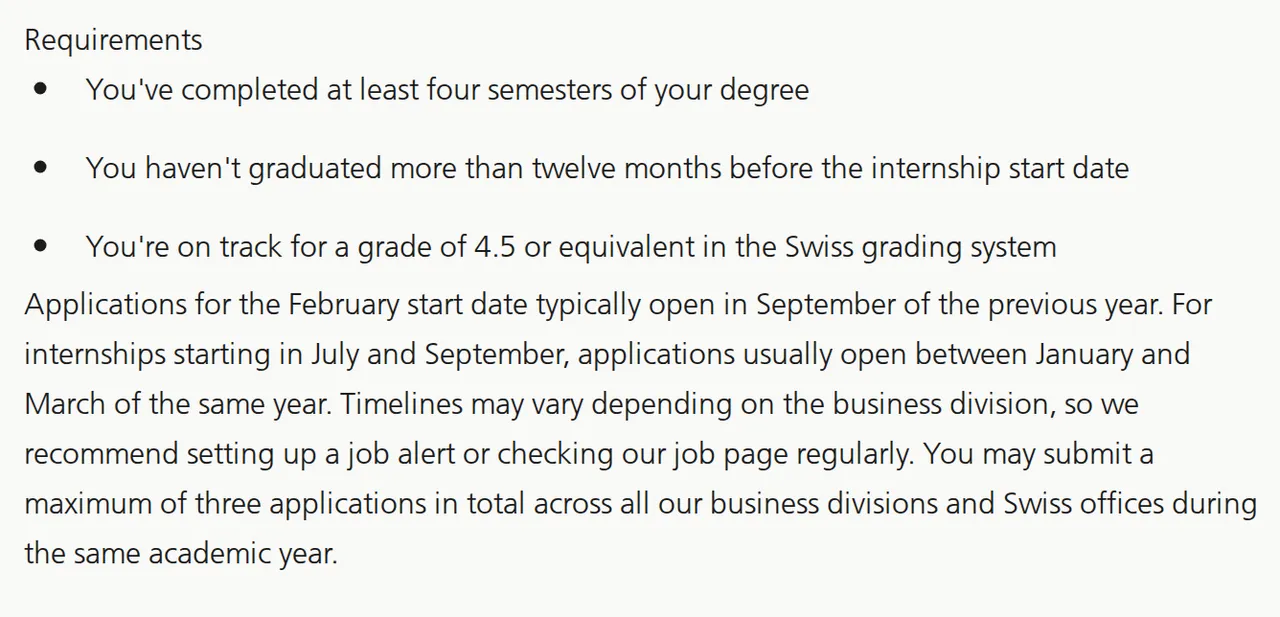
So for a July 2027 start at UBS, you apply between January and March 2027 (programme page). You can submit at most three applications per academic year in Switzerland, across all divisions and offices combined. Because timelines vary by division, the bank recommends setting up a job alert.
Zürcher Kantonalbank offers a classic ten-week summer programme, for example in private banking, IT or trading. Its application windows open at the start of each year (ZKB), but it gives no exact date. For 2026, Julius Baer's own posting offered a ten-week programme from July; the roles went online in March and the deadline was 31 March 2026. We haven't found dates for 2027 yet. Pictet recruits for its summer internships in Geneva in March; they last two to three months and start in June or July (Pictet).
Partners Group in Zug recruited earlier. Its 2027 Summer Analyst Program runs for nine weeks from Wednesday, 16 June 2027, and the deadline was 30 October 2026 (Partners Group). According to the posting, the programme is aimed at women from all fields of study. Vontobel doesn't name a summer window for 2027, but instead an internship programme starting on 1 March 2027. You can apply from 5 to 15 November 2026, at most twice (Vontobel). That works if you can take the spring semester off. The law firms decide even earlier than the banks.
Commercial law firms: the earliest deadlines
If you study law and wanted to join one of the two firms in our comparison for summer 2027, you had to apply by the end of October 2026. On the plus side, Lenz & Staehelin is the only firm here that states its pay.
In Zurich, Lenz & Staehelin takes students who have completed at least five semesters by the start, from 12 July to 20 August 2027, for a flat CHF 6,000 gross. The deadline was 23 October 2026 (Lenz & Staehelin). In Geneva the programme runs from 28 June to 13 August 2027 for CHF 6,500, only for bachelor's students in their fifth or sixth semester at a Swiss university who are native French speakers or fully bilingual. There too, applications closed on 23 October, explicitly as a firm deadline (stage d’été). Short internships outside these dates are also possible in Zurich.
MLL Legal runs its summer internship in Zurich every year from early August to mid-September. The firm accepts applications until 31 October of the year before and puts the team together in January (MLL Legal). You need to be studying law at a Swiss university with at least five semesters completed. If you missed these deadlines, the courts in Zug are an alternative with no published deadline: you apply by email, but you need a completed or nearly completed bachelor's in law. If there are more applicants than places, people with ties to the canton of Zug get priority. The audit and consulting firms plan in a completely different way.
Big Four and consulting
At the large audit firms, an internship usually lasts three to six months and isn't tied to the semester break. PwC specifies six months full-time, from the fourth semester of your bachelor's, with the start agreed with you or set in the job ad (PwC). Part-time is possible only as an exception. Deloitte offers three to six months in audit, tax, technology or consulting, for students with at least four semesters completed and for graduates (Deloitte). KPMG lists both internships and a summer internship on its page for students, but gives neither length nor dates there (KPMG). For a pure summer internship at the Big Four, a job alert is therefore worth setting up, because the length and dates only appear in the job ad.
In strategy consulting, BCG has published the clearest rules. As a Visiting Associate you work in a project team for eleven weeks, from the fourth semester of your bachelor's or during your master's, and you must be enrolled during the internship (BCG). English is a must, German or French a plus. There are no fixed deadlines: BCG accepts applications all year and recommends applying at least six months before the start you want. For a start in early July 2027, by our count that means applying by early January at the latest. Deadlines in industry are similarly flexible, but the internships are longer.
Insurance, pharma and tech
Of the companies in these industries whose pages we read, only Roche has a summer programme in the strict sense. The insurers rely on longer internships and jobs alongside your studies. Zurich Insurance offers working student positions in almost all areas all year round and asks for very good German at C1 to C2 level (Zurich). AXA says its internships normally last at least four to six months, with entry possible all year and ideally just before or after your bachelor's (AXA).
Roche has both. The Opening Up Roche programme is a three-month summer internship for bachelor's and master's students in Switzerland, Germany or the UK, including those without a pharma background. Applications run in March, interviews between April and June, the start is in July and the final presentation in September in Basel (Roche). Different rules apply to the production internships in Kaiseraugst: six to twelve months, starting in March or September, usually advertised in September and October and in March and April. You can apply while studying or up to twelve months after graduating (RiKO).
Swisscom gives three to twelve months for its university internship (Swisscom). For internships in IT and data, the Polymesse in April is therefore the main event to attend, provided you can plan beyond the summer anyway. Whether you can depends on your semester schedule.
Does the internship fit your semester break?
At UZH it depends on your faculty; at ETH and HSG it fits only with restrictions. The three universities have similar lecture periods but different exam dates, and at ETH and HSG they fall in the middle of the summer.
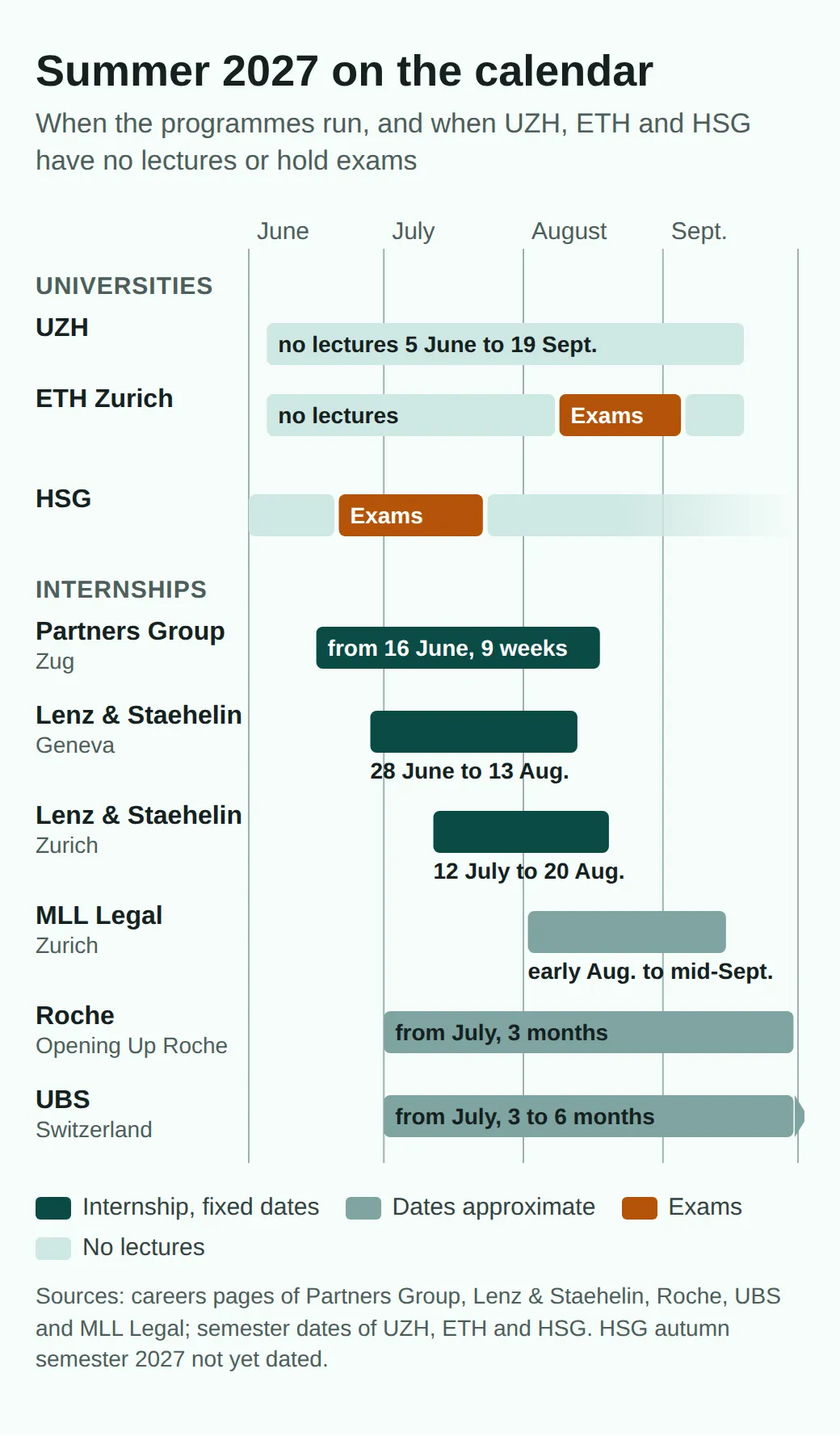
At UZH, lectures in the spring semester end on 4 June 2027 and the autumn semester starts on 20 September (UZH). When your exams fall within that time is set by your faculty, so check before you accept an offer. At ETH, lectures end in calendar week 22, so also in early June, but the summer exam session runs in calendar weeks 32 to 35, which by our conversion is 9 August to 5 September 2027 (ETH). If you sit exams at ETH, that clashes with the last week at Partners Group and with any internship that starts in July and lasts three months, as at Roche or UBS. It hardly affects the law firms, since you can't study law at ETH.
At HSG it's the other way round. Lectures end as early as 28 May 2027, but the central exams run from 21 June to 23 July (HSG). Partners Group starts on 16 June, Lenz & Staehelin in Geneva on 28 June, UBS and Roche in July. For HSG students, the second half of the summer fits best, so MLL Legal or a programme that starts at the end of July. And if you join Roche or UBS in July for three months, you won't finish until the end of September or in October, after the semester has started at UZH and ETH. Whether you're accepted at all depends on how far along you are in your studies.
Who can apply: semesters, language, work permit
For most programmes you need at least four semesters, for the law firms five. The overview shows what the employers ask for on their pages.
| Employer | Who can apply |
|---|---|
| Julius Baer (2026) | Bachelor's or master's, from the 2nd year of study |
| UBS Switzerland | At least 4 semesters, grade 4.5, graduated no more than 12 months before the start |
| PwC | From the 4th semester of a bachelor's |
| Deloitte | At least 4 semesters completed, graduates too |
| BCG | From the 4th semester of a bachelor's or a master's, enrolled |
| Partners Group | Second-to-last or last year of study, bachelor's or master's |
| MLL Legal | Law, at least 5 semesters completed |
| Lenz & Staehelin | Zurich at least 5 semesters, Geneva 5th or 6th semester of a bachelor's |
| Courts of the canton of Zug | Bachelor's in law completed or nearly completed |
| Pictet | Enrolled when you apply |
The working language is mostly English. Partners Group works in English and asks for an English CV, and Vontobel recommends applying in English. Where German or French matters, the job ad says so: Zurich Insurance wants working students to have German at C1 to C2, Lenz & Staehelin in Geneva wants native French speakers.
On permits there's a hard line. Partners Group only accepts applications from people who are fully entitled to work in Switzerland and doesn't help with a visa. Vontobel only considers applications from people with the right to work in Switzerland or the US. If you come from a country outside the EU and EFTA and study in Switzerland, you need a permit to work part-time, at the earliest six months after starting your studies and, outside the holidays, for at most 15 hours a week (OASA art. 38). What applies to you is explained in our post on internships with a foreign passport. That leaves the question of what ends up in your account.
What a summer internship pays
Hardly anyone tells you in advance. Of all the programmes in this comparison, only Lenz & Staehelin gives a figure: it pays CHF 6,000 for six weeks in Zurich, which by our count is CHF 1,000 a week, and CHF 6,500 for seven weeks in Geneva, so about CHF 929 a week. Vontobel only says the internship is paid. The banks, the Big Four, BCG and Roche don't state a salary on their pages.
So ask for the gross salary before you accept and convert it to a weekly figure; that way you can compare offers of six weeks and three months. Legally, a summer internship is a fixed-term employment contract: you're entitled to holidays in proportion to the time you work, you're insured against accidents, and a minimum wage may apply in Geneva, Neuchâtel, Jura, Ticino, Basel-Stadt and the city of Lucerne. Which exemptions exist for internships, and which salaries SECO and the Kaufmännischer Verband consider fair, is covered in our post on internship pay and rights. Whether a student job still fits alongside the internship, and what to watch out for with AHV and tax, is in our post on student jobs.
Your plan up to March
The law firms' deadlines for 2027 have passed. For everyone else, a plan in four steps is enough:
- November: look at Vontobel if you can take time off from March (applications 5 to 15 November), and talk to the companies at UZH's Long Nights of Careers on 11 and 12 November.
- December: get your documents ready: your CV, transcripts and certificates from the Matura onwards, plus a one-page motivation letter that you adapt for each company. Our post on the motivation letter shows how.
- January: apply to BCG if you want to start in July, and set up job alerts at ZKB and UBS. At UBS you have three attempts, so choose them carefully.
- March: use the windows at Pictet, Roche and, if it runs as in 2026, Julius Baer, and go to HSG Talents or the UZH JobHub.
If summer doesn't work out, the start dates in autumn and February are your next chance, and after graduating a trainee programme. You can already find open internships with us, for example in Zurich, Geneva or the canton of Zug.
Common questions
- Can I do a summer internship after I graduate?
- For the short summer programmes, usually not. BCG requires you to be enrolled during the internship, Pictet when you apply, and Vontobel for its internship programme. At UBS in Switzerland you can't have graduated more than twelve months before the start, and the same goes for Roche in Kaiseraugst. After that, a trainee programme is the better route.
- How many times can I apply to the same company?
- Some companies set a limit. UBS in Switzerland accepts at most three applications per academic year across all divisions and offices, and Vontobel at most two across all its internship positions. So pick the roles that really fit your degree rather than clicking apply everywhere.
- Do I need a cover letter for a summer internship?
- It depends on the company. UBS doesn't ask for one in most regions and wants your CV to speak for you. Roche automatically rejects applications for its summer programme that come without a one-page motivation letter, and Lenz & Staehelin wants a motivation letter, your CV and copies of your certificates from the Matura onwards.
- What can I do if I don't get a summer internship?
- Look at the start dates in autumn and in February. At UBS, applications for a February start open the September before, Roche advertises its internships in Kaiseraugst in September and October, and Pictet also recruits master's interns in October. At PwC the start date is agreed with you or set in the job ad, not tied to the semester break.
More posts
All posts
Graduate starting salary in Switzerland 2026, by field
Starting salary after university in Switzerland: median pay one year after a university, UAS or teaching degree, by field and region, and what to ask for.

Swiss trainee programmes 2027: pay, length, deadlines
Graduate trainee programmes in Switzerland compared: what SBB, Mobiliar, PostFinance, Baloise and FINMA pay, how long they last and when to apply.

Swiss internship pay: minimum wage, holidays and rights
Internship salary in Switzerland: when you're owed pay, where the minimum wage covers interns, what SECO and associations pay, plus holidays and insurance.