Internship in Switzerland for foreigners: work permits 2026

In short
With an EU or EFTA passport, you don't need a permit for an internship of up to three months: the employer notifies the authorities online, at the latest the day before you start. For longer, you get an L permit, and with a contract of a year or more, a B permit. From any other country, you always need a permit, and in practice there are only two ways to get one: as a compulsory internship during your studies, or through a young professionals agreement.
That last route is the least known, and for many people the only one. Fifteen countries outside the EU and EFTA have such an agreement with Switzerland, including the USA, Canada, Japan and Australia. If you're from one of them, have finished your education or training and are usually between 18 and 35, you can work in your profession for up to 18 months, without the employer first having to prove that nobody in Switzerland could have taken the job. Each country has a fixed number of places per year. We set out every route with its conditions, the places and age limits for each country, and how the application works. What you earn on an internship and what rights you have are covered in our post on internship pay and rights.
Which permit do you need for an internship?
Your passport decides first, then your education. One rule many people underestimate: an internship counts as work even if it's unpaid. The Foreign Nationals and Integration Act (FNIA) counts any activity that is normally done for pay, "irrespective of whether payment is made" (FNIA art. 11). Its implementing ordinance, the Ordinance on Admission, Residence and Employment (OASA), names interns and volunteers explicitly (OASA art. 1a, in German; there's no official English version). So there's no such thing as an internship on a tourist visa, or "just to try it out" without papers.
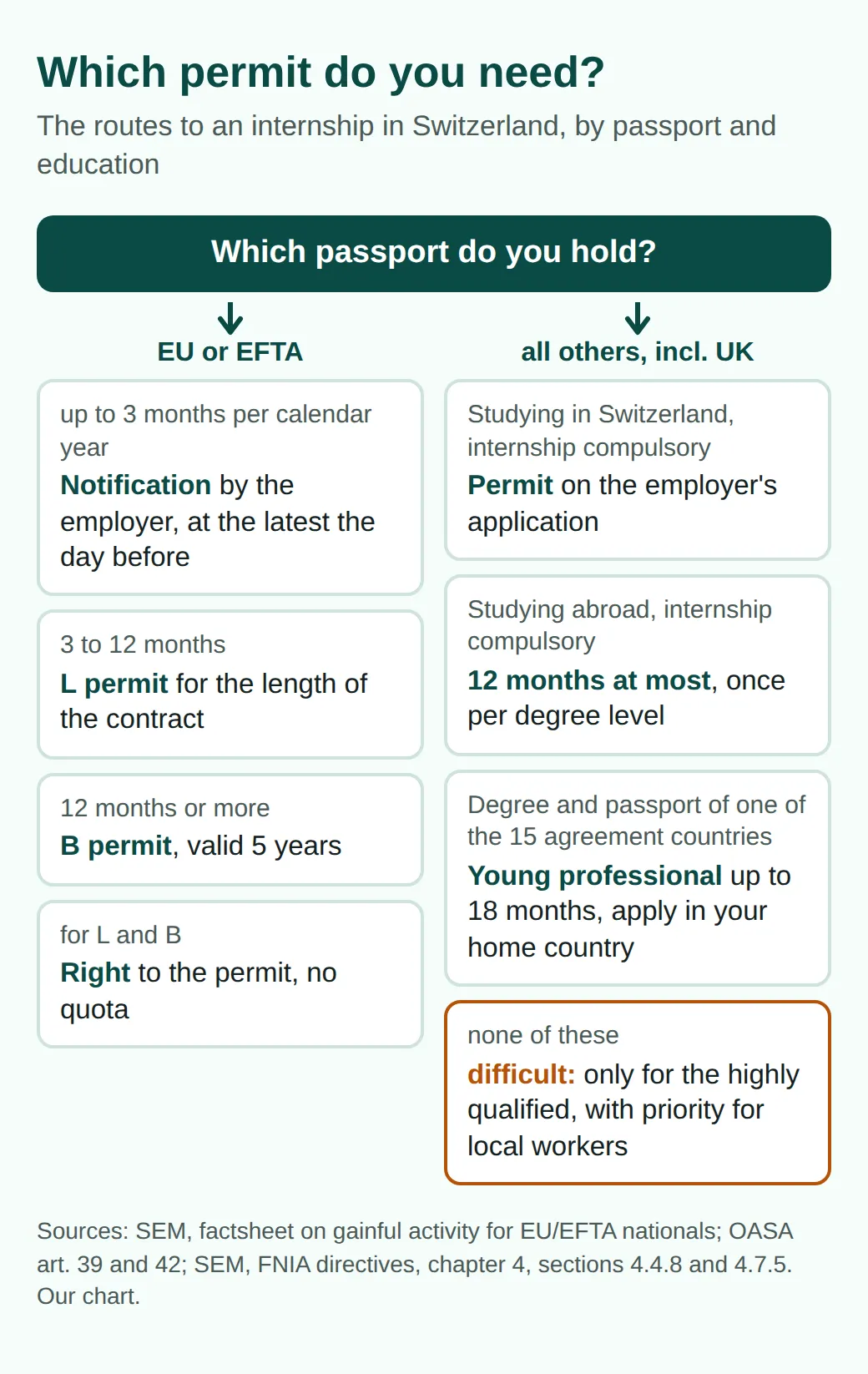
The left-hand side is quickly explained; the right-hand side takes up the rest of this article. Let's start with the simple case.
EU and EFTA: notification instead of a permit
With a passport from the EU, Iceland or Norway, you have the right to take up a job in Switzerland, internships included; special rules apply to Liechtenstein. How much paperwork you need depends only on how long you stay. That's what the State Secretariat for Migration (SEM) sets out in its factsheet on residence and gainful activity.
For an internship of no more than three months or 90 working days in a calendar year, you don't need a permit. But the employer has to register you through the notification procedure, at the latest on the day before you start. That's the employer's job, not yours. Still, ask whether it's been done before your first day.
If the internship lasts longer than three months but less than a year, you're entitled to an L permit, a short-term residence permit valid for as long as your contract. With a contract of a year or more, you get a B permit for five years. The canton issues the permit when you show your employment contract. There are no quotas any more: since January 2026, full free movement also applies to Croatia, because the number of permits issued in 2025 stayed below the thresholds (Federal Council, 14 January 2026).
One exception matters: none of this applies to British citizens any more. If you arrive after 31 December 2020, you're treated as a third-country national (SEM, United Kingdom). For them and everyone else, the harder part begins here.
Non-EU nationals: why a regular internship is rarely possible
For third-country nationals, Switzerland is strict about work permits. As a rule, only highly qualified people are admitted, meaning managers and specialists, usually with a university degree and several years of work experience (SEM, non-EU/EFTA nationals). The employer must also prove that it couldn't find anyone suitable in Switzerland or in the EU and EFTA states (FNIA art. 21). And permits are limited: for 2026, the ordinance sets 4,000 short-term residence permits for third-country nationals, with a separate quota for British citizens (OASA annex 1, in German).
An intern who wants to learn something almost never meets these conditions. That's why there are separate routes that skip this priority for local workers. The SEM describes them in its directives on the Foreign Nationals and Integration Act, chapter 4 (in German), sorted by when in your studies the internship falls: before, during and after. For an internship before your studies, the answer is short. If a Swiss university requires an internship before you start, you generally have to do it abroad. Exceptions are only made if the internship isn't possible in your country, the school supervises it and you're then admitted to the programme without an exam. The other routes depend on where you study.
Compulsory internship while studying abroad
If you study at a university outside Switzerland, you can come for a compulsory internship in the later semesters, with confirmation from your university. The letter must state that you're enrolled and that the internship is a required part of your degree. A voluntary internship isn't enough.
The directives set clear limits. Per degree level, meaning your bachelor's or your master's, you may stay for a total of twelve months at most, and only once. Permits are only granted at companies where foreign nationals on short-term permits make up no more than a quarter of the staff. If you work in Switzerland for no more than four months within twelve months, the internship doesn't count towards the quotas (OASA art. 19). A longer one needs one of the 4,000 short-term residence permits for 2026.
The application should generally go through a placement organisation; the directives name IAESTE and AIESEC, and IAAS for agriculture and forestry. These organisations find placements and look after you during your stay, and in return Swiss students get places abroad. Only universities, research institutes and companies with close ties to your university, set down in writing, may apply directly. Your pay must be in line with local and industry rates and should reflect how many semesters you've already studied.
For your search, that means writing to your university's international office or the local IAESTE or AIESEC committee first, before you apply to Swiss companies. If you study in Switzerland, things look different.
If you study in Switzerland
If you hold a student permit for full-time studies in Switzerland, you can be authorised to do a compulsory internship (OASA art. 39). The employer applies, not you. The internship must be required by your curriculum, the work may make up at most half of your whole programme, and pay and working conditions must be the usual ones. A detailed training programme goes with the application. If you do the internship in a different canton from the one your university is in, that canton has to agree as well. The same rule applies if you write your thesis at a Swiss company.
Alongside your studies, you can also have a side job, at the earliest six months after you start, for no more than 15 hours a week during the semester (OASA art. 38). A voluntary internship is only possible within that limit.
After graduating: six months to look for a job
With a bachelor's, master's or doctorate from a Swiss university, you get a permit for six months after graduating to look for a skilled job. If you have enough money and suitable housing, you're entitled to it (SEM, FNIA directives, section 5.1.2, in German). The six months start as soon as your degree is confirmed, and they can't be extended. During that time, you may work no more than 15 hours a week.
If you find a job, it can be approved without the employer having to give priority to local workers. The condition is that the work is of high academic or economic interest (FNIA art. 21 para. 3). Whether an internship meets that bar is up to the canton. For internships after graduating, the directives name only two routes: a young professional stay under an agreement, and an internship within an international group. The young professional route is the more important one.
The young professionals agreements: 15 countries, up to 18 months
Switzerland has agreements on the exchange of young professionals, known by the French word stagiaires, with 15 countries outside the EU. These agreements open a route of their own to a permit, regardless of the situation on the Swiss labour market (SEM, instructions for young professionals). Each country has a fixed number of places per calendar year for the whole of Switzerland, and the age limits aren't the same everywhere.
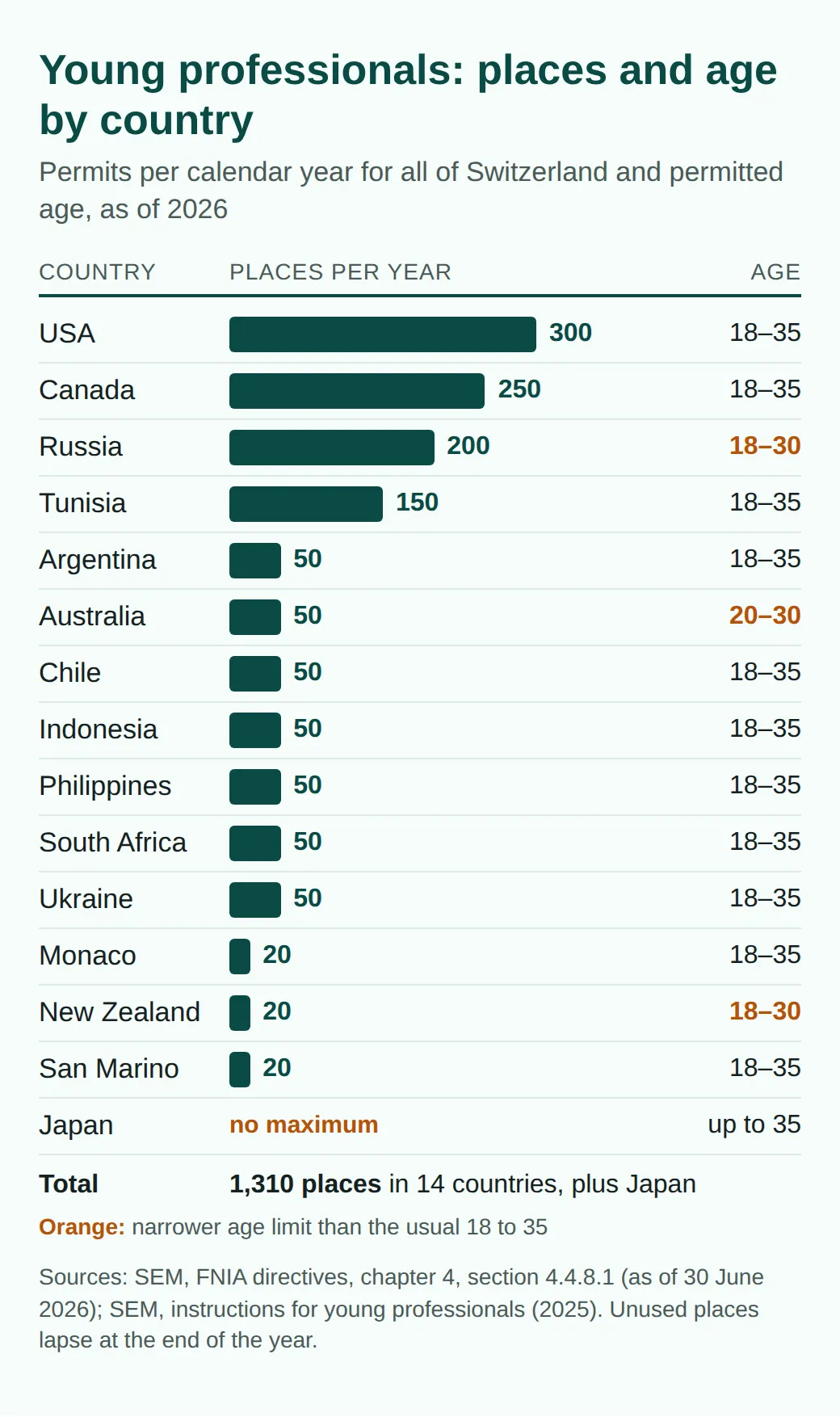
The chart shows how unequal the chances are. The USA has 300 places, New Zealand 20, and with Japan no maximum has been agreed at all. From Australia you must be at least 20, and from Australia, New Zealand and Russia no older than 30. Unused places lapse at the end of the year. The directives speak of 35 agreements because of old treaties with EU states and Norway. They're still in force but no longer used, since free movement allows more.
Who is eligible
You need completed education or training: an apprenticeship, a degree from a university of applied sciences or a university. On its website, the SEM gives a bachelor's degree or a two-year apprenticeship as the minimum. Students from Canada and the USA are also eligible, as are apprentices from the USA who have been in vocational training for at least two years.
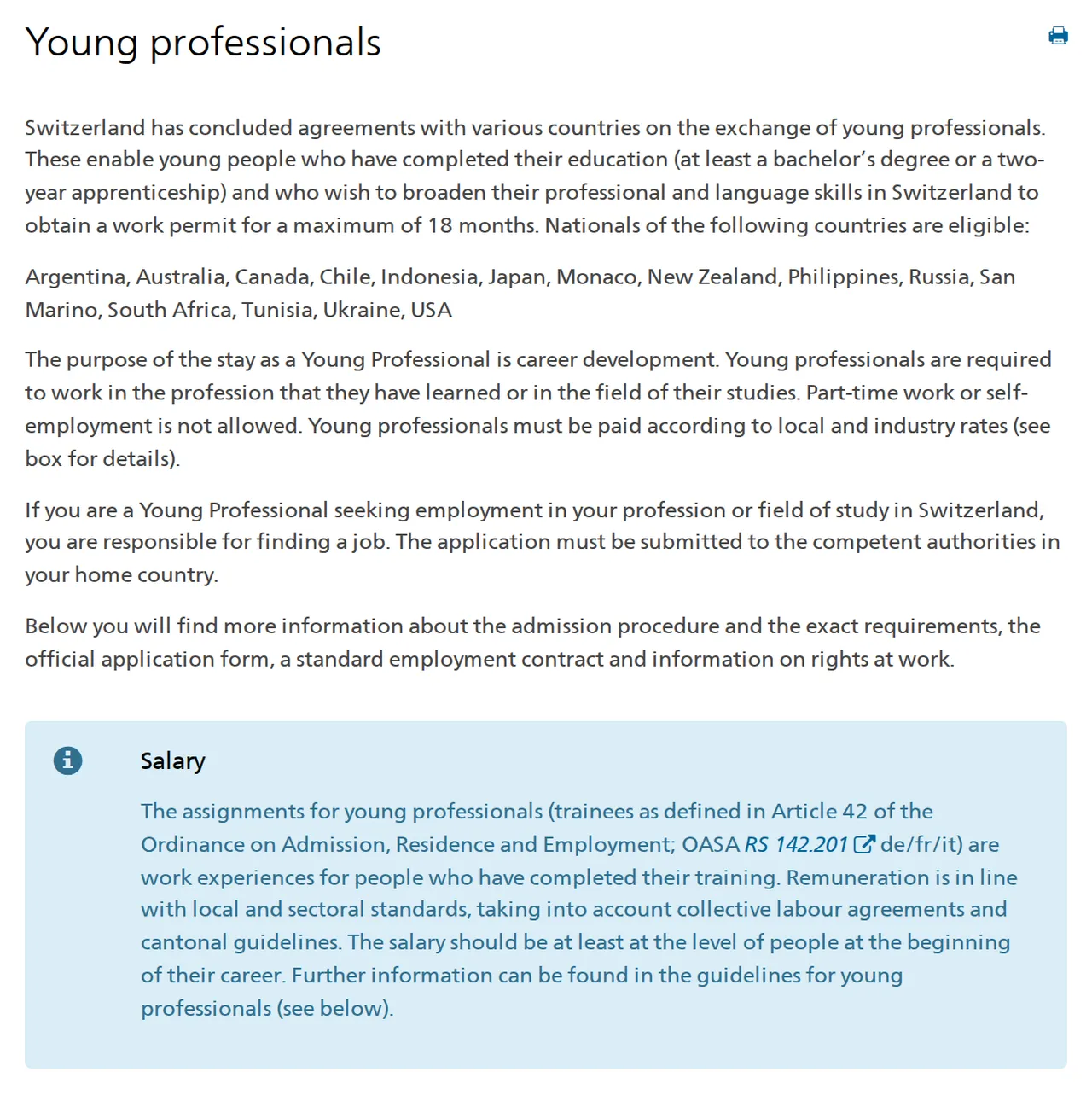
You may only work in the profession you trained for or in the field of your studies. For a regulated profession, you also need the required professional licence. Part-time work and self-employment are ruled out, and a staffing agency generally may not hire you out to other companies. As a rule, young professionals may make up no more than 5 percent of a company's staff. Your pay must be in line with local and industry rates, at least at the level of someone starting out in the career. If a collective labour agreement (CLA) applies in the industry, your pay follows it; otherwise it follows the canton's guidelines and the recommendations of the professional associations.
The 18 months are a ceiling for all stays combined. You can start on a shorter contract and have it extended up to that limit. You can't change profession, and you can only change job in exceptional cases. A second young professional stay after a first is only possible in justified cases (OASA art. 56).
New since late 2024: the agreement with the USA
The agreement with the USA is new and, with 300 places, has the largest quota. It has been in force since 30 November 2024 (agreement with the USA, in German). The Swiss part of the programme lasts four to 18 months. It's open to US citizens aged 18 to 35 with a completed apprenticeship or university degree from the USA, to students at a US university, and to apprentices after at least two years of training. The limit of 300 permits a year is the only one written directly into the ordinance (OASA annex 1, item 9, in German). So if you're from the USA and still studying, you have a route that students from the other countries, apart from Canada, don't.
How to apply as a young professional
You apply yourself, and you do it in your home country. That's the biggest difference from the other routes in this post, where the employer, the university or an organisation applies. You also have to find the job yourself; the SEM doesn't place anyone.
The basis is a written employment contract with a built-in training programme, signed by you and the employer. It sets out your tasks and the plan of what you'll learn and when, the duration, pay, probationary period and notice period, working hours, holidays, health and accident insurance, and travel costs. The SEM provides a standard employment contract for this, with every field in English too. Send it to the employer as soon as you have an offer.
The application consists of the application form, also in English, and the contract, both in duplicate, plus a copy of your diploma, an up-to-date CV, employment references if you have any, and a copy of your passport's photo page. Students from Canada and the USA add a certificate of enrolment. The documents may be in German, French or English. For each country, the instructions name the authority to apply to, usually a Swiss embassy or consulate general; in Monaco, Russia, South Africa, Tunisia and Ukraine, it's an authority of that country.
That authority forwards the application to the SEM, which decides. According to the instructions, this usually takes four to eight weeks: four to five from Monaco, four to six from Australia, New Zealand and San Marino, six to eight from the Philippines and eight from Ukraine. During that time you may not be in Switzerland; you wait for the decision abroad.
If the application is approved, nationals of Australia, Japan, Monaco, New Zealand and San Marino enter without a visa, with their passport and a Zusicherung der Aufenthaltsbewilligung, the SEM's pre-authorisation for a residence permit. From the other ten countries, you need a visa, which you apply for at the Swiss embassy or consulate with the SEM's authorisation. In Switzerland, you register with your municipality within 14 days, and only then do you start work. You must have Swiss health insurance no later than three months after arriving. If you want to extend, you submit a reasoned application directly to the SEM about two months before your permit expires, together with a new contract.
These steps are the core. Alongside them, there are three smaller routes that suit particular groups.
Corporate, exchange and hotel internships: three special cases
If you've finished your degree and already work for an international group abroad, you can come for an internship at its Swiss branch, as long as an assignment for the group abroad is planned afterwards. The canton of Zurich gives 18 months as the maximum and requires the employment with the foreign group to exist before the internship starts (canton of Zurich). It's a route for trainees a company is deliberately developing, not for outside applicants.
Even without a degree, an international youth exchange can lead to a placement at a Swiss company, but only if a recognised exchange organisation applies. The directives name Movetia, Intermundo with partners such as ICYE, and, for apprentice exchanges, ch Jugendaustausch in Solothurn. Such a stay usually lasts twelve months at most.
The hospitality industry has rules of its own. If you're from a third country and have graduated from a hotel management school abroad, a further training stay of generally twelve months is possible, up to age 35 and only if the canton allocates a place from its quota. The employer draws up the programme with the industry associations, and your pay must be at least what the hospitality industry's collective labour agreement (L-GAV) sets for wage categories II to IIIa. Students at a recognised hotel management school can do their compulsory internship, at the L-GAV intern wage. In both cases, the business needs a staff of at least five full-time equivalents and 40 indoor seats, and no more than a quarter of the positions may be filled by people in training. That rules out a small restaurant.
What applies on every route
If you work in Switzerland with a permit, you're entitled to the pay and working conditions customary for the location and the industry (FNIA art. 22). That's a condition for the permit, not a favour from the employer. The routes for students and for young professionals all require pay in line with local and industry rates, so an offer of "no pay, but great experience" fits none of them. The rights under your employment contract, from holidays to sick pay, also apply to you just as they do to everyone else.
The second rule: never start before the notification or the permit is in place. That also goes for a trial day or an induction week, because even work lasting a few hours or days counts. And between two short stays, say a study internship and a later young professional stay, you must spend at least two months abroad, and be able to prove it (OASA art. 57). If you're planning more than one, leave a gap between them.
Before you say yes
Settle your route before you commit, not after you've accepted. Don't assume your future employer knows the routes for interns from third countries. A short message helps, for example:
Hello, and thank you very much for the offer. I'm a Canadian citizen and can do the internship under the young professionals agreement (OASA art. 42). I'll submit the application myself in Canada, and for that I need a signed contract with a training programme. The SEM provides a template, which I'm happy to send you. Processing takes around four to eight weeks. Would it be possible to start after that? Kind regards
Adapt the example to your route: for a compulsory internship as part of studies in Switzerland, the employer applies to the canton, with the training programme from your university. If you study abroad, ask your university or the placement organisation first. How to win companies over in your application is the subject of our post on the motivation letter. You can browse our open internships by location, for example in Geneva, Basel, Lausanne or the canton of Bern.
Common questions
- Do I need a work permit for a one-week internship in Switzerland?
- Yes. Swiss immigration law requires a permit however long you work, and the ordinance counts even a few hours or days of work. With an EU or EFTA passport, it's enough for the employer to notify the authorities; from any other country, you need a permit.
- Does free movement still apply to UK citizens in Switzerland?
- No. If you come to Switzerland after 31 December 2020, you're treated as a third-country national. The United Kingdom also isn't one of the countries with a young professionals agreement. For an internship, that mainly leaves the routes through your studies.
- Can my partner come with me during a young professional stay?
- It's possible. Spouses and children under 18 can get a short-term residence permit, unless the agreement with your country says otherwise. Raise it when you apply, because the permit isn't automatic.
- Can I keep working in Switzerland after my young professional permit ends?
- Not as a young professional. A second stay under the agreement is only possible in exceptional cases, and the total can never exceed 18 months. A permanent job afterwards needs a regular permit, and for third-country nationals the strict rules for highly qualified workers apply.
More posts
All posts
Swiss internship pay: minimum wage, holidays and rights
Internship salary in Switzerland: when you're owed pay, where the minimum wage covers interns, what SECO and associations pay, plus holidays and insurance.

Student jobs in Switzerland 2026: hours, AHV and tax
How many hours you can work as a student in Switzerland, including on a B permit, and the pay limits that trigger AHV, tax, insurance and family allowances.

Internship motivation letter: structure, examples, mistakes
How to write an internship motivation letter in Switzerland: one-page structure, before-and-after examples, Swiss details and the mistakes universities flag.