Internship motivation letter: structure, examples, mistakes

On one page
A motivation letter for an internship fits on one A4 page and has three or four paragraphs: why this particular company interests you, what you bring, each point backed by an example, what you want to learn and contribute, and a short closing without "would". That's what the career services of the universities of Zurich, Bern and Basel, ZHAW and the Bern University of Applied Sciences teach, with small differences.
An internship adds one difficulty: you have little work experience to point to. So your evidence comes from your studies, from projects, a part-time job or a club. And you have to say things a normal application leaves out, such as whether the internship is part of your degree, when you can start and what you want to learn. We go through the letter from top to bottom, with example sentences from the universities' own material. And we show where the career services contradict each other.
Do you need a motivation letter at all?
A motivation letter makes sense when your CV alone doesn't explain why you're applying. A handout from the University of Zurich Career Services (in German) splits the work like this: the CV shows your qualifications, your certificates and references prove them, and the letter makes your motivation visible, shows off your strengths and explains things. For interns, that last point is often the most important. Why is a law student applying for an internship in communications? Why did you take a semester off? No CV answers that.
On their page about the motivation letter, the UZH Career Services also say when you can skip it. If an ad explicitly asks only for a CV and references, and the portal has no field for a letter, you don't send one. If a form asks several questions about your motivation, answer those well rather than uploading a letter on top. And for short, purely practical jobs, a brief statement is enough. For a sought-after internship, a switch into another field, or a profile that doesn't fit at first glance, UZH leans the other way and suggests writing one.
If you're looking for an apprenticeship rather than an internship, different habits apply, and we cover them in a separate post on finding an apprenticeship for 2027. This one is about internships during or after university or after the Matura (the Swiss school-leaving exam), and a letter that fits on one page.
How to structure a motivation letter
One page is the maximum; every university whose material we read agrees on that. At UZH, ZHAW and BFH, the letter follows the same order after the header: first the company, then you, then what the two of you can achieve together, and finally a short closing. UZH calls this YOU, ME, WE.
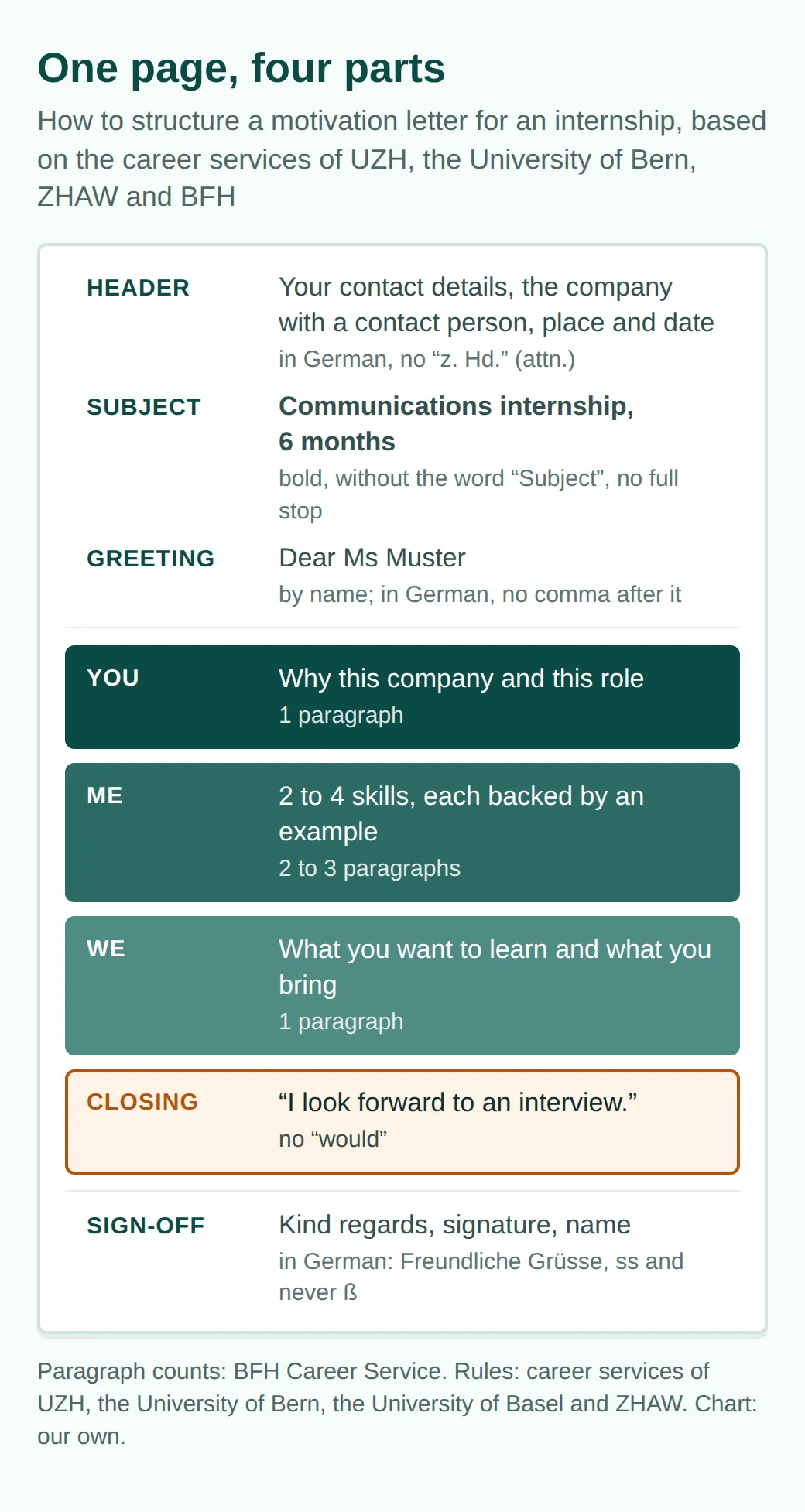
The most precise guidance comes from the Bern University of Applied Sciences (BFH) Career Service (in German). It gives the part about the company one paragraph, the part about you two or three, and the shared part one again. Each paragraph should carry one idea. UZH recommends three to four sections, the University of Bern three to five.
The header is an ordinary business letter: your contact details, the company's address with the contact person, place and date. According to the University of Bern, the subject line gives the job title, where you found the ad and the date it was published. The ZHAW School of Management and Law career service wants the exact job title and, if there is one, the reference number. Use the same font and font size as in your CV, so your whole application looks consistent. What comes right under the subject line then decides whether anyone reads on.
How to start a motivation letter
With the reason you're applying, in the very first sentence. The UZH Career Services cut the stock phrase "I hereby apply" just as they cut the sentence about which website you found the job on. Neither tells the reader anything they don't already know. Under the heading «Nicht langweilen» (don't bore them), the UZH handout lists exactly this kind of opening as a bad example: "I hereby apply", followed by the date and website of the ad and the job title. The date and where you found the ad belong in the subject line, not in your first sentence.
It's better to start with a real point of contact. As possible hooks, the handout names a company's talk in the University of Zurich's lunchtime series «Karriere über Mittag» that inspired you, or a phone call that encouraged you to apply. For generic openings, such as the ad having appealed to you straight away, the handout adds the note that makes the difference: the reason has to follow. A sentence about enthusiasm with no reason behind it is just a nicer cliché. ZHAW lists guest lectures, careers fairs, acquaintances and career events at the university as points of contact, exactly the places where students get to know companies.
For an internship, an opening could read like this:
At our university's careers fair, a team leader from the communications department told me that interns there run a campaign of their own. That's exactly the responsibility I'm looking for in my placement semester.
What to avoid: copying advertising lines from the company's website. UZH warns against it explicitly, and it shows, because the people at the company know their own slogans. If you have no personal contact, pick something concrete from the ad or from one of the company's projects and say what interests you about it. Then comes the longest part.
The main part: evidence, not adjectives
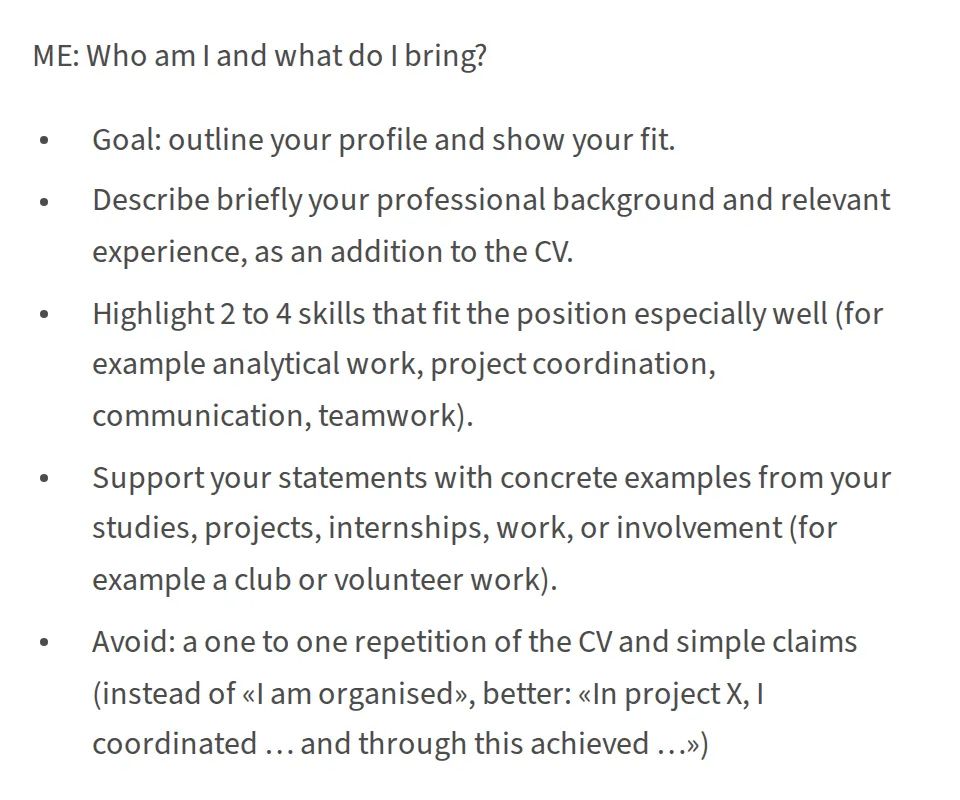
In the middle, you show two to four skills that fit the role and back each one with something you've done. That's how UZH puts it, and the others say almost the same: ZHAW suggests three or four skills with an example each, BFH about three.
The ad tells you which skills to choose. The UZH handout shows how companies grade their requirements. Hard requirements sound like "we require ..." or "we expect ...". Preferences sound different: "ideally ...", "... is an advantage" or "... would be desirable". Deal with the hard requirements first. A preference you meet is a bonus for the end of the middle section.
For each skill, write when and where you acquired it and how you'll use it in the new role. That's what BFH asks for, and its example (in our translation) shows how it sounds: "I'm also confident negotiating in Italian. During my exchange semester in Bologna, I took all my courses in Italian and joined a debating seminar." BFH calls this the "show, don't tell" rule. Instead of "I show initiative", its example reads: "For my bachelor's thesis, I founded a company that sells sustainably produced jewellery."
Without work experience, this kind of evidence is easier to find than many people think. The UZH handout shows how team spirit can be demonstrated through a basketball club or volunteering, and gives an example from someone's free time: "For years I've coached a junior football team in my spare time. I enjoy motivating the young players and turning a bunch of individuals into a strong team." A seminar paper under time pressure, a Saturday shift on the till, a club event you organised: all of it works, as long as you say what you actually did.
What doesn't work is a string of adjectives. BFH quotes "I am motivated, flexible, a team player and independent" as a sentence that hardly sounds authentic. The UZH handout shows the same problem in a sentence about an earlier internship, and how it gets better:
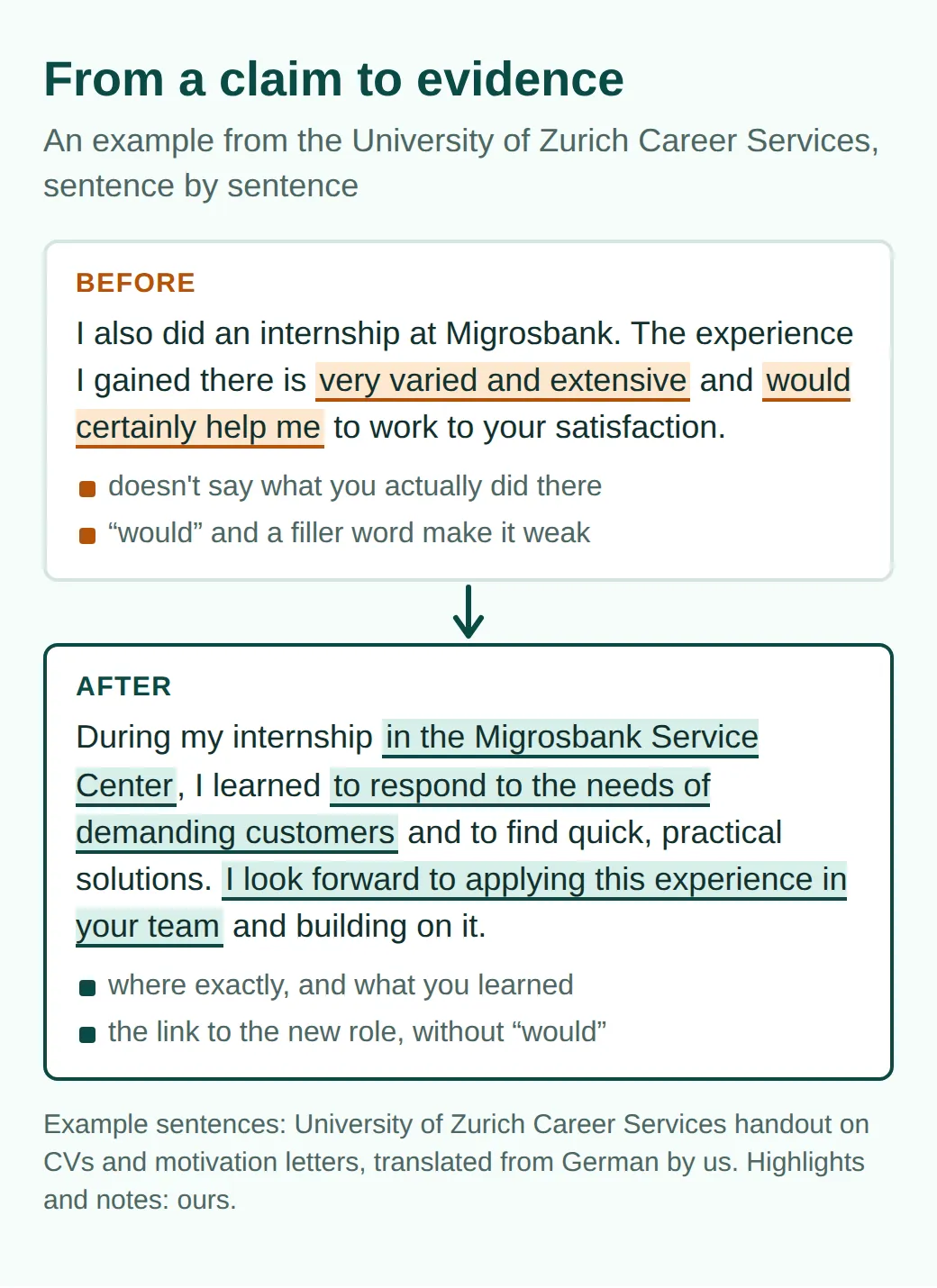
The second version is barely longer, but it says where you were, what you learned and how that helps the new company. Only write what matters for the role. BFH gives the example of English skills: if you won't need them in the job, they belong in your CV, not in the letter. The same goes for anything that's in your CV anyway. ZHAW reminds you that many recruiters read the CV first. Retelling it in the letter wastes your only page. One topic is still missing, and it's the one that sets an internship apart from a job.
What to add for an internship
When you apply for an internship, the company needs to know what you want to learn, when you're available and on what terms. In the UZH model, this goes into the shared part: show what you want to achieve in the role, which topics you want to go deeper into and what responsibility you want to take on. BFH adds that this part is less about expertise and more about how you'll fit into the team and help it succeed.
For an internship, that means three things. First, the context: is the internship part of your degree, or voluntary after you graduate? For a compulsory internship, half a sentence on this is worth it, because different rules can then apply to the company, for example on the cantonal minimum wage. Second, the key facts: earliest start date, length, and how many hours (full or part time). The University of Bern advises giving a start date or salary expectation whenever the ad asks for it. Third, a learning goal that fits the role. The idea that an internship should teach you something is more than a nice thought. In Neuchâtel and Ticino, written learning goals are among the conditions under which an internship is exempt from the cantonal minimum wage, as we show in our post on internship pay and rights. If your letter already says what you want to learn, you give the interview a focus.
A paragraph like that could look like this:
The internship is part of my bachelor's degree in communication. I can work full time for six months from February 2027. Above all, I want to learn more about media relations: so far in my studies I've only written press releases, never sent them out or followed them up.
After that, only the last paragraph is left, and that's where the most common style mistake happens.
A closing without "would"
The closing is one or two sentences that look ahead to an interview, without the conditional. The University of Bern says it word for word: not "I would be pleased…", but "I am pleased…". UZH calls phrasing such as "I would be happy if…" too cautious and recommends clear, positive sentences.
Not even UZH is fully consistent on this. Its handout, whose examples date from 2016, still offers as the better version of a closing a sentence with «würde mich sehr freuen» (I would be very pleased), together with the wish to learn more about the team's work in a personal interview. Going by UZH's current page, you drop the "would":
I'm curious about the work in your team and look forward to talking in person.
According to UZH, two things have no place anywhere in the letter: criticism of former employers, and justifying yourself. If you had a difficult semester, explain it briefly and factually, if at all, and end by looking ahead. Below that come the sign-off, your signature and your name, and that's where the Swiss details begin.
What's different in Switzerland
Mostly the small print of a letter written in German. Many templates online follow the habits of Germany, and some details don't fit here. In Switzerland, German is written with ss instead of ß, so «Freundliche Grüsse», as the University of Bern prescribes on its German page, or «Mit freundlichen Grüssen», as at the University of Basel (in German). In German, there's no comma after the greeting, as in the UZH sample letter (in German), and so the first sentence starts with a capital letter.
In the address block, leave out «z. Hd.», the German "attn.", as the University of Basel and the UZH handout point out. Whatever language you write in, the subject line is in bold and without the word "Subject", say the universities of Bern and Basel and UZH. The University of Bern adds: no full stop at the end. The date comes with the place in front, in the University of Bern's German example «Bern, 5. Juli 2013».
The most important difference concerns how you address the reader in the letter itself. UZH is clear here: in a motivation letter, formal address is still standard, even if the ad addresses you informally. In German, that means Sie, even if the ad says du. You may adapt the tone, a little more relaxed for a start-up than for a public authority or a large corporation, but you don't switch to first-name terms in return. On other questions, the universities agree less.
Where the career services contradict each other
On three details, the universities give opposite advice. If you only read one source, you'd think its rule was the only one.
| Question | University of Bern | ZHAW SML | UZH |
|---|---|---|---|
| "Dear Sir or Madam" | avoid it, call instead | fine if no name is known | page: possible; handout: avoid |
| Signature | by hand, in blue | typed name is fine if sent digitally | digital or scanned |
| List of enclosures | yes, without the word "Enclosures" | not mentioned | optional (handout) |
Our advice from these sources: find the name. If it isn't in the ad, call, as the University of Bern recommends. With a large company that uses an application portal, that doesn't always work, and then ZHAW's solution is sensible. For the signature, it depends on how you send the letter. The University of Bern's blue is meant to show that a paper letter is an original. A PDF has no original, so a scanned signature or your typed name is enough. And a list of enclosures never hurts, as long as you keep it short.
Most applications go out digitally these days, and that changes the form of the letter too.
Online form, email and short pitch
The motivation letter now comes in three main forms, each with its own formalities. UZH distinguishes them like this.
As a PDF, it stays a full letter with header, date, greeting and signature. If you apply by email, you attach the letter as a PDF, according to the UZH handout. In an online form, the address block, date and signature drop out. The you, me, we structure stays, and the form's character or field limits apply.
The third form is the short pitch. Some portals offer a quick application and expect only a brief reason, three to five sentences according to UZH: an opening, one or two skills and a sentence on the value you'd add. For an internship, for example:
The data analysis internship fits my master's focus on statistics exactly. For my master's thesis, I'm using R to analyse the responses to a survey I ran myself. I'm available for six months from March 2027 and want to learn how analysis supports decisions in a company's day-to-day work.
If you have a real number, such as how many responses you analysed or how many customers you looked after, put it in. Especially in a short pitch, it carries more weight than any adjective. However short the format, every version needs the same last step.
Before you hit send
Give the letter to someone to proofread, as the University of Bern and UZH advise. It's the quickest way to catch the mistakes you can no longer see yourself, and it's best to reread it yourself the next day as well. Above all, check these points from the universities' material:
- Sentences that say nothing: BFH cuts "I'm very motivated" to work at the company, because that's taken for granted anyway.
- Filler words: the UZH handout has a long list, including «eigentlich», «wirklich», «natürlich», «bestimmt» and «sicherlich» (actually, really, naturally, certainly, surely).
- Repetition and the conditional, especially in the closing.
- Spelling and grammar mistakes, which ZHAW and UZH both mention explicitly.
- The right name and the right company, if you've reused parts of an earlier letter.
That last point leads to the mistake the universities of Bern and Basel both name explicitly: the standard letter. In a column for the UZH Career Services (in German), Rolf Murbach writes that anyone who relies only on guides ends up writing like everyone else. His advice for getting started: don't write the finished text straight away. Collect material first, talk to friends about your interests and skills, write freely, and only then condense it.
When you're ready, find an ad that really fits and write the letter for that one role. You can browse open internships on our site by location, for example in Bern, Basel, Lausanne or the canton of Aargau, and by field, for example marketing and communications or finance and accounting.
Common questions
- How do I address a motivation letter if I don't know the contact person?
- The University of Bern advises calling the company and asking for the name. If you still can't find one, address the letter to the department, such as HR, and open with Dear Sir or Madam. The ZHAW career service considers that fine when no name is known.
- How do I apply for an internship that isn't advertised?
- Call the HR department first and ask whether and how they accept unsolicited applications. Say in the subject line that it's an unsolicited application and name the internship you're after. Always send a complete application file. If you haven't had a confirmation after about two weeks, you can follow up politely, as the University of Bern advises.
- Should a motivation letter include a photo?
- No. A photo belongs in your CV if anywhere, and even there it's optional. The career services of UZH and the University of Basel both call it optional. If you use one, make it professional and friendly.
- Can I use a motivation letter template from the internet?
- For the layout, yes; for the text, no. The universities of Bern and Basel advise against standard letters, and a column for the UZH Career Services warns that a letter written by the usual rules sounds like everyone else's. Take the structure and write every sentence from scratch for that specific role.
More posts
All posts
Student jobs in Switzerland 2026: hours, AHV and tax
How many hours you can work as a student in Switzerland, including on a B permit, and the pay limits that trigger AHV, tax, insurance and family allowances.

Internship in Switzerland for foreigners: work permits 2026
Internship in Switzerland on a foreign passport: which permit you need as an EU/EFTA or non-EU national, and what the young professionals agreements allow.

Swiss internship pay: minimum wage, holidays and rights
Internship salary in Switzerland: when you're owed pay, where the minimum wage covers interns, what SECO and associations pay, plus holidays and insurance.