Student jobs in Switzerland 2026: hours, AHV and tax

The short answer
With a Swiss passport or a C settlement permit, there is no special limit on the hours of your student job. With a B permit for studies, you may work at most 15 hours a week during the semester and full time in the semester break, in some cantons only on application. From a non-EU/EFTA country, you can start only six months into your studies and only with a permit your employer applies for.
The rest comes down to a few amounts in francs that hardly anyone knows. Up to CHF 2,500 per employer, AHV is only deducted from your pay if you ask for it. Once you earn CHF 5,000 with AHV deducted, your pay covers the AHV minimum contribution that students otherwise pay themselves. Above CHF 22,680 with one employer, you join the pension fund. And above CHF 30,240 a year, your parents lose the education allowance for you. We go through the rules one by one, with the figures for 2026 and their sources. The Federal Council has already raised some amounts for 2027, and we give the new figures alongside.
How many hours can you work as a student in Switzerland?
If you are Swiss or hold a C permit, no law sets a separate limit for students. The same rules apply as for any employee: the maximum working week is 45 hours in offices, industry and large retailers and 50 hours in all other businesses (Labour Act, art. 9). The real limit is your timetable.
The Federal Statistical Office (FSO) survey from 2024 shows how much students actually work. 72% of students at Swiss universities work alongside their studies. Most of them work part-time in small workloads: 61% of working students average 40% of full time or less over the year (FSO). Averaged across all students, 10.4 hours a week go into the job and 33.3 hours into studying.
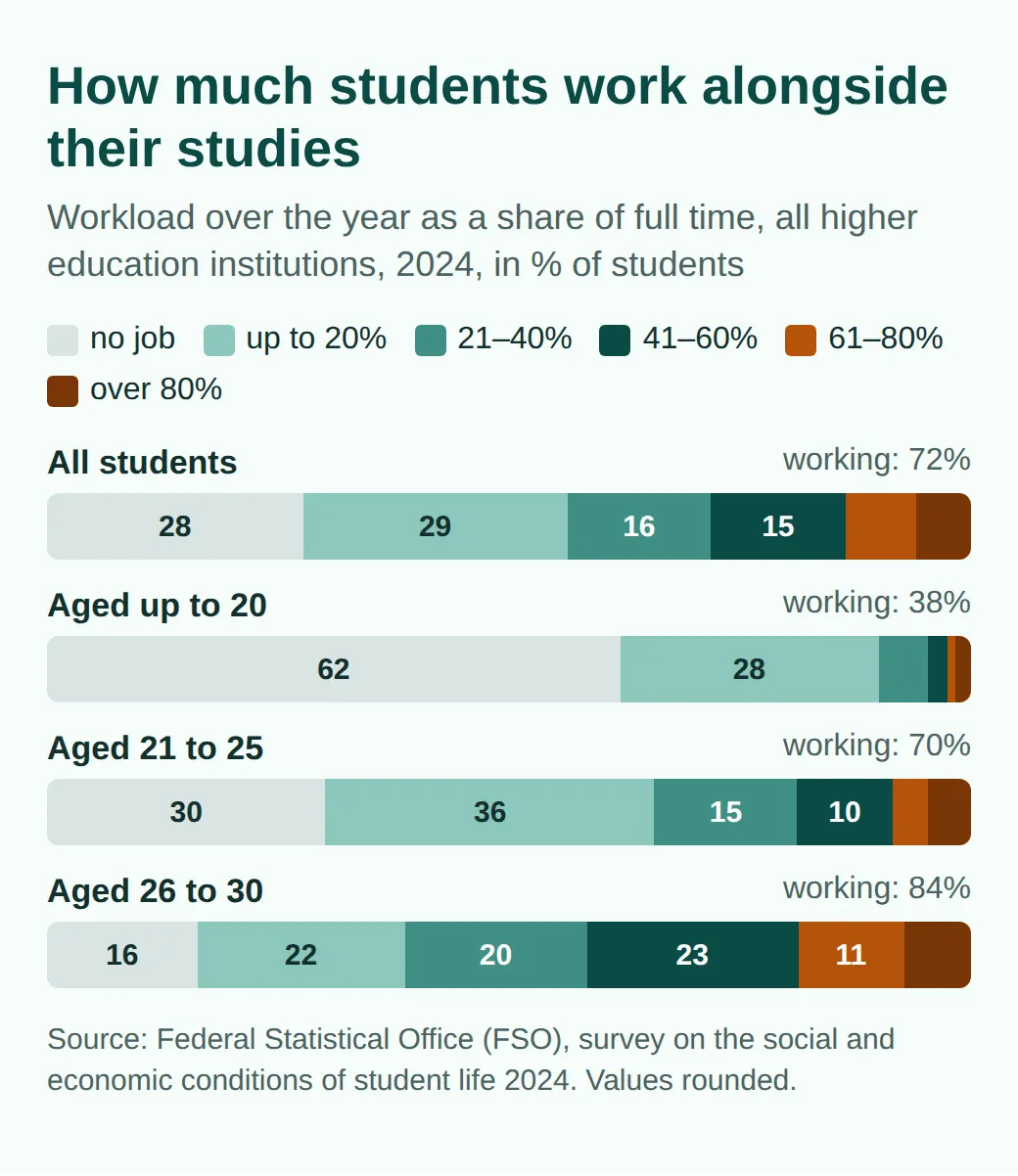
Age makes the biggest difference. Among students up to 20, only just over a third work, averaging 2.8 hours a week. Among the oldest students, it is 19.1 hours. From about 26, students cover most of their spending with their own pay, according to the FSO; before that, more than half comes from the family. With a permit for studies, however, you cannot choose your workload freely.
International students: 15 hours during the semester
With a B permit for studies, a cap of 15 hours a week applies during the semester, whether you come from the EU or from a non-EU/EFTA country. The difference lies in how you get there. The canton of St. Gallen sums up the rules in its leaflet on side jobs while studying (in German) like this:
| Your permit | During the semester | In the semester break |
|---|---|---|
| Swiss passport or C | no limit beyond the Labour Act | no limit beyond the Labour Act |
| B for studies, EU/EFTA | up to 15 h, no new application | full time on application |
| B for studies, non-EU/EFTA | up to 15 h, only after 6 months, with a permit | full time on application, with the university's consent |
With an EU or EFTA passport, you need no new application for up to 15 hours. Whether you have to apply for holiday work over 15 hours or just report it differs a little from canton to canton: St. Gallen requires an application, while in the canton of Zurich it needs neither a report nor a permit, according to the Zurich University of the Arts leaflet (in German). If you regularly work more during the semester, you need a permit as an employed person. As an EU or EFTA citizen, you are entitled to one.
For students from non-EU/EFTA countries, the rule is set out in the Ordinance on Admission, Period of Stay and Employment (VZAE):
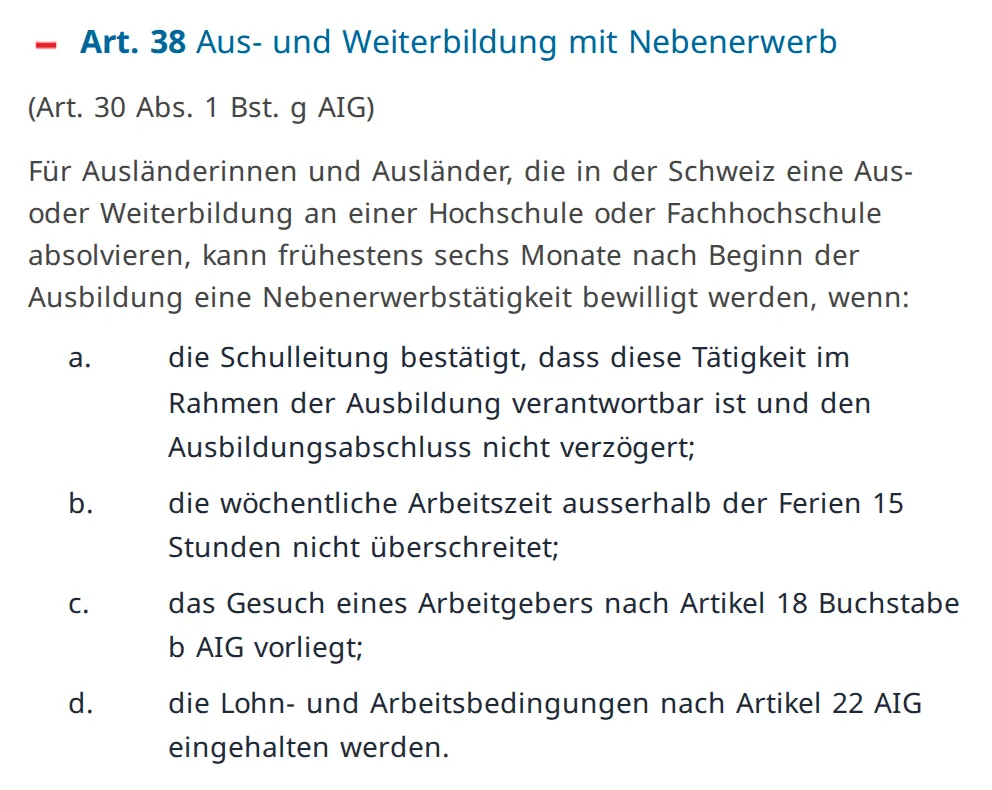
So, four conditions, and for three of them you depend on others. Your university confirms that the job will not delay your studies. Your employer submits the application to the migration office before you start (art. 38 VZAE). And pay and working conditions must match what is usual for the place, the occupation and the sector (art. 22 of the Foreign Nationals and Integration Act). According to St. Gallen, every change of job needs a new permit too. The canton makes one exception to the waiting period: Master's students with a foreign Bachelor's in the same subject, if they work at their own institute. The Zurich University of the Arts reckons the procedure takes at least three months. So start looking for a job early, and do not work a single day before the permit arrives. What applies to internships and to the time after you graduate is explained in our post on internships for foreigners.
Five amounts you should know
Hours are one limit, money is the other. Five amounts decide what is deducted from your pay in a student job, what you have to pay in yourself and what your family loses.
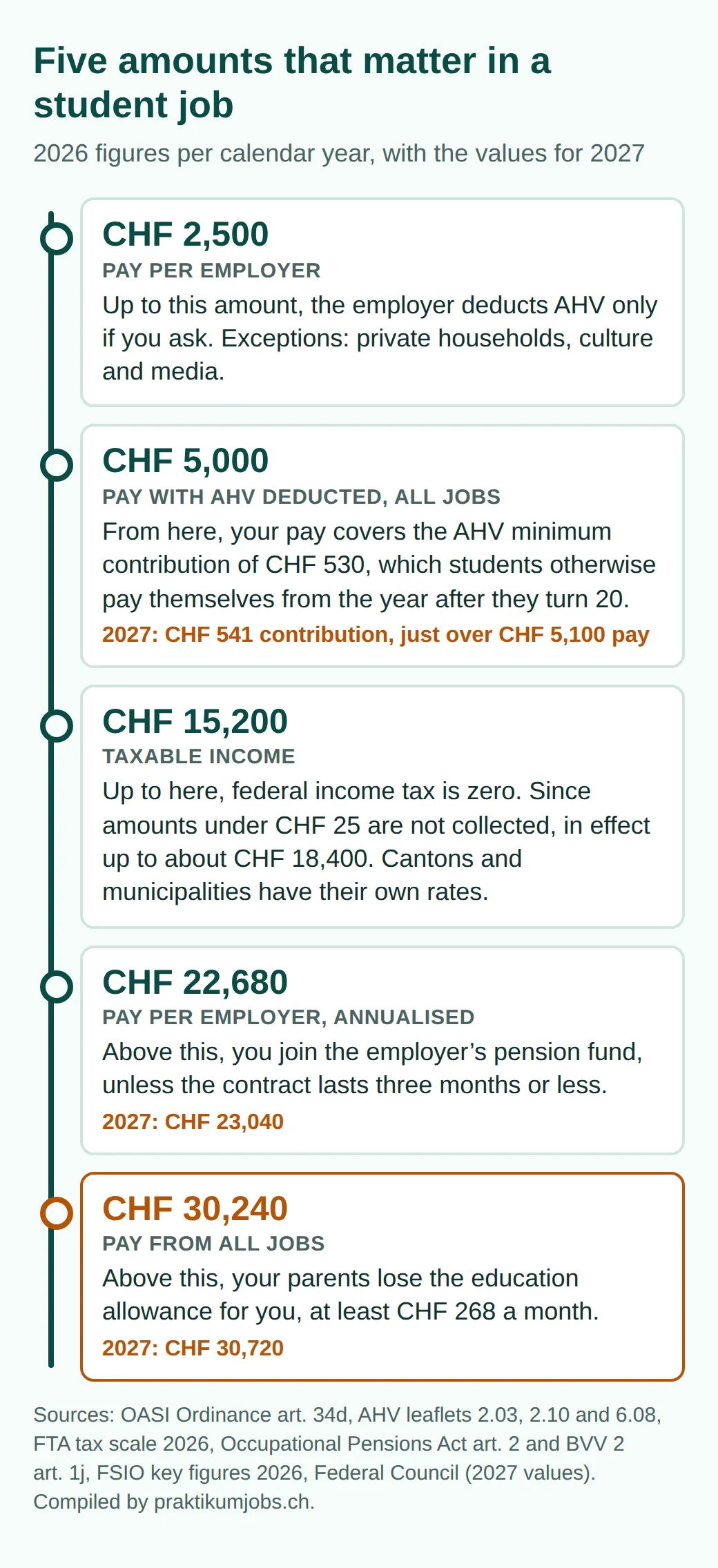
The first two concern the AHV, and they deserve a closer look.
AHV: why CHF 5,000 is the number that matters
As soon as you earn a wage, you pay AHV/IV/EO (old-age, disability and income compensation insurance) from 1 January after your 17th birthday: 5.3% of your pay, and your employer adds the same amount (AHV leaflet 2.01). Small wages are an exception. If you earn at most CHF 2,500 with one employer in a calendar year, contributions are only collected if you ask for them (AHVV art. 34d). This does not apply to work in private households, such as babysitting or cleaning for a family: contributions are always due there. The only exception is for people up to the end of the year in which they turn 25, if they earn at most CHF 750 a year from one household. Contributions are also always deducted at theatres, orchestras, choirs, radio, television and other media, design firms, museums and art schools.
Many people do not know the second rule. Students living in Switzerland must pay at least CHF 530 a year to the AHV from 1 January after their 20th birthday, even with no job at all, plus administrative costs of at most 5% (AHV leaflet 2.10, in German). The bill comes from the compensation office where your university is based, or directly from the university. Contributions from your pay are credited, including the employer's share. If together they reach CHF 530, you pay nothing more; otherwise you pay only the difference. The AHV itself works out that CHF 530 equals a gross salary of CHF 5,000 (AHV leaflet 2.03). From 2027, the minimum contribution rises to CHF 541 (Federal Council, October 2026), which by our calculation equals just over CHF 5,100 in pay.
Two examples, worked out with the 2026 figures. A summer job paying CHF 3,000 brings in CHF 318 of contributions, so you still pay CHF 212 on top. With a side job paying CHF 2,000 a year, it pays to ask for the contributions to be deducted: then CHF 212 goes to the AHV, and your employer covers CHF 106 of that. You pay CHF 106 through your wage and CHF 318 to the compensation office, CHF 424 in total instead of CHF 530. And every year without contributions is a gap that can cut your pension later. From the year after your 25th birthday, by the way, the contribution for students without a job depends on assets and pension income, no longer on the minimum contribution. Besides the AHV, your employer also deducts tax, but only in certain cases.
Tax on a student wage
Your pay is income and is taxed, even if you are not yet 18: children are taxed in their own right on income from work (DBG art. 9). With small wages, it rarely adds up to much. For direct federal tax in 2026, single people pay nothing on the first CHF 15,200 of taxable income, and tax amounts under CHF 25 are not collected at all (Federal Tax Administration, 2026 scale). In effect, federal tax stays at zero up to about CHF 18,400 of taxable income. Taxable means after deductions such as AHV contributions and work expenses, so your gross pay can be higher.
The canton and municipality have their own rates, and there tax kicks in sooner or later depending on where you live. To see how much it is for you, use the Federal Tax Administration's tax calculator for your municipality. Keep the salary certificate from every employer; you need it for your tax return.
If you have neither a Swiss passport nor a C permit, your employer usually deducts tax at source directly from your pay (DBG art. 83). That is usually the end of it. If you want to claim deductions, such as travel costs, you can apply for a subsequent ordinary assessment by 31 March of the following year (DBG art. 89a). Miss the deadline and no further deductions are granted. Note that once you make this application, you are assessed the ordinary way every year after that until you are no longer taxed at source (DBG art. 89). Tax only affects you; the next limit, by contrast, hits your parents.
CHF 30,240: the limit for the education allowance
As long as you are in education, your parents receive an education allowance for you, until the end of the month in which you turn 25. Federal law sets a minimum of CHF 268 a month, and many cantons pay more. For the first two children in 2026, for example, it is CHF 268 in Zurich, 310 in Bern, 325 in Basel-Stadt, 415 in Geneva and 425 in Vaud (FSIO, 2026 rates).
This allowance stops if your gross pay exceeds CHF 30,240 a year (AHV leaflet 6.08, in German). The limit is set in the AHV ordinance: you no longer count as being in education if you earn more on average per month than the maximum full AHV old-age pension (AHVV art. 49bis). In 2026, that is CHF 30,240 a year (FSIO key figures), or CHF 2,520 a month. All your earned income counts, from all your jobs together. From 2027, the maximum pension is CHF 2,560 a month (Federal Council, October 2026), so under the same rule the limit rises to CHF 30,720 a year.
For most students, that is a long way off. But if you work almost full time alongside your studies, do the maths: earning a few hundred francs over the limit costs your family CHF 3,216 a year in the canton of Zurich and CHF 5,100 in Vaud, by our calculation. Your parents must report such changes to their employer or the family compensation fund, and they have to pay back allowances they received wrongly. That settles the amounts, which leaves the contract itself.
Small jobs: holidays, sick pay and minimum wage
A job of four hours a week is a perfectly normal employment contract. So you are entitled to at least four weeks of holiday a year, five until your 20th birthday, and a pro rata share in shorter jobs (Code of Obligations, art. 329a). With hourly pay, many employers simply add holiday pay to each wage payment. Strictly speaking, that is not allowed, because holidays may not be replaced by money while the employment lasts (art. 329d). The Federal Supreme Court tolerates it only for irregular work, and only if the holiday share is stated in the written contract as an amount or a percentage and shown as an amount on every payslip (BGE 129 III 493). "Holidays included" is not enough. Worked out, four weeks of holiday on 48 working weeks is a supplement of 8.33%, and five weeks on 47 working weeks is 10.64%. If the supplement is missing from your payslip, you can claim the holiday pay afterwards.
If you are ill, your employer only has to keep paying you if the job has lasted more than three months or was agreed for more than three months, and then for three weeks in the first year of service (art. 324a). A summer job of exactly three months therefore does not qualify.
Minimum wage: Geneva has a special rule for holiday jobs
Where a cantonal minimum wage applies, it applies to student jobs too. In Geneva, that is CHF 24.59 gross an hour in 2026 and CHF 24.73 from 1 January 2027, in each case without the holiday and public holiday supplement (ge.ch). For enrolled students, though, Geneva has a rule of its own: occasional jobs during school and semester holidays, for at most 60 days in a calendar year, may be paid at 75% of the minimum wage (LIRT art. 39K), which by our calculation is CHF 18.44 an hour, then CHF 18.55 in 2027. Contracts with young people under 18 are also exempt in Geneva. The minimum wages in Basel-Stadt, Neuchâtel, Jura, Ticino and the city of Lucerne are listed in our post on internship pay and rights.
Insurance: accidents, pension fund and health insurance
Your employer always insures you against accidents at work. If you work at least eight hours a week for one employer, you are also covered there for accidents in your free time (Accident Insurance Ordinance, art. 13), and your employer deducts the premium for this from your pay unless it chooses to cover it (Accident Insurance Act, art. 91). If you work less, your commute also counts as an occupational accident, and all other accidents in your free time are covered by your health insurer. If your job gives you full accident cover, you can have the accident cover with your health insurer suspended and save on the premium (Health Insurance Act, art. 8). When the job ends, your health insurer covers accidents again as soon as the cover through your employer stops.
You only join the pension fund with annual pay of more than CHF 22,680 from one employer (BVG art. 2), and from 2027 of more than CHF 23,040. If you work for less than a year, your pay is scaled up to a full year. A holiday job paying CHF 2,000 a month therefore comes to CHF 24,000, which is above the threshold. Contracts of three months or less are exempt, however (BVV 2 art. 1j). Several small jobs are not added together. And until the year after your 24th birthday, the pension fund only covers death and disability anyway; you only start saving for retirement after that. On top of this comes unemployment insurance at 2.2%, of which you pay half (Unemployment Insurance Act, art. 3). On a typical student job payslip, then, 6.4% goes on AHV, IV, EO and unemployment insurance, plus the premium for non-occupational accidents if you work eight hours a week or more.
Student job or internship in the semester break?
A student job brings in money; an internship in the semester break often brings both pay and experience in your own field. For AHV, tax and insurance it makes no difference: an internship is usually a fixed-term employment contract too, with AHV, holidays and accident insurance. For students from non-EU/EFTA countries, though, a separate route applies: a compulsory internship during full-time studies is approved under a different rule and may take up at most half of the total length of the course (art. 39 VZAE).
When you apply, our post on the motivation letter will help.
Before you say yes
Most mistakes with student jobs happen not at work but when signing. So before your first day, find out how many hours a week you will work, how long the contract runs and how holidays are paid. A short message to the employer is enough:
Hello, and thank you very much for the offer. Before I sign: how many hours a week are planned, and is the contract fixed-term or open-ended? Is holiday pay included in the hourly wage, and at what percentage is it shown in the contract and on the payslip? I hold a B permit for studies and need a permit to work more than 15 hours a week during the semester. Kind regards
Leave out the last sentence if it does not apply to you. Then add up your yearly total from all jobs and compare it with the five amounts above: if you are just under CHF 5,000, ask for AHV contributions on your small jobs. If you are close to CHF 30,240 (2027: 30,720), talk to your parents. You can browse internships on our site by location, for example in Basel, Lausanne, Lucerne or Winterthur.
Common questions
- Do several small jobs count together for the CHF 2,500 AHV limit?
- No. The limit applies to each employer separately. For the minimum contribution of CHF 530 (CHF 541 from 2027), on the other hand, all the contributions paid through your jobs in the year are added up. So ask each employer for a written statement or your salary certificate.
- Do I have to pay AHV at 19 if I am only studying?
- No. Without a job, you only start paying on 1 January after your 20th birthday. As soon as you earn a wage, though, you pay from 1 January after your 17th birthday, through the deduction on your payslip.
- Can I work freelance on a Swiss student permit?
- With an EU or EFTA passport, you don't need a work permit for it, according to a Zurich University of the Arts leaflet, but you must register with the AHV compensation office and show that you can live on it. From a non-EU/EFTA country, self-employed work on the side is not possible with this permit. If in doubt, ask your canton's migration office.
- Do international students have to pay the AHV minimum contribution?
- Yes, if your legal residence (domicile) is in Switzerland. If you are only here to study and have no domicile here, you do not have to pay the minimum contribution. Whether that applies to you is decided by the compensation office where your university is based.
More posts
All posts
Swiss internship pay: minimum wage, holidays and rights
Internship salary in Switzerland: when you're owed pay, where the minimum wage covers interns, what SECO and associations pay, plus holidays and insurance.

Internship in Switzerland for foreigners: work permits 2026
Internship in Switzerland on a foreign passport: which permit you need as an EU/EFTA or non-EU national, and what the young professionals agreements allow.

Internship motivation letter: structure, examples, mistakes
How to write an internship motivation letter in Switzerland: one-page structure, before-and-after examples, Swiss details and the mistakes universities flag.