Apprenticeship in Switzerland 2027: when and how to apply

As of October 2026
The search for an apprenticeship starting in August 2027 is already under way. Places have been advertised since August 2026, and in mid-October 2026 berufsberatung.ch listed 29,392 open places starting in 2027. Going by past years, about two thirds of all apprenticeships are taken by March or April. If you're doing taster placements and applying in autumn 2026, you're in good time. If you start later, you'll still find open places well into the summer, especially in certain industries.
There's no single deadline when everything is decided. Companies fill their apprenticeships as they go, each on its own schedule. How this has actually played out in recent years is measured twice a year by the State Secretariat for Education, Research and Innovation (SERI) in its transition barometer, a survey of young people and companies. From those figures and the official apprenticeship search, we've put together your timeline to August 2027: when to do what, what companies really look at when they choose, and where most places are still open in spring.
Where do you find apprenticeships for 2027?
The official overview is the apprenticeship search on berufsberatung.ch, the information portal of the public careers guidance services. The site is in German, French and Italian; its English page has factsheets on taster placements, aptitude tests and the apprenticeship contract for English speakers living in Switzerland. Behind the search is the list of apprenticeship positions, known as LENA. Every host company needs a licence from its canton to train apprentices. A company should report its open places to the LENA of its cantonal Vocational Education and Training Office and advertise them on berufsberatung.ch, as the official VET portal vocationaleducation.ch advises host companies. That puts them all in one search for the whole of Switzerland.
Apprenticeships starting in August are advertised from early August of the year before in German-speaking Switzerland, and from September in French-speaking Switzerland (vocationaleducation.ch). For you, that means the places for 2027 are already there. With the filter for a 2027 start, the search showed this many open places in mid-October 2026:
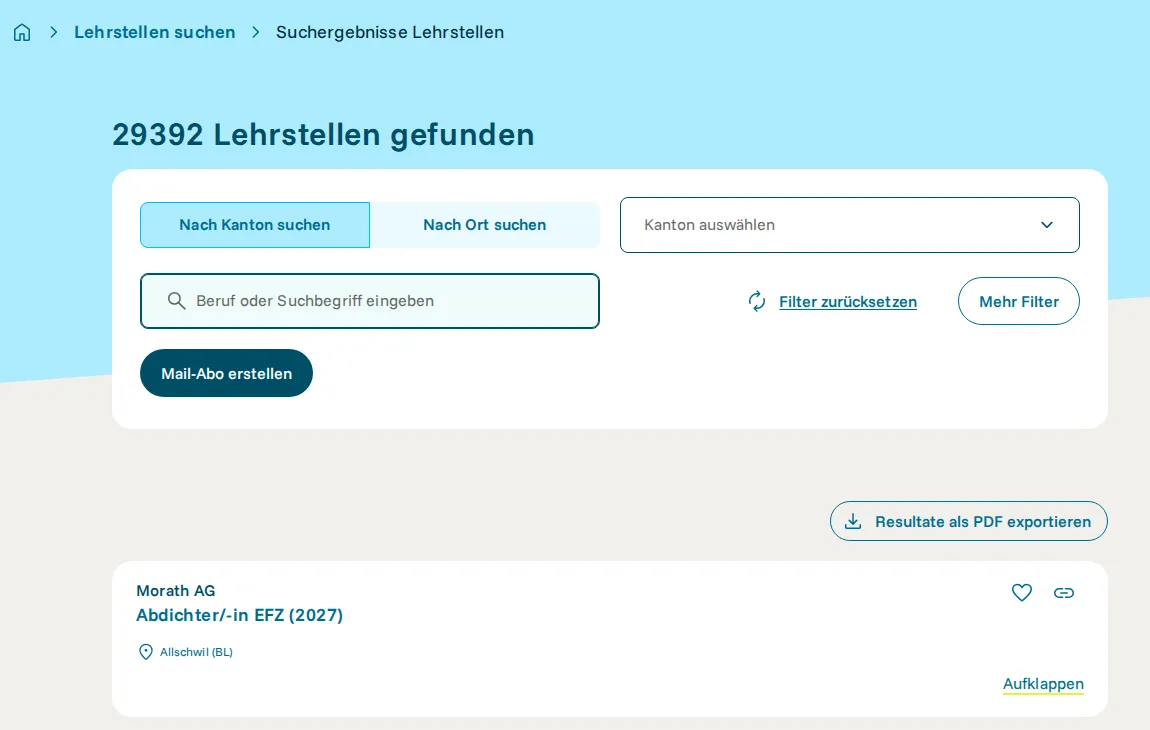
The 29,392 places are spread across 20,372 listings, because some companies are looking for several apprentices in the same occupation. You can filter by canton, town, occupation and language, and set up an email alert. It tells you about new apprenticeships automatically, so you don't have to start your search from scratch every week.
The list isn't everything, because not every company posts its places there. In SERI's 2026 transition barometer (in German), 44 percent of companies said they publish open apprenticeships through the cantonal list, 45 percent on their own website or their trade association's, and 38 percent through personal contacts. So also look directly on company websites under "Careers" or "Jobs" (berufsberatung.ch). If a company you like has no ad at all, you're welcome to call or send an unsolicited application. And ask the people around you: anyone who works in the occupation you want can tell you whether their company is looking for apprentices. That gives you the list. The question is how much time you have.
The timeline to August 2027
The months that matter most run from autumn to spring. By March and April 2026, 68 percent of the apprenticeships on offer across Switzerland had already been filled, as the transition barometer shows. That figure is remarkably stable: since 2018 it has always been between 63 and 70 percent. Of the young people finishing school who wanted an apprenticeship, 62 percent had a signed contract at that point, and another 11 percent had a verbal offer.
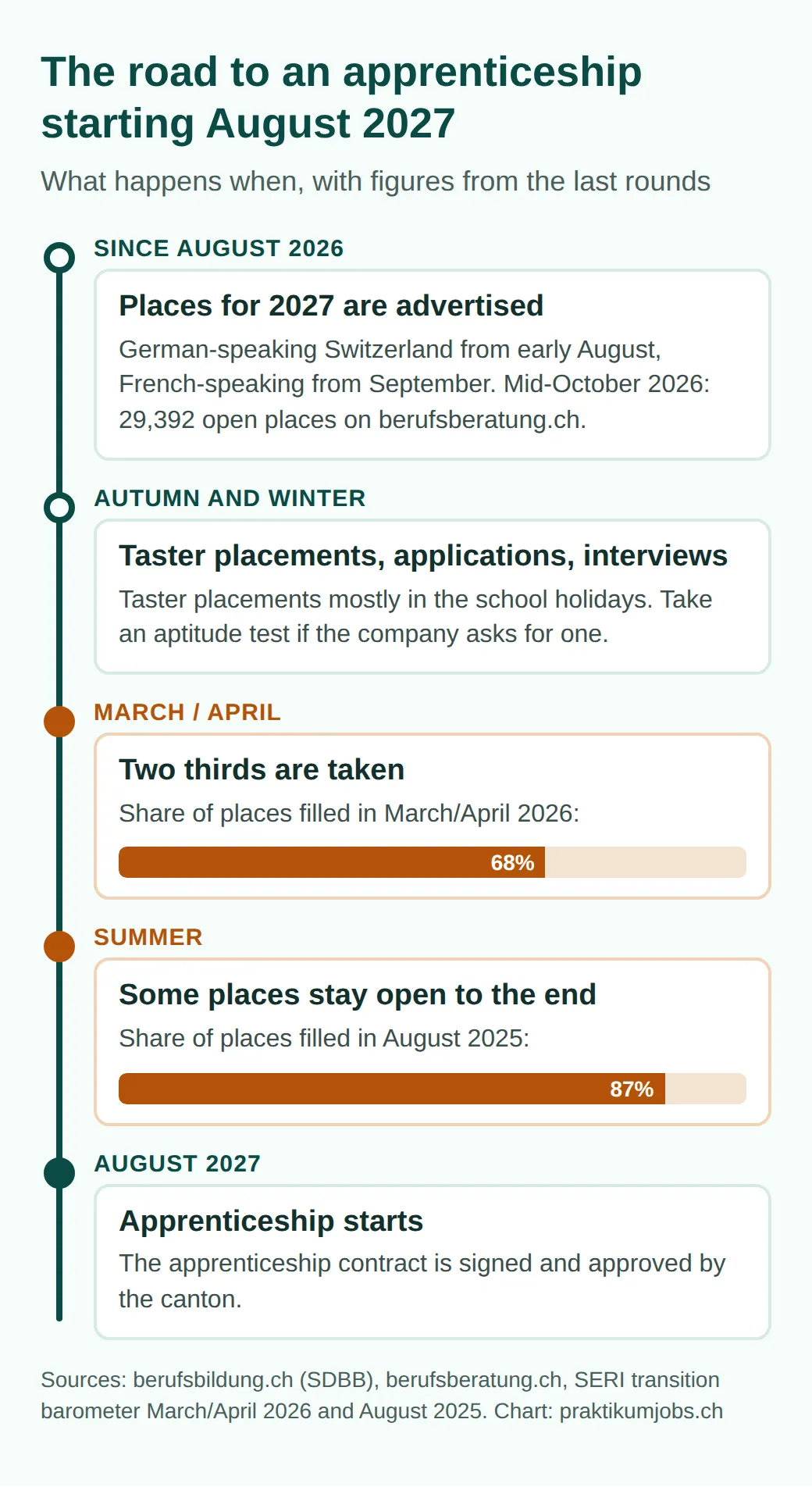
In the end, companies don't fill every place. In August 2025, 87 percent of apprenticeships had been filled (transition barometer August 2025, in German), so just over one in eight stayed open. In the spring of that same round, only 67 percent had been filled. So a noticeable share of places is still filled between April and August, even though you can't simply subtract one figure from the other: companies counted more apprenticeships on offer in August than in spring. If you have nothing by spring, you're not too late, but you're searching in a smaller field.
For an apprenticeship starting in August 2027, that means, if the next round goes like the last few: get your taster placements done before winter if you can, send your applications out in autumn and winter, and expect most people to know where they'll start by the spring holidays. That's an extrapolation from recent years, not a guarantee. For most companies, the first step on this timeline isn't the application but the taster placement.
Taster placements: the step almost everyone takes
Almost everyone looking for an apprenticeship does a taster placement first, a few days trying out the job in a company, called a Schnupperlehre in German. In spring 2026, 95 percent of young people interested in an apprenticeship had done at least one, and 74 percent had done several. Companies count on it too: only 4 percent of training companies offer no taster placements, and in 2026 a company hosted five pupils on average, the largest firms 60 on average.
The rules are simple. You can do a taster placement from age 13, for two weeks at most and not at weekends (berufsberatung.ch, FAQ). As a rule, it's unpaid. It usually lasts from one day to a week and takes place in the school holidays. If you want to do one during term time, your school has to agree (berufsberatung.ch).
What matters is what you take away. For companies, the taster placement is part of the selection. They see how you cope with a normal working day, and some invite you for a taster placement before there's even an interview, as vocationaleducation.ch advises host companies. At the end, ask the person who looked after you for feedback and a written taster report. It goes into your application later as an attachment.
If you do your taster placement where you also want to do your apprenticeship, it's often half the battle. A company remembers young people who were on time, asked questions and did careful work. If you liked the occupation but not the company, try the same occupation somewhere else. If you can't find a taster placement at all, talking to people who do the job, an open day or a careers fair can help. With the taster report in hand, it's time to put your documents together.
What companies look at in your application
Your school report counts most. That's what the 2026 transition barometer found when it asked companies what they base their choice on:
| Document | Very or fairly important to companies |
|---|---|
| Personal and social skills as rated in the school report | 73% |
| School track (level) in the school report | 72% |
| Marks in the school report | 70% |
| The industry's own aptitude tests | 50% |
Companies rate external tests such as Multicheck, Stellwerk or Basic Check as important much less often; more on that below. On attitude, the picture is clear: at the start of the apprenticeship, they mainly expect motivation (74 percent) and a willingness to learn (62 percent), along with a friendly, polite manner (76 percent). Ready-made specialist knowledge isn't a priority for companies.
Companies also said in August 2025 what goes wrong in many applications: most often weak school marks, then spelling and grammar mistakes, and unclear motivation or impersonal applications. By this stage, you can only improve your marks in the current school year. The other two are entirely in your hands. So have an adult read through your application, such as your teacher, someone in your family or an adviser at the careers information centre (BIZ).
A complete application consists of a cover letter, a CV and attachments (berufsberatung.ch). The attachments include your lower secondary school reports, your taster reports, aptitude test results and, if you have them, confirmations of holiday jobs or courses (berufsberatung.ch). Save everything as PDFs, one file per attachment, with the latest school report first. For the cover letter itself, berufsberatung.ch has its own guide: a separate letter for each company, which refers to the ad and says why you want to go there in particular. Write in the company's language. If you send your documents by email, keep the text short:
Subject: Application for an apprenticeship as an electrician EFZ, starting August 2027
Dear Ms Meier
Please find attached my application for the apprenticeship as an electrician EFZ starting in August 2027. In October I spent three days on a taster placement in Mr Rossi's team; the report is attached. I would be glad to be invited for an interview.
Kind regards
In a German-speaking company, that greeting becomes Guten Tag Frau Meier, and you sign off with Freundliche Grüsse.
How many applications you need depends a lot on the occupation. Young people who started an apprenticeship with a company in 2025 had written 8 applications on average, according to the transition barometer of August 2025. The other way round, companies received an average of 11 applications per place in 2026, with large firms and industries such as information and communication, finance and insurance, public administration and health getting more than average. If you're aiming for a popular occupation, or only just meet the requirements, send more applications. And keep a list of where you've applied and who has already replied. Before an application goes out, many occupations raise one more question: do I need a test?
Aptitude tests: when you need one and what it costs
Whether you need an aptitude test is up to the company, the vocational school or the trade association. Some require one, others only recommend it. If in doubt, ask before you sign up. The tests check school subjects such as German and maths, plus concentration, logical thinking or spatial awareness, and sometimes personality. According to berufsberatung.ch, they usually take place between February and May and cost between about CHF 20 and 150; some are free.
The best-known external tests are Multicheck and Basic Check, both from the same provider. According to the provider, Multicheck costs CHF 60 to 100 depending on the field, and Basic Check CHF 100. Both test school material up to the end of the 8th school year (year 10 in the HarmoS count, which includes kindergarten). You can retake Basic Check once within a test period, which runs from the end of May to the end of May the following year.
How much these tests are worth is a fair question. In German-speaking Switzerland, only 29 percent of training companies rated Multicheck as very or fairly important in 2026, the same share rated the Stellwerk test that way, and 24 percent Basic Check. Half or more rated each of the three as not very or not at all important. So don't take every test just in case; take the one the companies you want are asking for.
A poor result isn't the end. With average scores, a strong application with good taster reports can make up for a lot. With scores that fall short, you can practise and retake some tests the following year, or look at occupations that call for other strengths. The careers guidance service can help you weigh this up.
Careers guidance: when an appointment is worth it
Every canton has its own careers guidance service, in many cantons called the BIZ. Advisers there help you in confidence with any question about training and work, and you'll find the addresses of all of them on berufsberatung.ch. In the canton of Zurich, for example, advice is free for anyone under 20, and the information desk with short consultations of up to 15 minutes is free for everyone (canton of Zurich, in German). Your own canton's rules are on the website of your local service.
An appointment is worth it above all if you're torn between two occupations, if the rejections pile up, or if you still have no offer by spring. Advisers help you look for an apprenticeship and know which bridge-year programmes (Brückenangebote) your canton offers and when you need to sign up for them. Once you have an offer, there's one last step on paper.
The offer, the contract and the trial period
An apprenticeship starts with a written apprenticeship contract. If it isn't in writing, it isn't valid. It must be in place before the apprenticeship starts, or at the latest on the first day, and the cantonal Vocational Education and Training Office checks and approves it (vocationaleducation.ch). If you're under 18 when you sign, your parents or legal representative must also give their written consent. As a rule, you can start an apprenticeship once you're 15 and have finished compulsory schooling, as the FAQ on berufsberatung.ch states.
Before you sign, take a close look at the trial period, holidays and pay. The trial period lasts between one and three months and can be extended to six at most; if the contract says nothing, it's three. Until you turn 20, you're entitled to five weeks of paid holiday. And your pay is set in the contract: there's no legal minimum wage for apprentices anywhere in Switzerland. Companies usually follow their industry's recommendations, and collective labour agreements and cantonal minimum wages also apply.
A signed contract almost always holds. Only 5 percent of young people said in 2025 that their apprenticeship contract had been cancelled before the start. Once you've signed, withdraw from the other companies where your application is still open. That frees up a place for someone who's still looking. A month before you start, your company should send you a written invitation with everything you need for the first day, as vocationaleducation.ch advises host companies.
If you have nothing by spring
Then keep looking where places are still open, and that varies a lot by industry. By March and April 2026, 87 percent of apprenticeships in finance and insurance had already been filled, and 81 percent in information and communication. In construction, by contrast, it was only just over half, and in hotels and restaurants less than half.
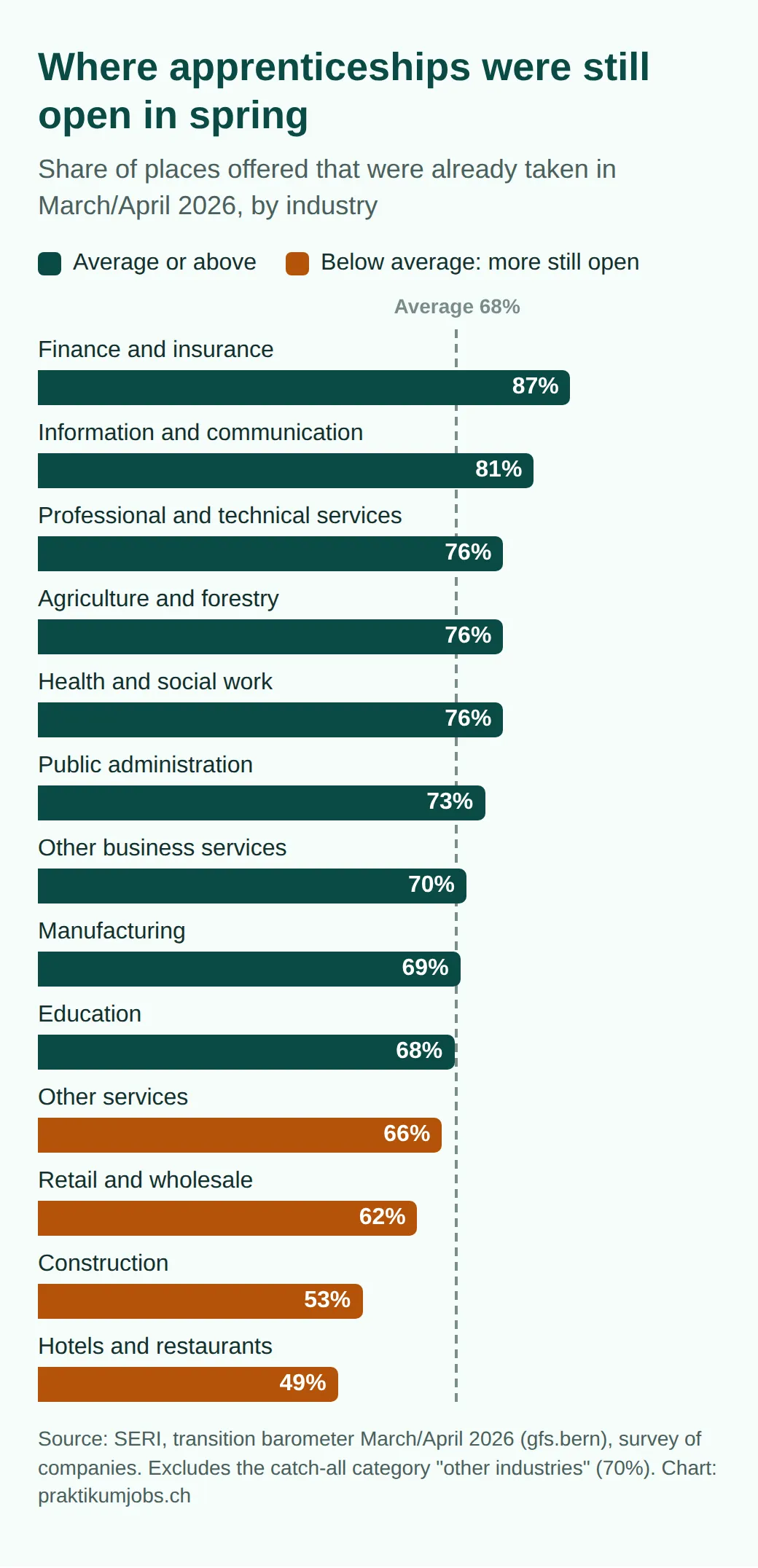
The pattern holds into the summer. In August 2025, one in four apprenticeships in construction was still unfilled, one in five in agriculture and forestry, and 18 percent each in hotels and restaurants and in manufacturing. The most common reason companies gave was that they had only received unsuitable applications (56 percent), closely followed by receiving none at all (53 percent). And 59 percent of companies with open places wanted to keep them open so they could still fill them that year.
For you, that means first of all: search further afield. A neighbouring canton, or a town half an hour away, can have quite different companies with open places. Look at related occupations too, especially in industries with many open places, or at a two-year EBA apprenticeship, after which you can go on to an EFZ. And keep at it over the summer, with the email alert and by calling companies that turned you down in spring. If it doesn't work out by August, there are bridge-year programmes, usually lasting six to twelve months, that prepare you for the apprenticeship search, for an apprenticeship in a particular field or for a school (berufsberatung.ch). In 2026, a lack of apprenticeships was the most common reason young people were interested in a bridge-year programme. How and by when you sign up depends on your canton and the programme; the careers guidance service in your canton knows the deadlines.
Your next steps
Set up an email alert on berufsberatung.ch for a 2027 start in the occupation and region you want, so you don't miss any new place. Make a list of five to ten companies, including some without an ad, and ask them about a taster placement in the next school holidays. At the same time, put your application together: scan your school reports, write your CV, collect your taster reports. And ask the companies you want whether they require an aptitude test before you book one.
If, after your first taster placements, you're unsure which occupation suits you, book an appointment at the BIZ before the main round of applications starts in winter. Choosing the wrong occupation is still easy to fix in autumn, with another taster placement rather than by dropping out of an apprenticeship.
Common questions
- Do you get paid for a taster placement in Switzerland?
- No. Taster placements are generally unpaid, last two weeks at most and never take place at weekends. If you're between 13 and 15, you may work at most 8 hours a day and 40 hours a week, and only between 6 am and 6 pm.
- What is the difference between an EFZ and an EBA apprenticeship?
- An apprenticeship leading to a Federal VET Diploma (EFZ) takes three or four years, one leading to a Federal VET Certificate (EBA) takes two, with teaching more closely tailored to the apprentices. After an EBA you can go on to an EFZ. Of the apprenticeships offered in 2026, 91 percent led to an EFZ and 8 percent to an EBA.
- Can you quit an apprenticeship during the trial period?
- Yes. During the trial period, you and the company can end the apprenticeship contract with seven days' notice. The trial period lasts one to three months, and if the contract says nothing, it's three. After that, the contract can only be ended by mutual agreement or for good cause, and the cantonal Vocational Education and Training Office must be told.
- Are there still apprenticeships starting in 2026?
- A few. In mid-October 2026, berufsberatung.ch still listed 1,428 places starting in 2026, against 29,392 for 2027. Whether such a late start is still possible is something to settle directly with the company, and the careers guidance service can help you with it.
More posts
All posts
Gap year after the Swiss Matura: options and money in 2027
Gap year after the Matura: internship, language stay, recruit school or civilian service. What you earn and when your parents lose the education allowance.

Student jobs in Switzerland 2026: hours, AHV and tax
How many hours you can work as a student in Switzerland, including on a B permit, and the pay limits that trigger AHV, tax, insurance and family allowances.

Internship in Switzerland for foreigners: work permits 2026
Internship in Switzerland on a foreign passport: which permit you need as an EU/EFTA or non-EU national, and what the young professionals agreements allow.