Gap year after the Swiss Matura: options and money in 2027

First things first
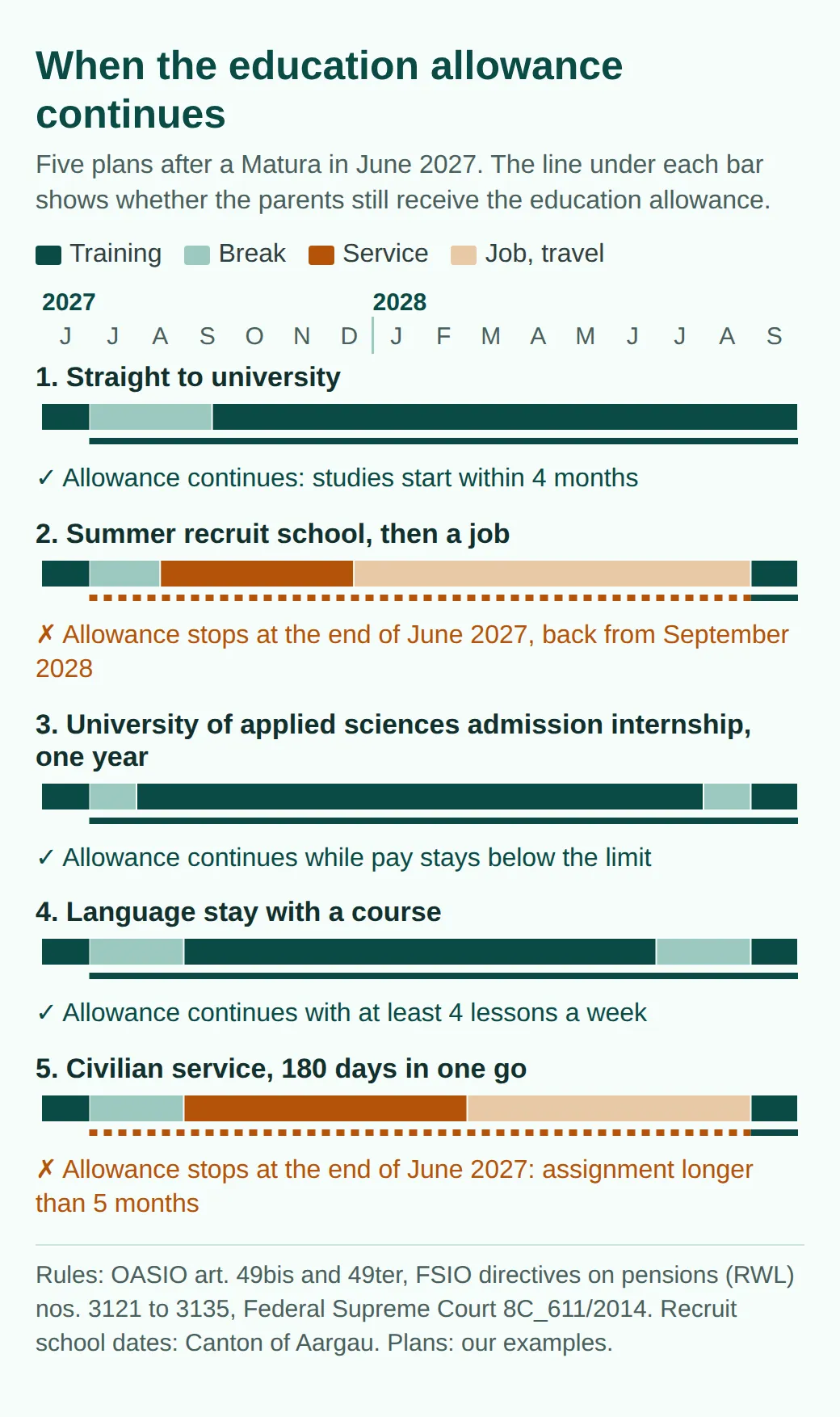
A gap year after the Matura won't hurt your CV, but it can cost your family money. Your parents' education allowance only continues if you start your next course within four months, or if your year itself counts as education: an internship a university of applied sciences requires for admission, or a language stay with lessons. Working and travelling don't count. Recruit school and civilian service only count if they last five months at most and you start studying straight afterwards.
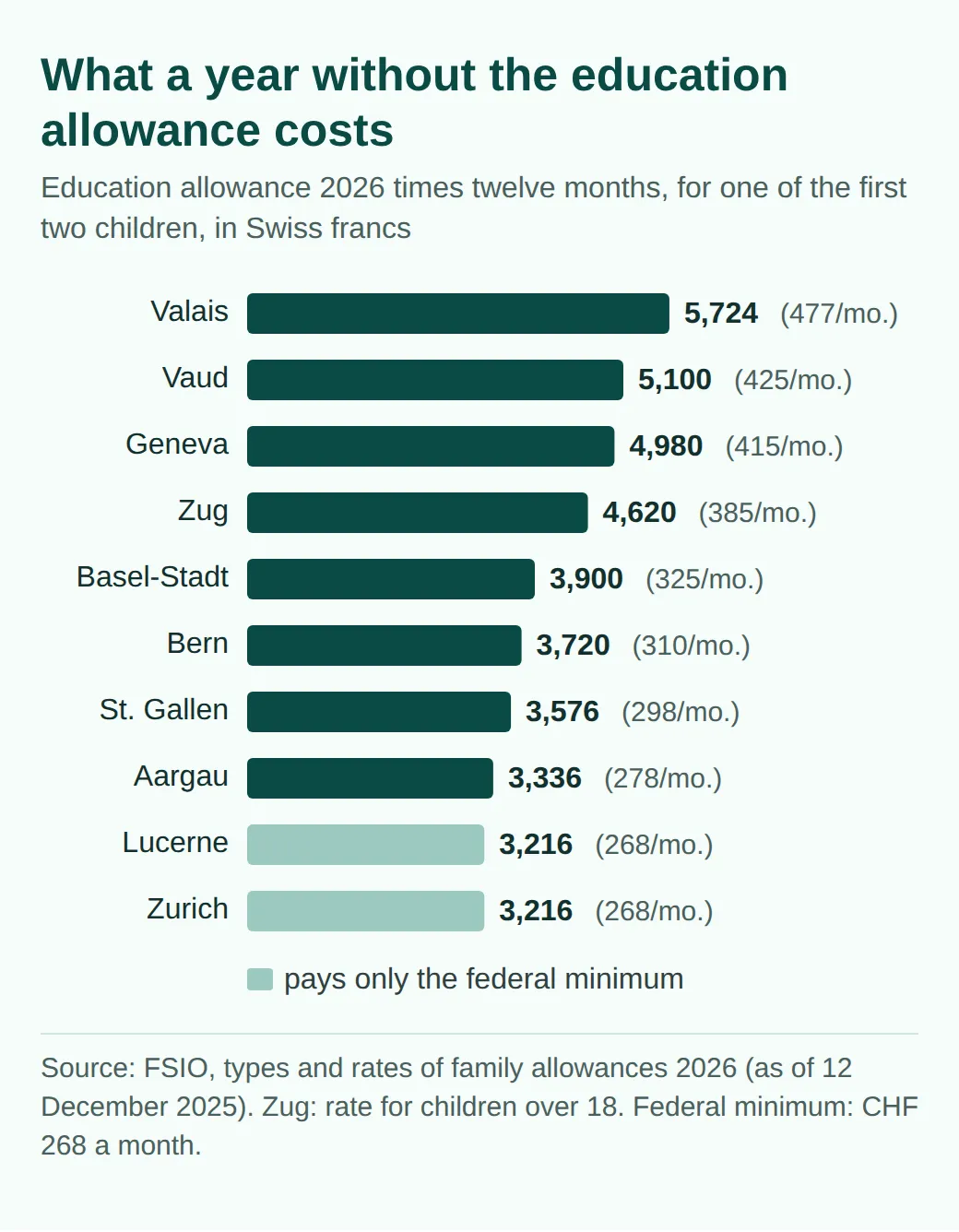
That's no small matter. Depending on the canton, it's worth CHF 3,216 to 5,724 a year (2026 rates). On top of that comes a change in 2027 that upsets many plans: the summer recruit school will now start in mid-August and end just before Christmas, so it overlaps almost the whole first semester. Below are the rules, what each path pays, and the deadlines for getting back into education.
The clock starts on the day of your Matura
For family allowances, your education ends with the Matura, even if it's only a step along the way, unless you carry on within four months. A break afterwards only counts as time in education if it falls between two courses and lasts four months at most (OASIO art. 49ter; our Fedlex links go to the German text where the English translation is out of date). The directives of the Federal Social Insurance Office (FSIO) count part months too: 16 June to 16 October is already four months (directives on pensions, RWL, nos. 3133 to 3135, in German). If you sit the Matura in June and start university in September, you're on the safe side. At the University of Basel, lectures in the autumn semester 2027 begin on 20 September (semester dates).
Military and civilian service have a limit of their own: they don't interrupt your education if they last five months at most and you carry on studying straight afterwards. A case the Federal Supreme Court decided in 2015 shows how strictly that's meant. A young man passed his Matura in December 2013. In January and February he did a nursing internship, and the family compensation office still paid for those two months. From 10 March to 11 July 2014 he did recruit school, he failed the aptitude test for medicine, and on 15 September he started a business degree. The office stopped the allowance from March. The Aargau insurance court sided with the family, the Federal Supreme Court with the office (ruling 8C_611/2014). The gap came to six and a half months. That's more than the four months allowed for a break and more than the five for service, and you can't add the two limits together.
The allowance itself isn't small. Federal law sets a minimum of CHF 268 a month, many cantons pay more, and it runs until the end of the month in which you turn 25 (AHV leaflet 6.08, in German). Over a whole year's break, that adds up like this:
A second limit concerns your pay. If you earn more on average than the maximum AHV old-age pension, you no longer count as being in education (OASIO art. 49bis). In 2026 that's CHF 2,520 a month, and in 2027 the limit rises with the pension to CHF 2,560 (Federal Council, October 2026, in German). If the allowance stops, your parents must tell their employer or the compensation office themselves, or they'll have to pay it back later. This overview shows which plans keep the allowance:
The internship that counts as education
An internship counts as education if a school requires it for admission. That's exactly what universities of applied sciences (UAS) do: with an academic Matura, you need at least one year of work experience in a related occupation before you can start a UAS bachelor's degree (Higher Education Act, art. 25). The FSIO expressly recognises such an internship as education, because the regulations make it a condition of admission (RWL, no. 3121).
Each UAS decides what counts as work experience. The Lucerne University of Applied Sciences and Arts (HSLU) requires a 100 percent job for its business programmes, for at least six months in a row at the same company. Pure telephone work in a call centre or a holiday job doesn't count (HSLU, admission internship, partly in German). The details vary from programme to programme, so check them before you sign a contract.
Even without a UAS requirement, an internship can count if it's needed in practice for a particular course, you genuinely intend to take that course when the internship starts, and the internship lasts a year at most at the same company (no. 3122). One example is the nursing internship before medical school that several universities ask for. An internship that only helps you choose a career or improves your chances of a job doesn't count (no. 3123). So a "trial year" at an agency is work, not education.
On pay, the earnings limit works as a ceiling. The Kaufmännischer Verband, the Swiss association of commercial employees, recommends at least CHF 2,100 for an internship after the Gymnasium, paid 13 times a year (KFMV, pay recommendations, in German). Spread over twelve months, that's CHF 2,275, clearly below the limit. HSLU quotes a monthly salary of CHF 2,000 to 2,500 for its own internships, also with a 13th-month salary. At the top end, that averages CHF 2,708, above the limit for both 2026 and 2027. The FSIO then counts the internship months separately, and the allowance stops for those months (no. 3129). So do the sums before you negotiate a few hundred francs more. Our post on internship pay and rights covers what else you're entitled to.
To keep the compensation office from having doubts, a written confirmation from the UAS helps. A short email to the admissions office is enough, written in the language your programme is taught in:
Dear Sir or Madam, I passed my academic Matura in June 2027 and would like to start the bachelor's degree in business administration in autumn 2028. From August 2027 to July 2028 I'm working full time as an intern in the accounting team at Example AG. Could you briefly confirm in writing that this internship meets the required work experience? I need it for my parents' family compensation office. Kind regards
You can browse our open internships by location, for example in Bern, Lucerne or the canton of St. Gallen. Our post on the motivation letter explains how to apply convincingly with little experience. If you have to do military service, though, plan the internship around recruit school, and its dates are changing.
The new recruit school dates from 2027
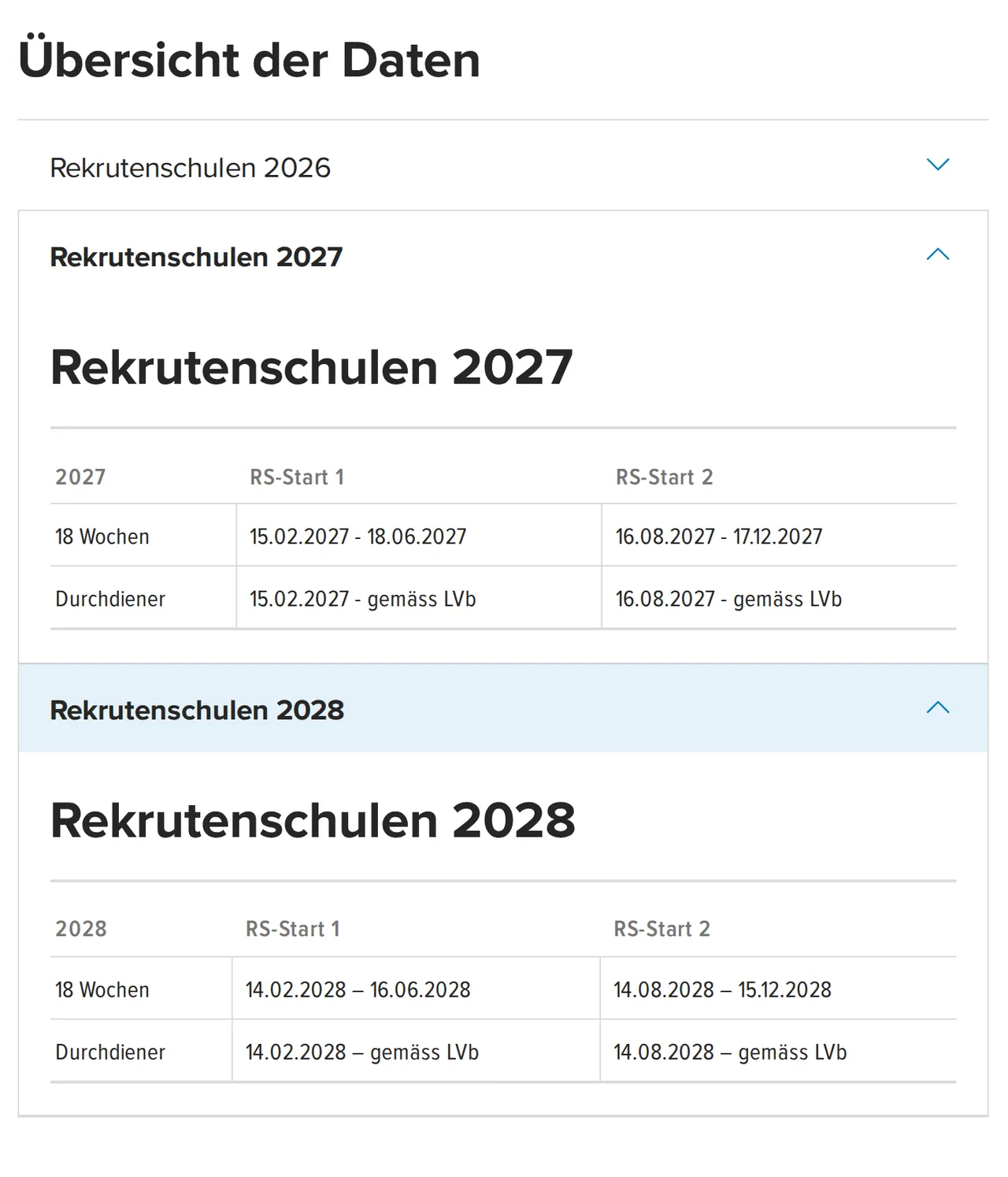
From 2027, recruit schools start in mid-February and mid-August. In 2027, the 18-week winter recruit school runs from 15 February to 18 June and the summer recruit school from 16 August to 17 December. In 2028 the dates are 14 February to 16 June and 14 August to 15 December. The Canton of Aargau has published the dates:
What that means for you depends on the year of your Matura. If you finished in 2026 and are in your gap year 2026/27, the winter recruit school fits well: it ends on 18 June 2027, and the autumn semester starts in September. If you sit the Matura in 2027, the summer recruit school clashes with your first semester. You can then either study first and do recruit school later, or take a gap year and combine recruit school with an internship. On that second path, the allowance is gone either way: more than five months lie between the Matura and your studies, and doing all your service in one go as a single-term serviceman (Durchdiener) doesn't count as education anyway (no. 3135).
For medicine, there's a separate path that needs no gap year at all. The recruit school for military doctors lasts twelve weeks, from calendar week 26 to 37. If you've passed the aptitude test or have a place to study in Geneva, Lausanne or Neuchâtel, you start university in week 38. You get leave for the aptitude test in week 27. The universities of Basel, Bern, Fribourg and Lausanne and ETH Zurich accept this recruit school instead of the nursing internship. You apply for it at recruitment, which takes place three to twelve months before recruit school starts (Swiss Armed Forces, standard path for military doctors, in German).
Recruit school is paid through loss of earnings compensation (EO). As a recruit, you get CHF 69 a day, a quarter of the maximum EO amount of CHF 275, whether you were working or still at school before (AHV leaflet 6.01, in German). During service you're covered by military insurance (Military Insurance Act, art. 1a). If you choose civilian service instead of recruit school, the numbers work differently.
Civilian service: 180 days that shape your plan
If you haven't done recruit school, your civilian service includes one long assignment of at least 180 days (Civilian Service Ordinance, art. 37). In total, civilian service lasts 1.5 times as long as the training service you'd still owe the army (Civilian Service Act, art. 8). You're only admitted once you've attended the introduction day and then confirmed your application (art. 18).
The long assignment is the core of your gap year, and it comes with rules. You do it with a single host organisation, preferably in a priority programme of the Federal Office for Civilian Service, abroad or at the office itself. Under current law you may split it into two parts within two calendar years, and it must be finished by the end of the third calendar year after your admission (Civilian Service Ordinance, art. 39a). On 14 June 2026, voters approved an amendment to the Civilian Service Act. If you apply during recruit school, you'll then have to do the long assignment in the year after your admission, and all civilian servants will serve every year from the year after their first assignment (Federal Office for Civilian Service, fact sheet, Federal Chancellery, correction, both in German). No date for it to come into force had been published by mid-October 2026, and Fedlex still shows the act as it stood on 1 January 2025.
Two sources pay you. For as many days as recruit school would have lasted, you get the same loss of earnings compensation as a recruit (Loss of Earnings Compensation Act, art. 9). The host organisation pays you pocket money equal to a soldier's pay, feeds you and gives you accommodation (Civilian Service Act, art. 29). For your parents' allowance, though, the long assignment in one go is too long: 180 days are six months, and the limit is five. A language stay, on the other hand, can save the allowance.
Language stays and au pair years: four lessons a week
A language stay or an au pair year counts as education if you attend at least four lessons a week in a region where another language is spoken (RWL, no. 3125; OASIO art. 49bis para. 2). That's not just true of Australia or Spain. Going by the wording, a year as an au pair in French-speaking Switzerland, the traditional Welschlandjahr, also meets the rule if it includes a language course. Without a course, it stays work and travel.
Get the language school or course provider to confirm in writing how many lessons a week you attend. And don't cancel your health insurance. As long as you remain resident in Switzerland, you stay insured, and basic insurance pays for emergencies abroad up to twice the amount it would cover in Switzerland (Health Insurance Ordinance, art. 36). Anything above that is only covered by supplementary insurance. For the allowance, compensation offices assume for up to five years that you keep your residence in Switzerland while you study abroad. Cancelling your health insurance, though, suggests you've moved away (directives on the Family Allowances Act, FamZWL, no. 301.1, in German).
Working, travelling, volunteering
A year of work, travel or volunteering isn't education as far as the allowance is concerned. That doesn't make it a bad year. Many school leavers use it to save money for university or to work out what they want to study. It just means that if the break lasts longer than four months, your parents stop getting the allowance from the month after your Matura.
You have to sort out two things yourself during that year. The first is accident insurance. If you work at least eight hours a week for the same employer, you're also insured against accidents in your free time through them (Accident Insurance Ordinance, art. 13). When the job ends, that cover runs out on the 31st day after your last pay. You can extend it by up to six months with the employer's insurer through what's called extended cover (Abredeversicherung) (Accident Insurance Act, art. 3). After that, your health insurer covers accidents again. Tell your insurer yourself, or it will charge the premium retroactively with late-payment interest (Health Insurance Act, arts. 8 and 10).
The second is the AHV, the Swiss old-age and survivors' insurance, once you're 20. From 1 January after your 20th birthday you pay contributions even without a salary: at least CHF 530 a year, and CHF 541 from 2027 (AHV leaflet 2.03). Our post on student jobs works out how a side job counts towards it. That leaves the question of when to apply for what comes next.
Deadlines for getting back in
A gap year only stays a year if you don't miss the application for your studies. Most deadlines fall in the middle of your gap year, often while you're abroad or on service. At the University of Basel, with a Swiss Matura you must apply for the autumn semester 2027 by 30 April 2027. To start in the spring semester 2027, the deadline there is 30 November 2026 (University of Basel, application deadlines). Other universities have similar dates, but not the same ones.
For medicine, the deadline is much earlier: registration runs from early December to 15 February through swissuniversities, and studies begin in the autumn (University of Zurich, medicine, in German). Universities of applied sciences add their own aptitude assessments and the confirmation of your internship. Put these dates in your calendar on the first day of your gap year, not in March.
How to plan your year
Start with where you want to end up, not with the time off. If you're aiming for a university of applied sciences, an admission internship is the path that gives you experience and a salary, and keeps the allowance for your family. For university and military service, check whether the winter recruit school or a later service date fits better. And if you want to learn a language, pick a stay with at least four lessons a week.
After that, it comes down to three short conversations. Your parents ask their employer or the family compensation office whether your plan counts as education, before you say yes to anything. You check with the university or UAS what it accepts as work experience. And if you're liable for service, you fix your recruit school or civilian service early. If you then decide on an internship, you'll find open positions in Basel, Lausanne and many other places.
Common questions
- Does the four-month rule also apply after a vocational baccalaureate?
- Yes. After a Federal Vocational Baccalaureate, too, a break of four months at most can still count as time in education, as long as your next course follows straight after it. If the break is longer, your education counts as finished when you graduate, and the allowance stops until you start again.
- When does the education allowance start again after a gap year?
- From the month in which you actually start your new course. What counts is when lectures begin, not the date you enrol. Your parents report the start to their employer or the family compensation office. They can claim allowances they forgot to ask for up to five years back.
- Do I lose an orphan's pension during a gap year?
- The AHV orphan's pension and the child's pension follow the same rules as the education allowance. The Federal Social Insurance Office's directives apply the four-month rule, the five-month rule for military and civilian service and the same pay limit. So a year without recognised education interrupts the pension too.
- Do I have to pay AHV contributions during a gap year?
- Yes, from 1 January after your 20th birthday, even with no income. The minimum contribution for non-employed people is CHF 530 a year in 2026 and rises to CHF 541 in 2027. If you work, the deductions from your pay usually cover it already.
More posts
All posts
Student jobs in Switzerland 2026: hours, AHV and tax
How many hours you can work as a student in Switzerland, including on a B permit, and the pay limits that trigger AHV, tax, insurance and family allowances.

Internship in Switzerland for foreigners: work permits 2026
Internship in Switzerland on a foreign passport: which permit you need as an EU/EFTA or non-EU national, and what the young professionals agreements allow.

Internship motivation letter: structure, examples, mistakes
How to write an internship motivation letter in Switzerland: one-page structure, before-and-after examples, Swiss details and the mistakes universities flag.