Swiss trainee programmes 2027: pay, length, deadlines

At a glance
A trainee programme in Switzerland usually lasts 12 to 18 months, and two to three years in industry and at the financial market regulator. Where companies publish the salary, it's mostly between CHF 71,500 and 80,000 a year. You apply about six months before the start, at some companies in windows of only one or two weeks.
We read the programme pages of 18 employers in finance, insurance, industry and public administration. Two things stand out: only five of them give a salary, and the deadlines are spread across the whole year. One example shows how specific it can get. SBB starts its programme on 1 September 2027 and takes applications only from 1 to 14 February and from 3 to 16 May 2027. In return, SBB pays CHF 80,000 a year for a full-time post and keeps on more than 90 percent of its trainees afterwards (SBB). If you miss the February window, you can try again in May. At many other companies there's only one date a year. Where a company publishes its programme page only in German, our links go to the German page.
Trainee programme or internship: the difference
A trainee programme is an entry-level job with a set training plan, while an internship is a fixed-term placement for learning. The official Swiss careers guidance portal describes trainee programmes as structured programmes for graduates who already bring some practical experience from internships or student jobs (berufsberatung.ch). You work in one or more parts of a large company, have a mentor for your field and attend internal courses. An internship after your degree, by contrast, lasts from a few weeks to a year and pays an intern's salary.
The difference shows most clearly in the money. The Swiss Financial Market Supervisory Authority FINMA offers both, each for people with a master's degree. An internship of 9 to 12 months pays CHF 55,000 a year, the new Digital and Analytics trainee programme CHF 110,000 (FINMA). The contract is often different too. At Zürcher Kantonalbank and at ABB you're employed on a permanent contract from your first day as a trainee, whereas an internship ends on the agreed date. What rights you have as an intern and what's usual there is covered in our post on internship pay and rights.
Almost every programme sets one limit: your degree mustn't be too old. The careers guidance portal gives two years at most as a rule of thumb, and some companies are stricter. Before we get to those deadlines, let's look at pay.
How much do trainees earn in Switzerland?
Five of the seven programmes that state a salary pay between CHF 71,500 and 80,000 a year. SBB and Baloise each pay CHF 80,000, and Mobiliar pays CHF 79,300 in its 18-month Deep Dive programme and CHF 71,500 in its one-year Discovery programme, both including a 13th month's salary (Mobiliar). That's CHF 6,100 and 5,500 a month. PostFinance gives CHF 78,000 a year (PostFinance).
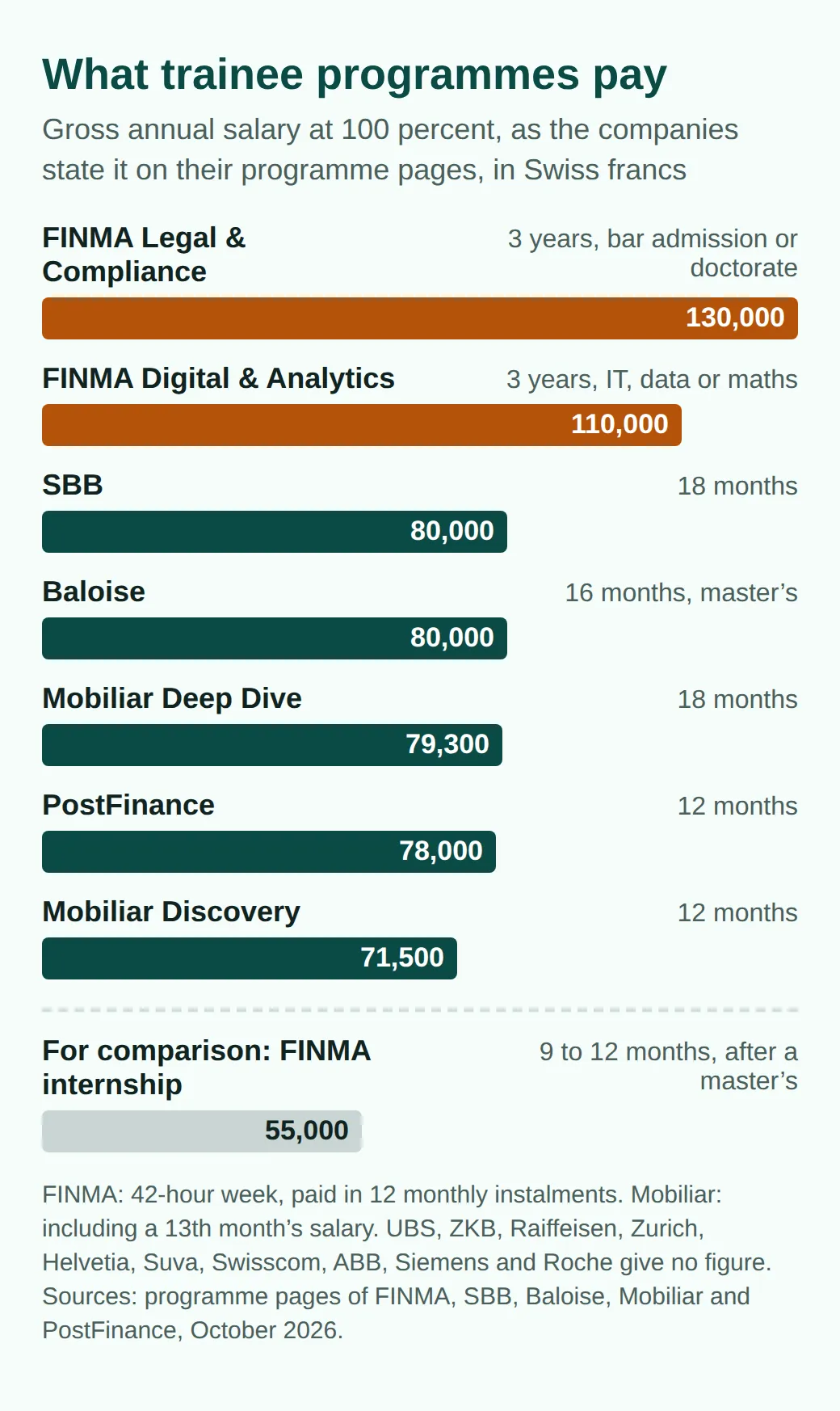
The two FINMA programmes stand out, and there are reasons for that. The programme for Legal and Compliance Officers, at CHF 130,000, is aimed at lawyers who have been admitted to the bar or hold a doctorate, so people who have already put years in after their degree. Both FINMA programmes last three years, assume a 42-hour week and pay the salary in twelve monthly instalments.
The other companies stay vague. ZKB promises «faire Vergütung», fair pay, while UBS, Raiffeisen, Zurich, Helvetia, Suva, Swisscom, ABB, Siemens and Roche give no figure on their programme pages. So ask about the annual salary in the first interview at the latest, and whether it's paid in twelve or thirteen instalments. The figures above are a good yardstick for the answer.
It's worth looking at the extras as well as the salary. SBB gives its trainees a second-class GA travelcard for the whole programme and five weeks' holiday. PostFinance gives six weeks' holiday at 100 percent and a personal training budget of CHF 3,000. Mobiliar pays CHF 120 a month towards health insurance, and Helsana gives an SBB voucher every year. How each sector builds its programmes varies more than the pay does.
Banks: one year or 18 months, fixed start dates
At the banks, programmes last one to two years, and many have a fixed start date. Raiffeisen Switzerland's programme lasts 12 months, starts in October and requires a full-time post in St. Gallen or at The Circle at Zurich Airport (Raiffeisen). You choose a specialism and do three rotations within it. The page currently lists Treasury & Markets, corporate clients, Portfolio Management & Advisory and IT Cyber Security. The specialisms change every year, and the new ones appear on the job board in February. Your degree can be no more than 18 months old, and you need German at C1 level. The individual Raiffeisen banks also run their own programmes, such as Raiffeisenbank Neukirch-Romanshorn, with 12 months from October and applications from March (Raiffeisenbank Neukirch-Romanshorn).
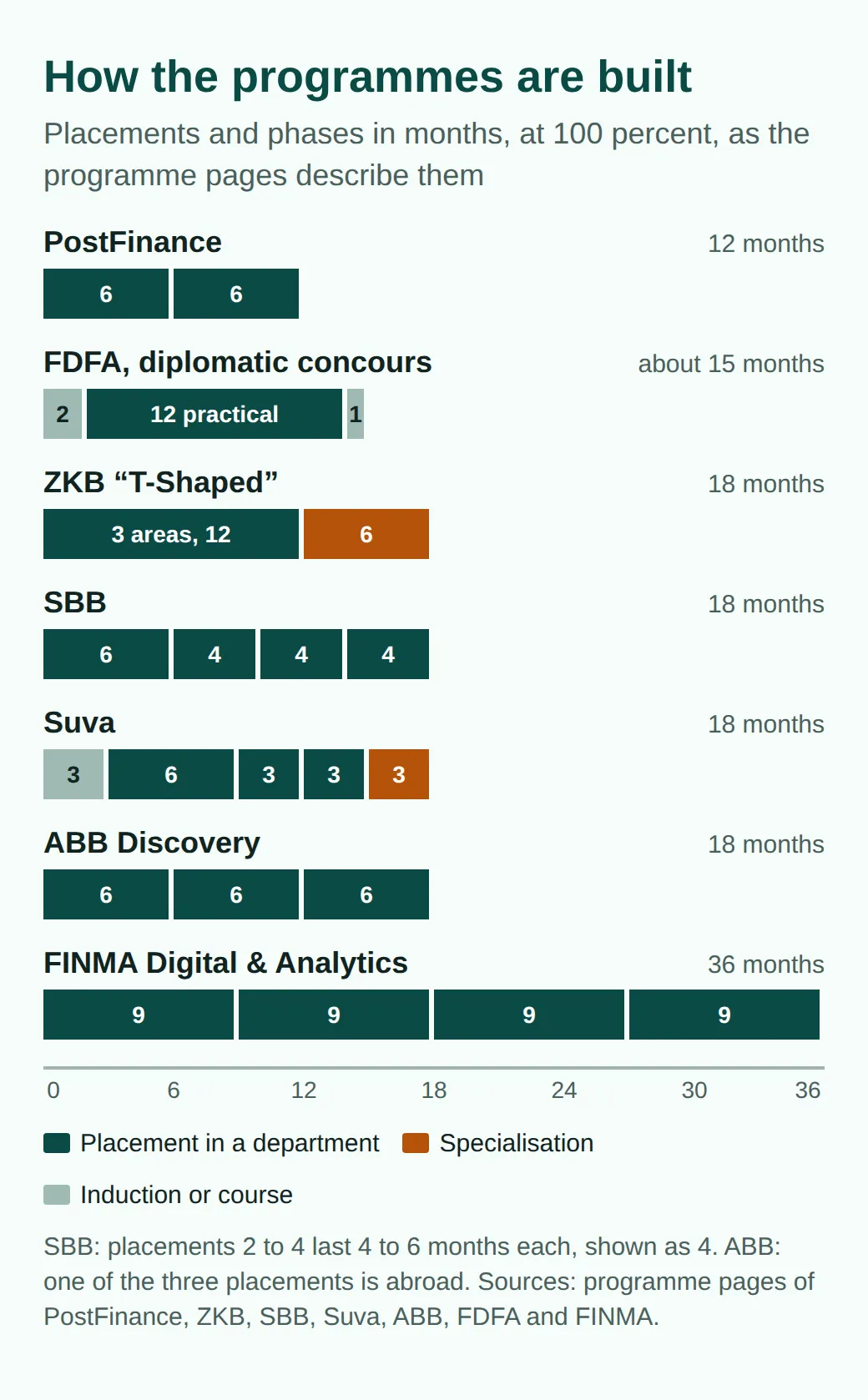
PostFinance also lasts 12 months, split into two placements of six months each in Bern. From the second month, you can spend up to 20 percent of your time on projects in other departments. Programmes start in March and September, and the application windows are short: for the March 2027 start, it ran from 5 to 11 October 2026, and the selection day takes place on 4 November 2026 in Bern. For the September 2027 start, you apply in March 2027. You need a master's degree completed no more than two years before the programme starts, or you must be studying for one.
Zürcher Kantonalbank has two routes. In the “T-Shaped” programme, you spend the first twelve months in three areas of your choice, such as private or corporate clients, IT, capital markets, communications or HR, and then specialise for six months in one of them (ZKB). Positions are advertised in autumn and spring. In the “Focus Institutionals & Multinationals” programme, you specialise from the start, for example in trading, asset management or research. Positions there are advertised on an ongoing basis as needed, and the start date depends on the vacancy (ZKB Focus).
UBS does things differently. The bank's Graduate Talent Program lasts 18 to 24 months, you can apply all year round, and each position is first online for four weeks (UBS). Because applications are reviewed as they come in, it pays to be early. The conditions are clear: a degree within the last 24 months, no more than two years of full-time experience and at least a 4.5 on the Swiss grading scale. You don't need a finance degree. The insurers are often more open on their pages.
Insurers: 12 to 18 months, a clear process
The insurers give the most precise details on the process, and two of them also give the salary. Mobiliar describes its process step by step: online application in mid-March, a reply within three weeks, an online interview with your future supervisor between late March and early April, an application event in mid-April and a decision within a week of that. Both programmes start in September, at 80 to 100 percent. In Deep Dive you change department after six or nine months, with options including Data, Analytics & AI, actuarial services, asset management and the legal protection insurance subsidiary Protekta. In Discovery you get to know two areas, such as controlling, marketing or internal audit (Mobiliar Discovery).
Baloise pays CHF 80,000 for 16 months with four placements of your choice, one of them abroad (Baloise). In return, the insurer asks for a master's degree, good grades and German, French and English. The start date is flexible. Baloise and Helvetia now belong to the same group, but Helvetia still runs its own programme: 18 months with three or four modules in one field, no work experience needed (Helvetia).
Zurich opens its application phase every year in mid-February, and you can only apply while the position is online (Zurich). The programme lasts 18 months at 80 to 100 percent. You need a bachelor's degree no more than two years old and German at C1 level. After the online application you hear back within two to three weeks, followed by a virtual interview with your future manager and an on-site interview, possibly with a case study.
Suva advertises its trainee positions between February and March, and the programme runs for 18 months from September to March (Suva). It asks for fluent German and good English or French. Helsana offers 12 to 18 months at its head office in Stettbach, for degrees no more than a year and a half old (Helsana). In October 2026 it had no trainee positions open, and the page points to a job alert. In industry, programmes are longer and often more technical.
Industry, rail and telecoms: longer, often abroad
SBB has the most thoroughly described programme. At 100 percent it lasts 18 months, longer if you work part-time. You do four rotations: the first lasts six months, the others four to six each. You can do the third at a subsidiary or partner company in Switzerland or abroad, and around 20 percent of your time is set aside for the accompanying training programme. According to SBB, your field of study matters less, but you need German at B2 level and a second national language at B2.
Swisscom is the strictest about your degree. Its programme is aimed at people with an above-average master's degree completed no more than 12 months ago (Swisscom). You pick your own projects on an internal marketplace. The next intake starts in November 2026, and Swisscom plans to publish information on the 2027 programme in spring 2027.
ABB hires trainees on its Discovery Trainee Program on a permanent, full-time contract from day one (ABB). Over 18 months you do three placements of six months each, one of them abroad. You need a master's in engineering or a related subject, no more than three years of work experience, very good English and at least a B permit. For graduates from abroad, that's a real hurdle. Which permit you get and when is explained in our post on internships for foreigners.
Siemens Switzerland offers two longer programmes: 30 months in its Digital Industries division and two years in Mobility's technical programme, covering rail signalling and rail automation (Siemens). Roche runs a two-year programme in production and engineering in Basel, Kaiseraugst and Penzberg in Germany, for master's degrees in science or engineering less than two years old (Roche). The page still lists the application period from 1 March 2026 as the next one and gives no date for 2027. Public administration looks quite different.
Are there trainee programmes in the public sector?
Hardly any, and the few there are set a high bar. For graduates starting out, the federal administration mainly offers university internships, more than 600 a year, paying CHF 4,500 a month after a master's (stelle.admin.ch). We didn't find a general trainee programme run by any cantonal administration. There are two exceptions close to the federal government.
The first is the concours for a diplomatic career at the Federal Department of Foreign Affairs FDFA (FDFA). If you pass, you start paid training in April that usually lasts 15 months: two months of theory in Zollikofen, twelve months of practical work abroad or in Switzerland, and one month of theory with a final assessment. The contract is fixed-term for the training, and the salary follows the federal pay scale and isn't negotiable. You need a bachelor's of at least 180 and a master's of at least 90 ECTS credits, and in the standard profile you can be no older than 30 in the year of selection. The 2026 window ran from 22 May to 16 June 2026, followed by tests, interviews and exams until the end of October, and the FDFA plans to announce its decision in early November 2026. It hasn't yet published the dates for 2027.
The second is FINMA. Its programme for Legal and Compliance Officers lasts three years in Bern and is aimed at lawyers admitted to the bar or holding a doctorate. The new Digital and Analytics programme also lasts three years, split into four placements of nine months each: asset management, banks, insurance risk management and FINMA's own IT, in Bern or Zurich. It's open to people with a master's in computer science, data science, mathematics, physics or a similar subject. FINMA doesn't publish application deadlines. For most other programmes, though, everything hinges on the right month.
When to apply for a 2027 start
For a start in autumn 2027, most windows open between February and May 2027. The first has already passed: PostFinance took applications for March 2027 from 5 to 11 October 2026.
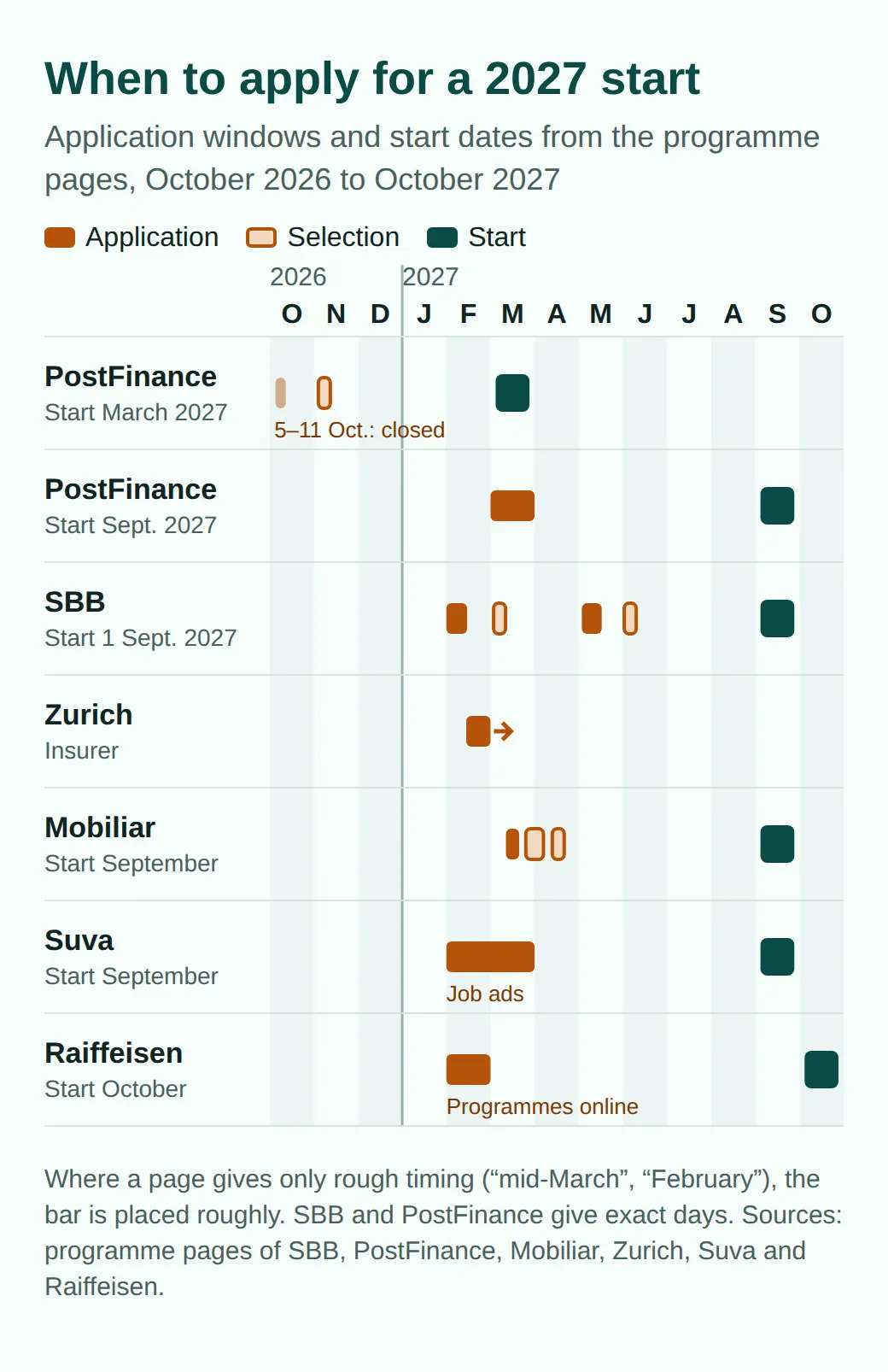
February is the busiest month. Raiffeisen Switzerland publishes its new specialisms for the October start, Suva advertises between February and March, Zurich opens in mid-February and SBB takes applications from 1 to 14 February. March brings Mobiliar, with its online application in mid-March, and PostFinance for the September start. SBB holds its Talent Days online on 3 and 4 March and on 2 and 3 June 2027. If you don't make it in February, SBB has a second window from 3 to 16 May.
UBS and ZKB's Focus programme work without a fixed window and advertise all year. For them, the advice is simple: set up a job alert and act as soon as a suitable position appears. For all the others, make a list of the dates in January. A two-week window is easy to miss when you're in the middle of exams. Whether you fit a window at all, though, depends mainly on when you graduated.
How recent does your degree have to be?
At most programmes, no more than two years, and at some much less. This limit is the most important number for your planning, because it decides which intakes you can still apply for.
| Employer | Degree no older than | Which degree |
|---|---|---|
| Swisscom | 12 months | Master's, above average |
| Helsana | 18 months | Bachelor's or master's |
| Raiffeisen Switzerland | 18 months | Bachelor's or master's |
| UBS | 24 months | Completed degree |
| SBB | 24 months | Bachelor's or master's |
| PostFinance | 2 years at programme start | Master's |
| Zurich | 2 years | Bachelor's |
| Roche | under 2 years | Master's |
An example: if you finish your master's in February 2027, you qualify at SBB for the September 2027 start and still for the one in September 2028. At Swisscom, a degree from February 2027 is already too old by spring 2028. Many companies will also take you shortly before you graduate: Mobiliar, Suva and Helsana say so explicitly, while at SBB your studies must be finished by the start of the programme at the latest.
If you plan early, you'll apply in your final semester. That lines up with the windows in February and March, about six months before a September start. After that, the selection process decides, and it varies a lot from company to company.
How selection works
Most companies work in several stages, and you don't always need a cover letter. SBB expressly doesn't ask for one (SBB). After a pre-selection, you're invited to a video interview, which you have to record within four days. Then come two online Talent Days, and by the following week at the latest you'll know whether it's a match.
At Mobiliar, Zurich and PostFinance, meeting in person is at the heart of it: an application event, an on-site interview with a possible case study, or a selection day in Bern. The FDFA takes longest, with tests, a political analysis, language exams and oral subject exams spread over several months. Where a letter is required, the effort pays off, and you'll find tips in our post on the cover letter.
Check each company's rules of the game too. At UBS, no more than three applications per academic year count across all areas combined, and at PostFinance only one trainee position per window. If you click apply on everything, you use up your chances at the company you're actually interested in.
Before you apply
Start with your graduation date and cross off every programme you no longer qualify for. Then check the languages: Raiffeisen, PostFinance and Zurich require German at C1, SBB German and a second national language at B2, Baloise German, French and English. Whatever's left goes into your calendar with its dates, with February 2027 as the key month.
The figures in this post help you compare offers. Ask about the annual salary, the number of monthly instalments and whether the contract is fixed-term. A programme with CHF 80,000, a GA travelcard and a retention rate of over 90 percent is a different thing from one with no salary figure and no commitment for afterwards. You'll find open entry-level jobs and internships on our pages by field, for example in finance and accounting.
Common questions
- Can I do a trainee programme part-time?
- At some companies, yes. SBB lets you choose between 60 and 100 percent, and at 60 to 80 percent the programme takes 24 months instead of 18. Mobiliar, PostFinance and Zurich give 80 to 100 percent, Raiffeisen Switzerland only 100 percent. If the programme page says nothing, ask before you apply.
- Do you get a permanent job after a trainee programme?
- That depends on the contract. At ZKB and ABB the job is permanent from day one. SBB says it keeps on more than 90 percent of its trainees, and Mobiliar aims to keep as many as possible. At the FDFA you're on a fixed-term contract during the training, and a permanent post is decided afterwards.
- Do I need work experience for a graduate trainee programme?
- Usually what you gained during your studies is enough. PostFinance asks for some first practical experience from internships or part-time jobs, and Helvetia says no work experience is needed. There are upper limits too: UBS accepts at most two years of full-time experience, ABB at most three.
- Where do trainees work, and can they work from home?
- Mostly at head office: PostFinance in Bern, Mobiliar in Bern or Nyon, Raiffeisen Switzerland in St. Gallen or at Zurich Airport. PostFinance says one or two days a week from home are usual, but you have to work from Switzerland. At Helvetia, at least half your working time is meant to be flexible in where and when you work. ABB and Baloise send you abroad for one placement.
- What can I do if I missed the application deadline?
- First check whether there's a second date. SBB has two application windows a year and PostFinance two starts, while UBS and ZKB's Focus programme advertise all year. Otherwise, set up a job alert, as Helsana and ZKB offer, so you don't miss the next window.
More posts
All posts
Swiss internship pay: minimum wage, holidays and rights
Internship salary in Switzerland: when you're owed pay, where the minimum wage covers interns, what SECO and associations pay, plus holidays and insurance.

Student health insurance in Switzerland 2027: what you pay
Swiss health insurance for students and apprentices in 2027: what you pay at 19 to 25, which deductible fits, premium reductions and the 30 November deadline.

Gap year after the Swiss Matura: options and money in 2027
Gap year after the Matura: internship, language stay, recruit school or civilian service. What you earn and when your parents lose the education allowance.