Student health insurance in Switzerland 2027: what you pay

First things first
Young adults aged 19 to 25 pay an average of CHF 338.80 a month for basic health insurance in 2027, 4.8% more than in 2026. With a CHF 2,500 deductible and the cheapest model, prices start at CHF 218.95 in the ten cities we checked. You can switch if your cancellation reaches your insurer by Monday, 30 November 2026.
This applies equally to university students, apprentices and interns, because your premium depends on your year of birth, not on your education. Your education does count in two other places: for the premium reduction your canton pays, and for the hospital contribution you don't have to pay. We use figures from the Federal Office of Public Health (FOPH) and with our own queries in the official premium calculator. We also show which deductible suits a small budget, how premium reductions work in Zurich, Bern and Aargau, and what happens at 26. The federal premium site and the cantonal offices publish in German, French and Italian only, so most of the official pages we link are in German.
How much does health insurance cost for students in 2027?
As a young adult, you pay an average of CHF 338.80 a month in 2027, CHF 15.40 more than in 2026. That's according to the federal press release of 29 September 2026. Adults pay CHF 487.60 on average, children CHF 128.10. The average premium is the sum of all premiums in the group divided by the number of insured people, so it's an average across all places of residence, insurers, deductibles and models. Your own premium can be well above or below it.
Insurers use only three age groups: children up to 18, young adults from 19 to 25 and adults from 26. What counts is your year of birth, not your birthday (Health Insurance Ordinance, KVV art. 91). In 2027, that means people born from 2002 to 2008. If you were born in 2001, you pay the adult premium from January.
To see how big the differences are, we ran the FOPH premium calculator for someone born in 2005 in ten cities, with accident cover and across all models. With the standard deductible of CHF 300, the cheapest offer ranges from CHF 347.25 in Chur to CHF 448.20 in Geneva. With a CHF 2,500 deductible, it's CHF 218.95 to CHF 319.90. In the city of Zurich, 27 insurers offer 128 variants between them. With a CHF 300 deductible, they range from CHF 379.75 to CHF 596.25 a month, for exactly the same benefits. Basic insurance pays out the same at every insurer; only the price differs.
The amounts are what the insurer bills you: the premium minus a small credit, CHF 4.75 a month in Zurich. It's made up of an environmental levy refund and a payment from a reduction of insurers' reserves. Your costs rise most on one day: 1 January of the year you turn 26.
The jump at 26
At 26, you move into the adult group, and your premium rises in one go. On average, it's CHF 148.80 a month, the difference between the two FOPH averages. For the cheapest offers in our ten cities, the increase ranges from CHF 121.20 in Lucerne to CHF 186.40 in Lugano.
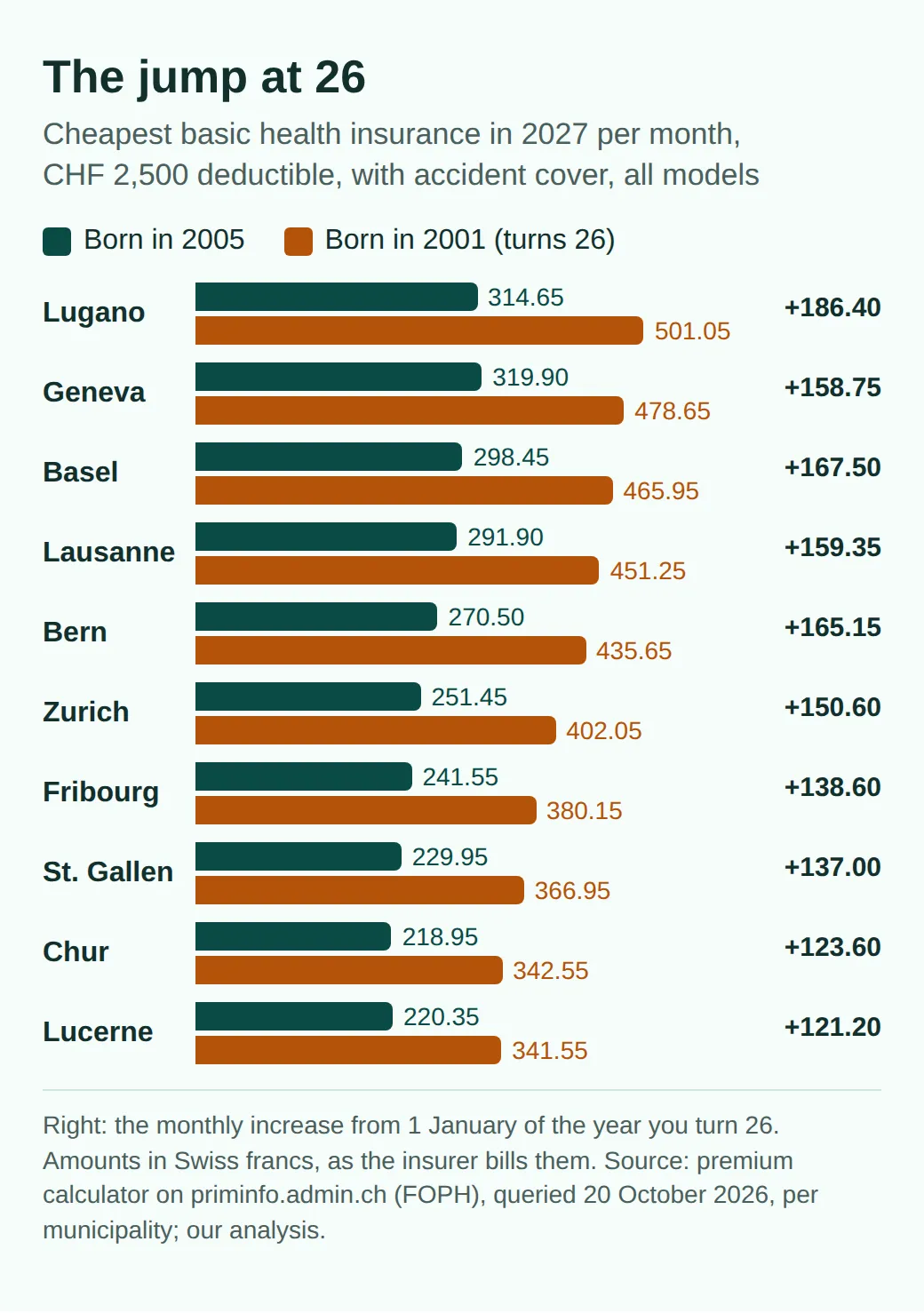
Over a year, that's just over CHF 1,800 more in Zurich, even if you already have the cheapest offer. The jump doesn't come on your birthday but always on 1 January. If you were born in 2001, it comes in 2027, even if your birthday isn't until December. This is the autumn when comparing pays off most, because the ranking of the cheapest insurers for adults isn't the same as for young adults.
You lose something else at 26. If you stay in hospital, you normally pay CHF 15 a day towards the costs. Young adults in education are exempt (KVV art. 104), but adults aren't. If you want to bring your premium down then, you end up with the same question as everyone else: which deductible?
Which deductible suits a small income?
The deductible, called the franchise in Switzerland, is the amount you pay yourself each year before your insurer steps in. After that, you pay 10% of the costs, up to CHF 700 a year (KVV art. 103). The standard deductible is CHF 300. You can choose CHF 500, 1,000, 1,500, 2,000 or 2,500 and pay a lower premium in return (KVV art. 93).
How much lower is capped. The discount may be at most 70% of the extra risk you take on. With a CHF 2,500 deductible, that's at most CHF 1,540 a year (Priminfo, saving). For young adults in Zurich, 93 of the 128 offers give this full discount, which is CHF 128.30 less a month.
That lets you do the sums. With a CHF 2,500 deductible, you save CHF 1,540 in premiums but pay up to CHF 2,200 more out of pocket. The two options cost the same if your medical bills come to around CHF 2,010 a year. Below that, the high deductible wins; above it, the low one. In the worst case, with very high costs, you pay CHF 660 more with a CHF 2,500 deductible than with CHF 300. With the full discount, a deductible in between is never the cheapest by this calculation: depending on your costs, either 300 or 2,500 wins.
On a tight budget, though, it's not just the average that matters but also the bad month. According to Priminfo, the high deductible pays off if you're healthy, rarely see a doctor and have enough money in your account in case you do need to. So you need to be able to pay a CHF 2,500 bill without falling behind on rent. If you don't have that cushion, or you're in regular treatment, CHF 300 is the safe choice. You can't insure the deductible, by the way; the law forbids it (Health Insurance Act, KVG art. 64).
The deductible has deadlines too. You can only move to a higher one from 1 January, and to a lower one only with the same notice periods as for a change of insurer (KVV art. 94). In both cases, the FOPH advises telling your insurer by 15 November. Choosing an insurance model saves less, but carries no risk.
Family doctor, telemedicine or pharmacy: the cheaper model
In an alternative model, you agree to go to a set first point of contact whenever you have a health question, and you pay less for it. For 2027, Priminfo sorts the models into four new groups: PRAXIS (a fixed doctor's practice first), TEL_DIG (by phone or app first), PHARM (a partner pharmacy first) and FLEX (you choose between several first points of contact). The benefits stay the same.
In Zurich, for someone born in 2005, the cheapest basic insurance with free choice of doctor and a CHF 300 deductible costs CHF 413.70, and the cheapest model CHF 379.75. That's CHF 33.95 a month. With a CHF 2,500 deductible, the gap is exactly the same. If you commute between your university town and your parents' home, a phone or app model usually suits you better than a fixed practice. A family doctor model is worth it if the practice is where you spend most of your time.
The switching rules differ here. From the standard model, you can move into a model at any time, even during the year. From one model to another, or to a different insurer, you can only switch on 1 January (KVV art. 100).
A third lever is for apprentices and interns. If you work at least eight hours a week for the same employer, your employer's accident insurance covers you for accidents at work and outside work. Send your insurer a confirmation from your employer, and it will remove accident cover and lower your premium. When this applies, and what happens when the job ends, is covered in our post on student jobs. If you only study, you need accident cover in your health insurance. That leaves the money your canton can pay you.
Premium reductions: whose income counts?
Cantons must reduce the premiums of young adults in education on low and middle incomes by at least 50% (KVG art. 65). What counts as a low income, and how you get the money, is up to each canton. The money goes straight to your insurer and is deducted from your bills.
If you earn next to nothing, you'll be counting on the reduction. In Zurich, Bern and Aargau, though, your parents usually count too, even if you're over 18 and no longer live with them. SVA Zürich, the canton's social insurance office, says so on its website so plainly that we show it here:
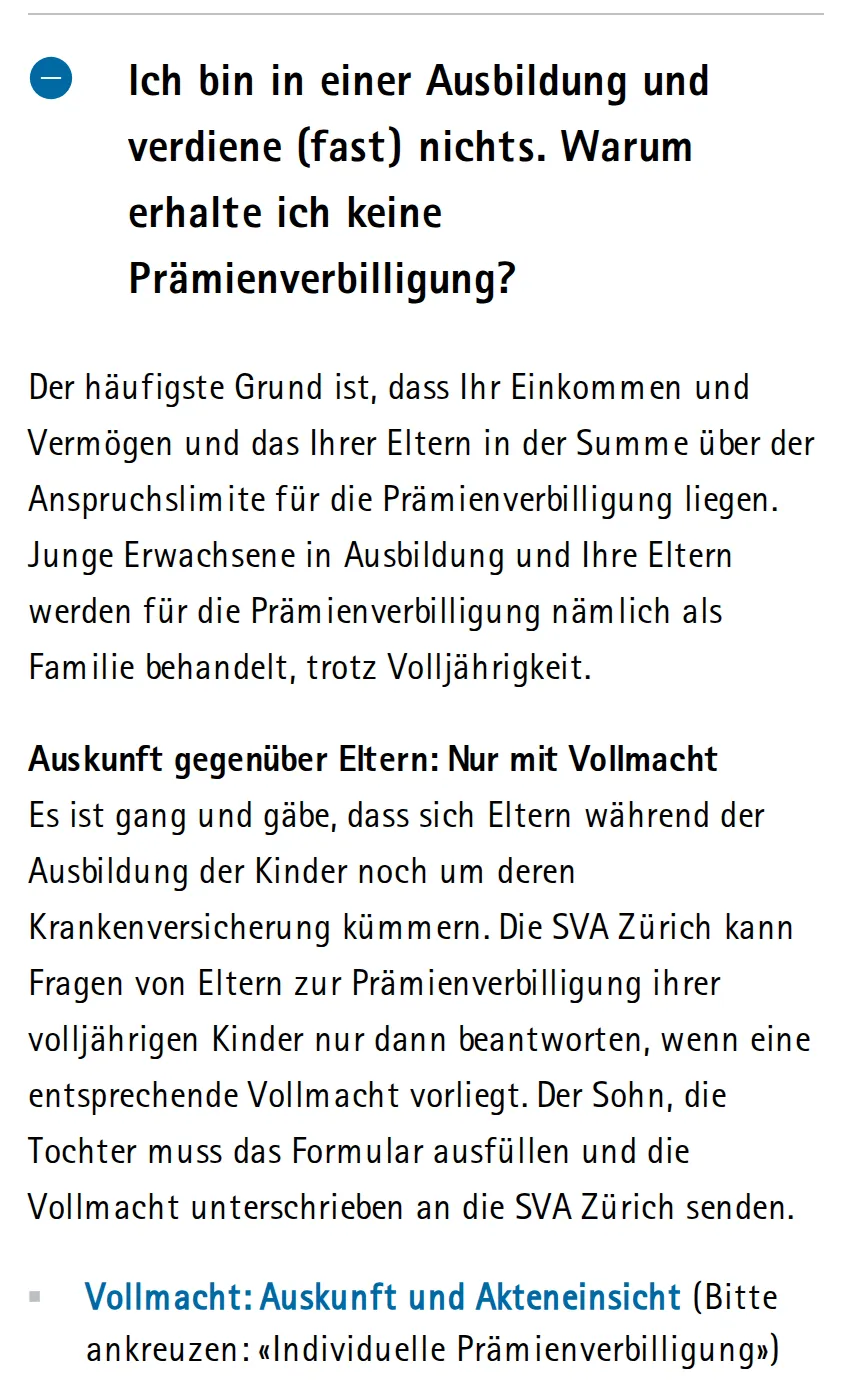
Here's how it works in three large cantons. You'll find the office for your canton in the FOPH list. In Zurich and Bern, the canton responsible is the one you live in on 1 January.
Zurich: your parents count, apply by 31 March 2028
If you were born between 2002 and 2008 and are in education or further training, SVA Zürich includes your parents' tax figures (customer information 2027). You're only exempt from this if you're married or have children of your own. If you were born in 2008 or later, you get your own application form, even if you live with your parents. You can submit your application for 2027 until 31 March 2028.
SVA first pays 80% provisionally, usually based on the 2024 tax data. The final calculation is only made with the final 2027 tax data, and you have to pay back anything you were overpaid. If you finish your education, drop out or interrupt it for more than three months, you must report it. That includes a gap year after the Matura. SVA only answers your parents' questions if you give them a power of attorney (FAQ).
Bern: automatic, together with your parents
In the canton of Bern, between 18 and 25 your entitlement is generally calculated automatically together with your parents, whether or not you still live with them (Amt für Sozialversicherungen, the canton's social insurance office). You only need to apply in two cases. First, if you're single, your adjusted net income is under CHF 14,000 (about CHF 21,000 net income a year, according to the canton) and your parents live in another canton or abroad. Second, if you're in education, your adjusted net income is over CHF 14,000 and you want the higher reduction of 50% of the average premium. The application must arrive within the current year, so for 2027 by 31 December 2027 (application).
Aargau: register by 31 December 2026
Aargau has the earliest deadline. For the 2027 reduction, you register with a registration code by 31 December 2026. After the deadline, SVA Aargau can't accept registrations for legal reasons, as its note on the 2026 deadline says (SVA Aargau). For young adults with a taxable income under CHF 24,000, the law assumes that their parents support them. Your parents then have to register, with their income and assets. You can contest this assumption, but you need evidence to back that up (calculation). The reference premium the calculation starts from is exactly CHF 4,440 for young adults in 2027, or CHF 370 a month.
Premium reductions and a change of insurer don't get in each other's way, by the way. In Zurich and Aargau, the switch is reported to the office automatically, and you don't have to do anything. That leaves the switch itself.
How to cancel your health insurance in time for 30 November
Your cancellation must reach your insurer by 30 November; the postmark doesn't count. Your right to cancel comes from KVG art. 7: when your insurer announces a new premium, you can leave at the end of December with one month's notice. Your insurer must send you the new premium at least two months in advance, so by 31 October.
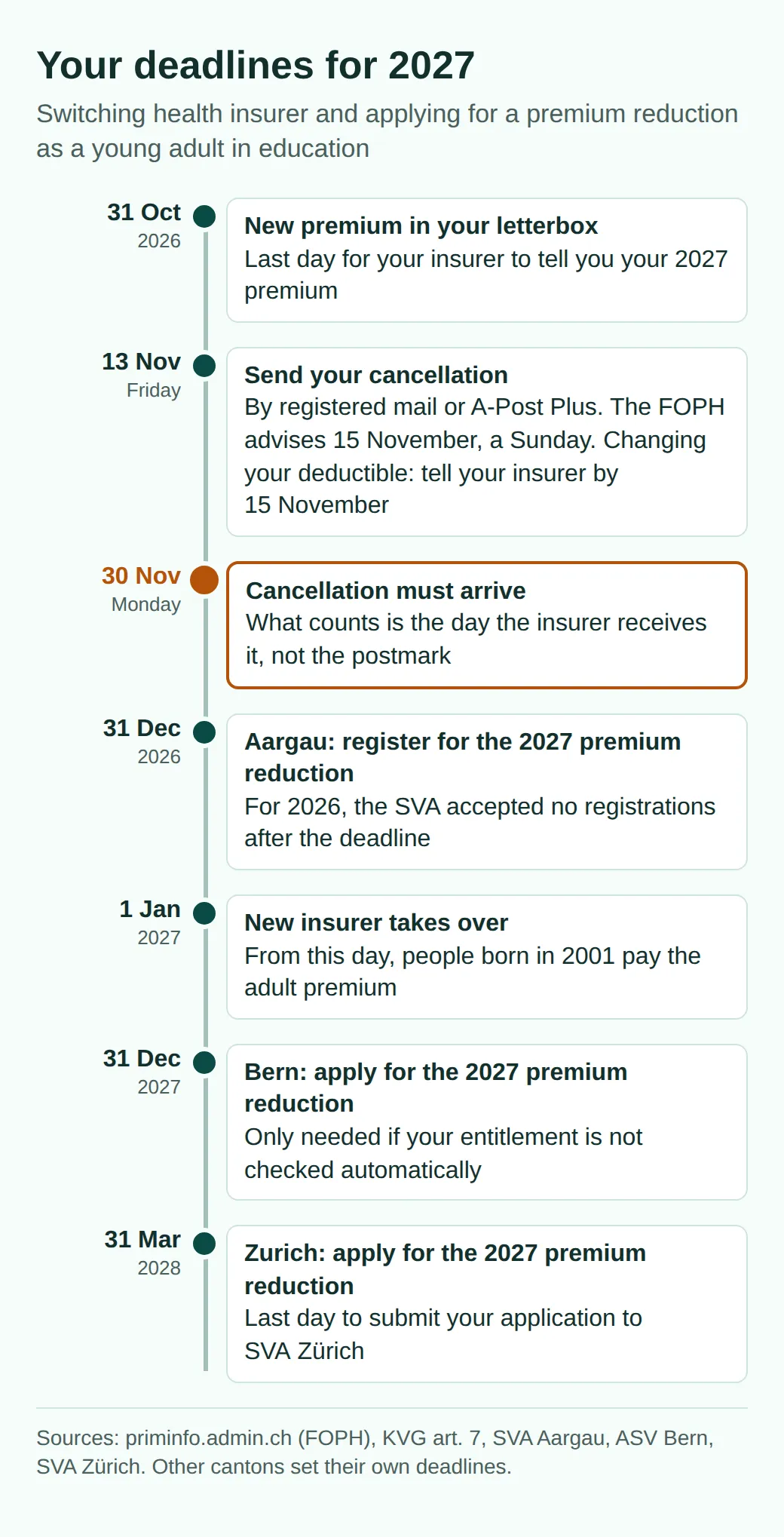
The order matters. First sign up with the new insurer, which you can also do online. Every insurer must accept you for basic insurance, with no health questions. Then cancel the old one. You won't be left without cover: your old insurance only ends once the new insurer has told it that you're insured without a break. The FOPH recommends sending your cancellation by 15 November, by registered mail or A-Post Plus (Priminfo). 15 November 2026 is a Sunday, so plan for the Friday before. A few sentences are enough. The FOPH sample letters come in German, French and Italian, so write in your insurer's language. In German, it can look like this:
Kündigung der obligatorischen Krankenpflegeversicherung. Sehr geehrte Damen und Herren, ich kündige meine Grundversicherung nach KVG auf den 31. Dezember 2026. Meine neue Krankenkasse meldet die lückenlose Weiterversicherung direkt. Meine Zusatzversicherungen laufen weiter. Ich bitte um eine schriftliche Bestätigung des Austritts. Freundliche Grüsse, Vorname Name, Adresse, Versichertennummer, Unterschrift
In English, it says: you cancel your basic insurance under the KVG as of 31 December 2026, your new insurer will confirm the uninterrupted cover directly, your supplementary insurance continues, and you ask for written confirmation. It ends with your first name and surname, address, insurance number and signature.
Two things can block the switch. If you have unpaid bills with your insurer for which you received a reminder by 30 November, and they're still unpaid on 31 December, you can't switch. So pay everything first. And supplementary insurance has its own deadlines, set out in your contract. Your old insurer can't make you cancel it along with your basic insurance. That's why the sample above says your supplementary insurance continues.
Your checklist before the end of November
Open the letter with your 2027 premium as soon as it arrives, then go through these steps:
- Check your year of birth. If you were born in 2001, expect the adult premium from January.
- Compare in the premium calculator for where you live, with or without accident cover, depending on whether you work eight hours a week for the same employer.
- Only choose the CHF 2,500 deductible if you could pay a bill of that size. Otherwise, choose 300.
- Sign up with the new insurer and send your cancellation by registered mail by 13 November.
- Agree with your parents on who applies for the premium reduction, and note your canton's deadline.
Your internship pay plays a part in both accident cover and premium reductions. Our post on internship pay and rights shows what you're entitled to.
Common questions
- Can I stay on my parents' health insurance as a student in Switzerland?
- No. In basic health insurance, everyone living in Switzerland has their own policy, and there is no family cover. Your parents may pay the bills for you, but the insurance is in your name. For premium reductions, though, Zurich, Bern and Aargau often count your parents' income as well.
- What happens if my health insurance cancellation arrives after 30 November?
- Then you stay with your current insurer for 2027, at the new premium. With the standard model and the CHF 300 deductible, you can switch at the end of June with three months' notice, so your letter must arrive by the end of March. With a higher deductible or in a family doctor, telemedicine or similar model, you can only change insurer at the end of a calendar year.
- Do international students need Swiss health insurance?
- In principle yes, as soon as you live here. If you are in Switzerland to study, though, you can apply to your canton for an exemption, provided your own insurance gives equivalent cover for treatment in Switzerland. The exemption lasts at most three years and can be extended by at most three more. You can't reverse it without a special reason.
- Does a gap year change my health insurance?
- Not the premium, because whether you are in education makes no difference to it. It does matter for premium reductions: in the canton of Zurich, you must report it if you interrupt your education for more than three months. And the exemption from the CHF 15 a day hospital contribution only applies to young adults in education.
More posts
All posts
Gap year after the Swiss Matura: options and money in 2027
Gap year after the Matura: internship, language stay, recruit school or civilian service. What you earn and when your parents lose the education allowance.

Swiss trainee programmes 2027: pay, length, deadlines
Graduate trainee programmes in Switzerland compared: what SBB, Mobiliar, PostFinance, Baloise and FINMA pay, how long they last and when to apply.

Student jobs in Switzerland 2026: hours, AHV and tax
How many hours you can work as a student in Switzerland, including on a B permit, and the pay limits that trigger AHV, tax, insurance and family allowances.