Daycare (Kita) internship in Switzerland: pay, length, rules

The short answer
You don't need an internship for the apprenticeship as a social care worker (Fachfrau or Fachmann Betreuung, FaBe) in childcare, because the apprenticeship can start straight after school. Many daycare centres (Kitas) still ask for one, often a full year for CHF 800 a month at most. Bern, Lucerne and Vaud allow only six months at low intern pay unless you've been promised an apprenticeship.
The daycare internship is not part of the training but a detour before it. That's why no specific law covers it, only a patchwork of cantonal rules, recommendations from associations and government replies to questions from cantonal parliaments. We've read these documents and analysed the latest figures from SAVOIRSOCIAL, the umbrella organisation for vocational training in the social sector, and show you canton by canton what applies, what an internship pays and how to keep it as short as possible. The documents we link are in German, or in French for Vaud; none of them is published in English.
Do you need an internship for the FaBe apprenticeship?
No. Like every apprenticeship leading to a Federal VET Diploma (EFZ), the FaBe apprenticeship can start right after compulsory school. SAVOIRSOCIAL says so clearly, and its goal has been the same since 2017: nobody should have to do an internship to start the apprenticeship (2025 survey report). The Basel-Landschaft government also wrote back in 2018 that the Federal Act on Vocational and Professional Education and Training makes no provision for internships before an apprenticeship (reply to the Landrat).
In practice things look different, but they are improving. Every year SAVOIRSOCIAL surveys first-year FaBe apprentices; in 2025, 3,196 responded, around 64 percent. Just under a third of them had done at least one internship before the apprenticeship. In 2020 it was almost half.
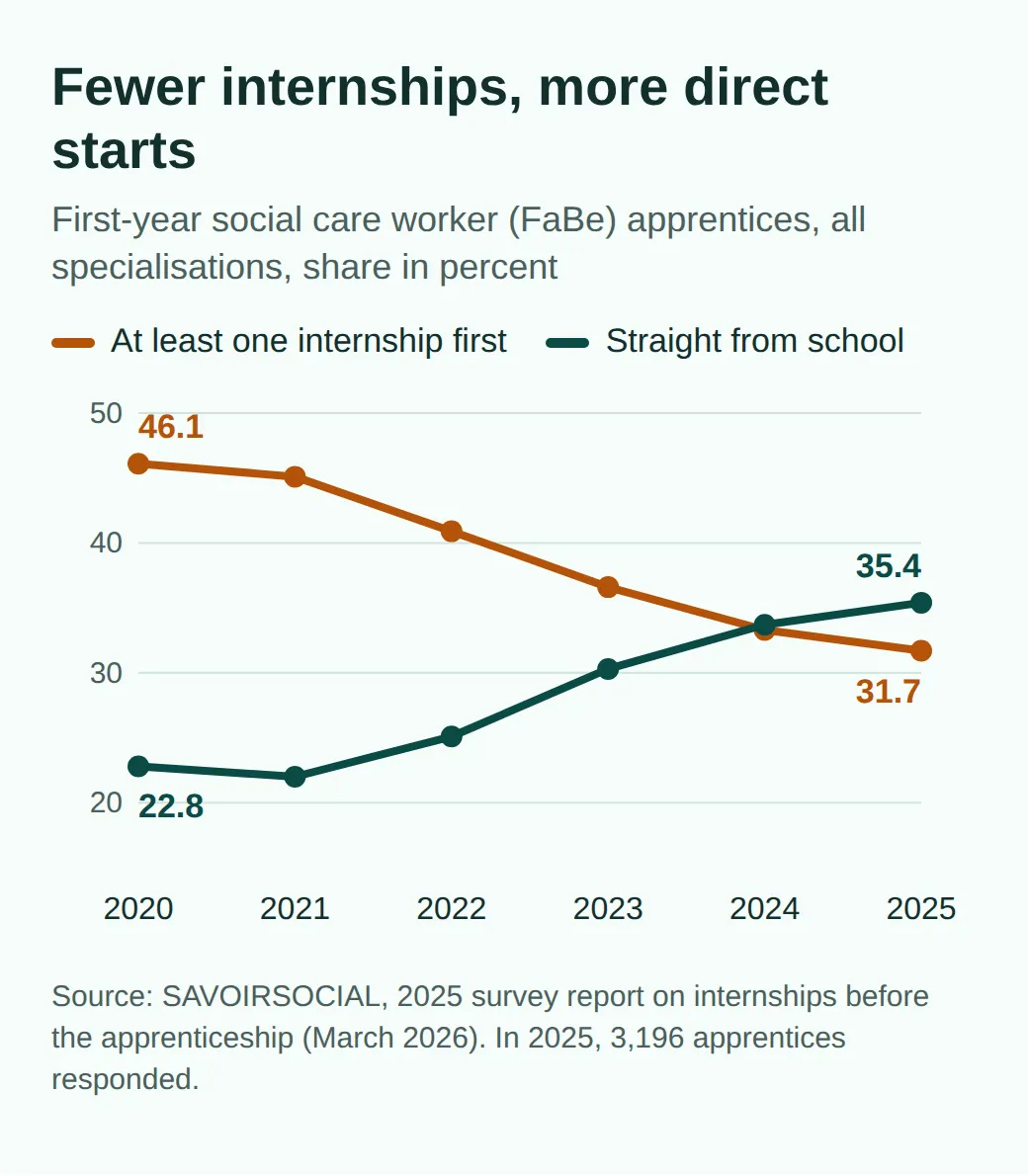
Childcare is where the issue lies. Almost four in five respondents train in the childcare specialisation. Among childcare apprentices in German-speaking Switzerland, 32.6 percent had done an internship first; in French-speaking Switzerland it was 44.5 percent, and in Ticino almost nobody. 65 percent of former interns in this specialisation gave a reason that lay with the daycare centre: it wanted to test whether they were suited to the job, thought they were too young or wanted to see whether they fitted into the team. Only a quarter did the internship because they wanted to. 83 percent then do the apprenticeship at the same centre, and half of these apprentices' internships lasted exactly twelve months.
SAVOIRSOCIAL names a likely reason for the trend: since the new FaBe training ordinance of 2021, a centre may take on more apprentices per qualified professional. Daycare centres can therefore offer more apprenticeships instead of internship places, and among childcare apprentices in the three-year apprenticeship, direct entry rose from 23 percent in 2020 to 38 percent in 2025. Across all EFZ occupations, though, half start straight after school. So the hurdle has shrunk, but it hasn't disappeared.
Where the often-quoted 84 percent comes from
If you search for daycare internships, you'll often read that 84 percent of FaBe apprentices did an internship first. The figure comes from SAVOIRSOCIAL's very first survey in autumn 2017 (2017 results report). It counts all 2,362 of the 2,809 respondents who answered a question about how long an internship lasted, including internships done as part of a 10th school year. Back then only one person in ten started the apprenticeship straight after school, and 57 percent of internships lasted a year. SAVOIRSOCIAL itself now puts the 2017 figure at "more than 50 percent" with an internship. So the 84 percent describes a situation that no longer exists. Pay, on the other hand, has barely moved.
How much does a daycare internship pay?
Usually CHF 800 a month at most for a full-time position. There is no Swiss-wide minimum wage for daycare internships. SAVOIRSOCIAL asked childcare apprentices in the three-year apprenticeship what they were paid in their earlier internship:
| Pay per month, full time | Share |
|---|---|
| up to CHF 400 | 5.3% |
| CHF 401 to 600 | 20.7% |
| CHF 601 to 800 | 47.2% |
| CHF 801 to 1,000 | 23.1% |
| more than CHF 1,000 | 3.8% |
So just over seven in ten earned CHF 800 at most. Pay above CHF 800 was more common in German-speaking Switzerland than in French-speaking Switzerland, where the report says it is very rare.
Cantons such as Basel-Landschaft and Zurich use the recommendation of kibesuisse, the Swiss childcare association, as a benchmark. In 2018 the Basel-Landschaft government gave it as CHF 800 to 950, paid 13 times, for a full-time pre-vocational internship. For someone with an EFZ in another occupation, the association recommended CHF 1,200. The "13 times" matters: at CHF 800, that's CHF 10,400 a year. So always ask whether there is a 13th-month salary. In its May 2026 newsletter, kibesuisse announced a thorough revision of its pay and employment recommendations. As of October 2026, it had not published new figures.
Intern pay is only binding where a canton prescribes it. That leads straight to the question of how long an internship may last at all.
How long can a daycare internship last?
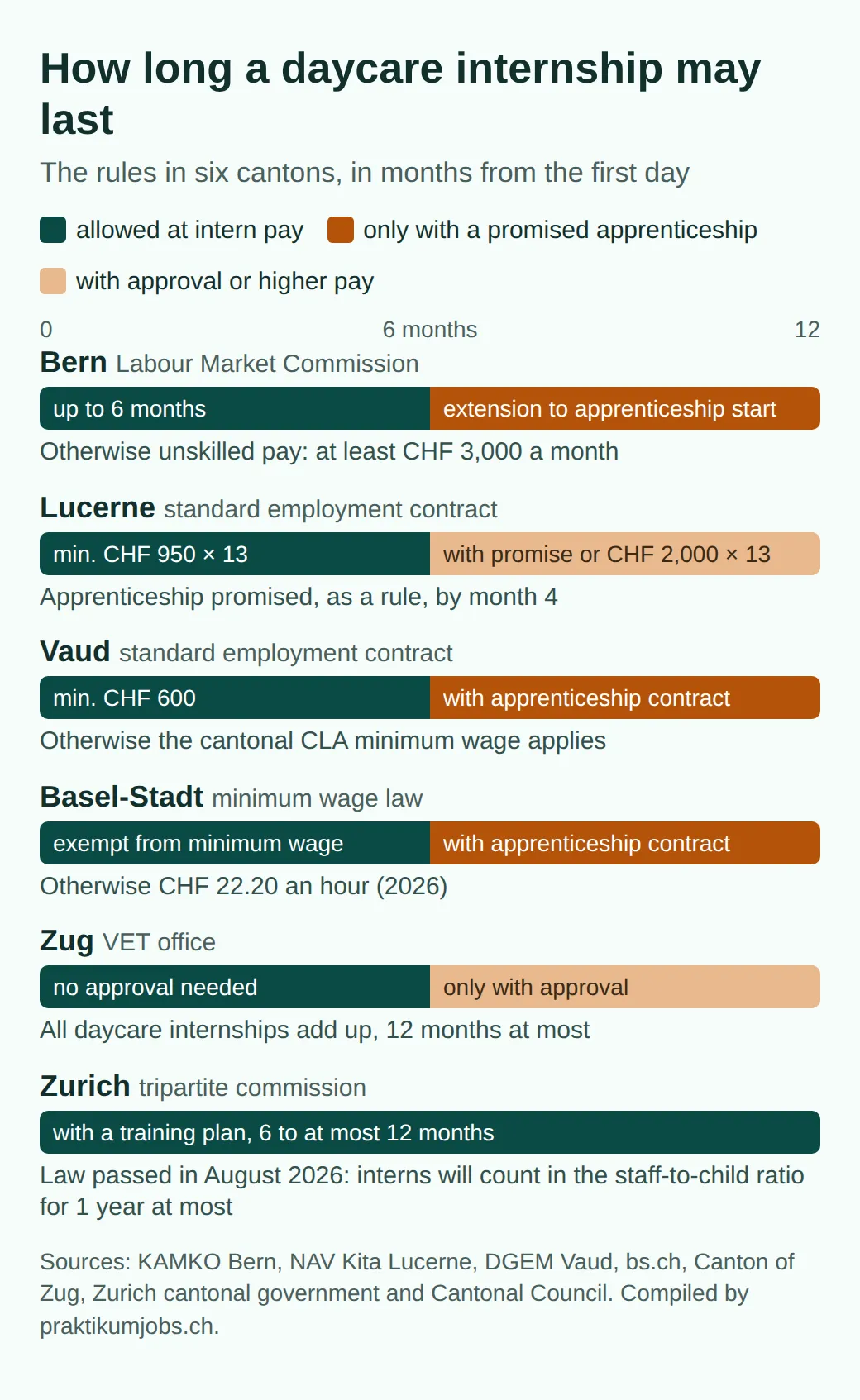
The Code of Obligations sets no limit, but several cantons do, following a common pattern: six months as an internship, after that only with a promised apprenticeship or at higher pay. The chart shows six cantons with their own rules.
Bern: six months, plus six with an apprenticeship
Bern has a clear limit. In February 2017 the cantonal Labour Market Commission (KAMKO) ruled that an introductory internship for FaBe childcare lasts six months at most (KAMKO factsheet). If the centre makes a binding promise of a training place, it may extend by up to six months until the apprenticeship starts. The limit applies per organisation: a daycare chain can't pass you from one location to the next.
If a centre doesn't comply, you count as an unskilled employee, with pay of at least CHF 3,000 a month for 42 hours, without a 13th-month salary. According to SAVOIRSOCIAL's overview, Bern also doesn't count interns as qualified staff in the staff-to-child ratio. When the education committee of the Zurich Cantonal Council asked Bern about its experience, the answer was that fewer internships had gone hand in hand with more apprenticeships.
Lucerne: minimum pay, a learning plan and taster days
Since 1 July 2024, Lucerne has regulated pre-apprenticeship internships in private daycare centres through a standard employment contract (NAV), a contract the canton issues for all employers in a sector (NAV Kita, no. 854b). It runs for three years, until the end of June 2027. The minimum pay is CHF 950 gross, paid 13 times, for a full-time position, and the centre can't go below that even with your signature. Meals at the daycare centre aren't part of it; they come on top as pay in kind.
A pre-apprenticeship internship may last six months. The centre may extend it to twelve months at most if it makes you a binding promise of an apprenticeship for the following year, as a rule by the fourth month at the latest. Without that promise, it must pay at least CHF 2,000, 13 times a year, from the seventh month. The NAV also names three rights explicitly: a learning plan with goals and supervision as part of the contract, five paid taster days for your career choice, and a copy of the NAV, which the centre must hand you.
Vaud: CHF 600 and one employer
Since 1 August 2023, Vaud has had a standard employment contract (contrat-type de travail) for internships in daycare centres and out-of-school care (letter from the DGEM). It requires at least CHF 600 gross a month for 40 hours, for the first six months. Once an apprenticeship contract is signed, the internship may continue on these terms until the apprenticeship starts, for at most six more months. Otherwise the minimum wage of the cantonal collective labour agreement for childcare applies. Only one employer may pay the CHF 600 for six months.
Basel-Stadt: minimum wage from the seventh month
Basel-Stadt draws the line through its minimum wage, which is CHF 22.20 an hour in 2026. Internships with a training character of up to six months are exempt from it (canton FAQ). Going up to twelve months is only possible if the signed apprenticeship contract is in place before the seventh month begins, and inspectors don't accept backdated contracts. How minimum wages in other cantons treat internships is covered in our article on internship pay and rights.
Zug: approval from the seventh month
Zug doesn't set a direct limit; it has the contracts checked. Since 1 January 2022, daycare centres must submit every contract for a pre-vocational internship to the Office for Vocational Education and Training if it lasts longer than six months (Canton of Zug).
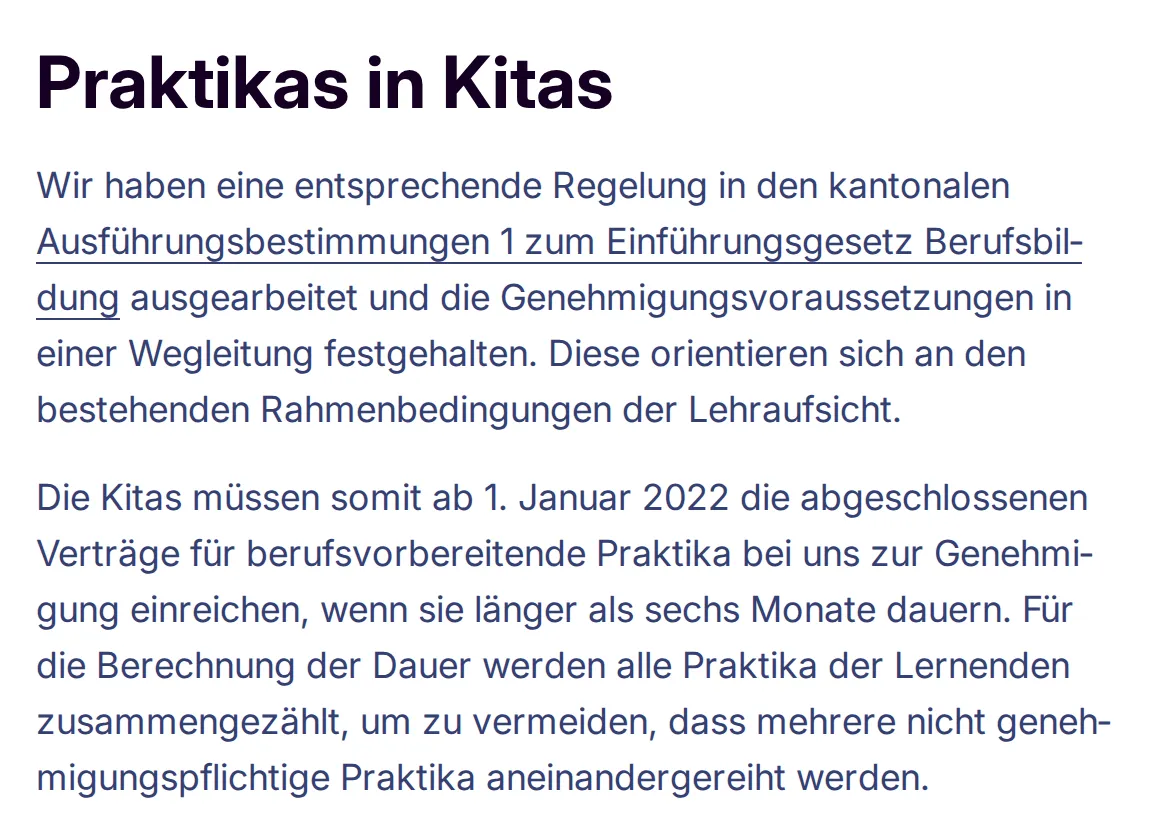
The decisive sentence comes at the end: all of one person's daycare internships are added together. So two internships of five months each at two centres don't get around the rule. According to the guidelines, approval is only granted if the centre is a licensed host company for apprentices, has a responsible vocational trainer, offers at least as many apprenticeships as internship places, and the internship lasts twelve months at most. The canton recommends at least CHF 750 a month. If you're under 18, your parents must agree to the contract.
Zurich: guidelines since 2016, a law in 2026
Zurich, the most populous canton, has had guidelines since September 2016 from the tripartite commission for labour market matters (TPK), made up of employers, unions and the canton. Under them, an introductory internship may last six to at most twelve months and must have a training character, which the centre shows with a training plan, for example (cantonal government reply, 2019). If either is missing, the position doesn't count as an internship, and the usual pay for employees is owed.
What the TPK found in daycare centres is above all a gap. Its standard pay of CHF 2,000 only applies where a sector has no recommendation of its own. For daycare centres, the TPK used kibesuisse's recommendation as the comparison: CHF 800 for 42 hours for school leavers. According to the cantonal government, the TPK keeps no statistics on its inspections, doesn't inform centres of its own accord, and, unlike minimum wages, can't legally enforce usual pay.
Change came through a different law. In future, interns will count towards a daycare centre's staff-to-child ratio (how many carers are present per child) for no more than one year of their total internship time. At the first reading on 22 June 2026, the Cantonal Council preferred this solution to excluding interns completely, by 118 votes to 54 (minutes of 22 June). In the final vote on 31 August 2026, it passed the amendment to the Child and Youth Welfare Act by 142 votes to 35 (minutes of 31 August). That should make a second internship hardly worthwhile for a daycare centre. The amendment is subject to an optional referendum (drafting committee proposal); as of October 2026 we found no date for it to take effect. During the debate, the head of the Education Directorate gave a figure that shows where things are heading: the share of interns in Zurich daycare centres has fallen from 17 to 11 percent since 2018.
The other cantons
In February 2026, SAVOIRSOCIAL compiled the rules of all cantons, noting that the list may not be complete. According to this overview, Obwalden and Nidwalden also apply the "six months, plus six with an apprenticeship contract" rule, Valais, like Zug, requires approval beyond six months, and Neuchâtel allows eight weeks, or up to twelve months with an apprenticeship contract. Schwyz, Uri, Basel-Landschaft and Fribourg recommend twelve months at most. If you're looking in one of these cantons, ask the cantonal vocational education and training office exactly what applies. The dispute behind the rules explains why there are so many different solutions.
What associations and unions want
Every side wants fewer internships; they disagree on how to get there and on the money. kibesuisse says it has supported the goal of reducing pre-apprenticeship internships and promoting direct entry into the apprenticeship for years (response on the Lucerne NAV). At the same time, the association wants cantons and municipalities to co-fund daycare centres so that doing without intern places becomes affordable. It opposed the Lucerne NAV in 2023, fearing that young people would be "put out on the street" after six months and replaced.
The unions go further. The public services union VPOD wants to abolish daycare internships altogether. Interns should no longer count in the staffing ratio, and only centres that plan without them should get licences and subsidies (VPOD Central Switzerland). Unia called for a ban back in 2018, telling Swiss public broadcaster SRF: "Such pre-apprenticeship internships must be banned." (SRF). Zurich shows how much the difference costs: according to the Education Directorate, the one-year limit raises daycare centres' costs by around 1 percent, while excluding interns completely would have cost around 4 percent. For you, this means the rules are getting tighter, but not everywhere at the same pace. That makes what's in your contract all the more important.
What to get in writing before your first day
Legally, a daycare internship is normally a fixed-term employment contract. So you're entitled to pay, holidays and accident insurance like any other employee. If you're under 18, the youth employment protection rules also apply: no more than nine hours of work a day, at least twelve hours of rest in a row, work until 8 pm if you're under 16 and until 10 pm from 16, and as a rule no night or Sunday work (SECO). In Basel-Landschaft, under the minimum standards of the cantonal supervisory authority, interns may also never be solely responsible for looking after the children, the government said in 2018.
Before you sign, the contract should state:
- start and end dates, so you can check your canton's six months
- the gross monthly pay and whether it's paid 12 or 13 times
- the weekly hours, holidays and probationary period
- a learning plan with goals and the name of your supervisor
- whether, and by when, the centre will promise you an apprenticeship
The last point matters most, and many people never ask about it. A short message after the interview is enough, written in the language the centre works in:
Hello, thank you very much for the offer. Before I accept, could you please send me the contract with the length, pay, learning goals and the name of my supervisor? I'd also like to know whether you can promise me an apprenticeship as a social care worker in childcare for summer 2027, and by when this will be decided. Kind regards
If the centre won't commit to anything, you know the internship is not a safe bridge.
How to keep the internship short
The shortest route is no internship at all. Apply directly for an apprenticeship first, even if a daycare centre mentions an internship in its job ad. Our timeline for an apprenticeship in 2027 explains when companies fill their apprenticeships and how to apply. SAVOIRSOCIAL's figures show that direct entry into the childcare specialisation now succeeds more often than in any year since 2020.
If you can't avoid an internship, choose one at a daycare centre that offers apprenticeships itself, and ask how many of its interns go on to start the apprenticeship there. Get the apprenticeship promised as early as possible; in Lucerne, the fourth month is the benchmark. Count your internship months across all daycare centres, because in Zug and under Zurich's new rule the whole time counts. And keep applying to other centres during the internship until you have a signed apprenticeship contract. Our guide to the motivation letter will help with your application. After six months without a promise, clearly higher pay is due in Bern, Lucerne, Vaud and Basel-Stadt. That's exactly why it pays to count the months.
Common questions
- Does an earlier internship at another daycare centre count?
- That depends on the canton. Zug adds up all pre-vocational internships in daycare centres, and Zurich's new law counts your total internship time. In Bern the six-month limit applies per organisation, in Vaud per employer. If you've already done an internship, say so openly at the interview and ask straight away about an apprenticeship.
- What happens if I'm not offered an apprenticeship after six months?
- In Bern the position then counts as ordinary employment, for which the cantonal Labour Market Commission sets pay of at least CHF 3,000 a month. In Lucerne the minimum rises to CHF 2,000 paid 13 times, and in Vaud the minimum wage of the cantonal collective labour agreement applies. In cantons without a rule, your main option is to keep applying directly to other daycare centres for an apprenticeship.
- Can I quit a daycare internship early?
- A fixed-term contract normally only ends on the agreed date. If your contract has a probationary period, you can give seven days' notice during it. In Lucerne the standard employment contract also lets both sides give one month's notice after the probationary period. Otherwise you can only leave if your contract allows notice or by mutual agreement.
- Can adults do a daycare internship too?
- Yes, but often for a different reason. From age 22, with at least two years of childcare experience at 60 percent or more, you can do the shortened apprenticeship. An internship that gives you this experience is not covered by Lucerne's standard employment contract. According to SAVOIRSOCIAL, adults in the shortened apprenticeship earned considerably more in their internship beforehand: 43 percent over CHF 1,000 a month.
More posts
All posts
Student health insurance in Switzerland 2027: what you pay
Swiss health insurance for students and apprentices in 2027: what you pay at 19 to 25, which deductible fits, premium reductions and the 30 November deadline.

Gap year after the Swiss Matura: options and money in 2027
Gap year after the Matura: internship, language stay, recruit school or civilian service. What you earn and when your parents lose the education allowance.

Unemployment benefits after university in Switzerland 2026
Unemployed after university or an apprenticeship? When to register with the RAV, who waits 120 days, your daily allowance and what a work placement pays.