Unemployment benefits after university in Switzerland 2026

Before your first RAV meeting
Once you finish university or an apprenticeship in Switzerland, you can get unemployment benefits even if you've never paid in, as long as you've lived here for at least ten years. If you've only studied, though, you first serve 120 waiting days, about five and a half months, and then get around CHF 61 a day if you're under 25. Apprenticeship leavers don't have this wait. Since January 2026, you can bridge it with a work placement paying CHF 102 a day, if the RAV approves it.
That last change is missing from many information pages and from leaflets that still sit on cantonal websites. So we've worked directly from the Unemployment Insurance Act (AVIG), its ordinance (AVIV) and the directives of the State Secretariat for Economic Affairs (SECO), which every unemployment insurance fund uses for its calculations. SECO's directives exist only in German, French and Italian, and the English translations of the act and the ordinance on Fedlex date from before the 2026 changes, so our links go to the current German text.
When should you register with the RAV?
Register as early as you can, and at the latest on the first day you want money for. You can't register retroactively (AVIG art. 17). You sign on with the regional employment centre (RAV) online on the work.swiss portal or in person, with your AHV number. You then get a first interview within 15 days, as SECO's 2026 guide for insured persons states. The money itself doesn't come from the RAV but from an unemployment insurance fund, which you choose freely and then keep for the full two years.
Your duty to look for work starts before you register. If you only sign on after your exam results, you have to show proof of job applications going back to the day you got your results. That's how SECO's directive on unemployment benefits sets it out (margin no. B319). On its page for people leaving education, the canton of Fribourg advises two to three applications a week from your results onwards. Keep every application and every rejection. If the proof is missing, your benefits can be suspended for a few days, and you get nothing during that time.
To register, you need your degree certificate or your Federal VET Diploma. For the fund, your education only counts as finished once you can prove it with the certificate, and your flat rate depends on it. If you haven't paid any contributions, also bring a confirmation from your school showing when your course started and ended and how many hours a week it took.
Don't wait longer than a year
This is a trap that's easy to miss. You're only exempt from the contribution period if, in the two years before you register, you couldn't work for more than twelve months because of your education (AVIG art. 14). Your education counts as ending on the day you learn the result of your final exams. Every month you wait after the results moves the window along and pushes one month of study out of it.
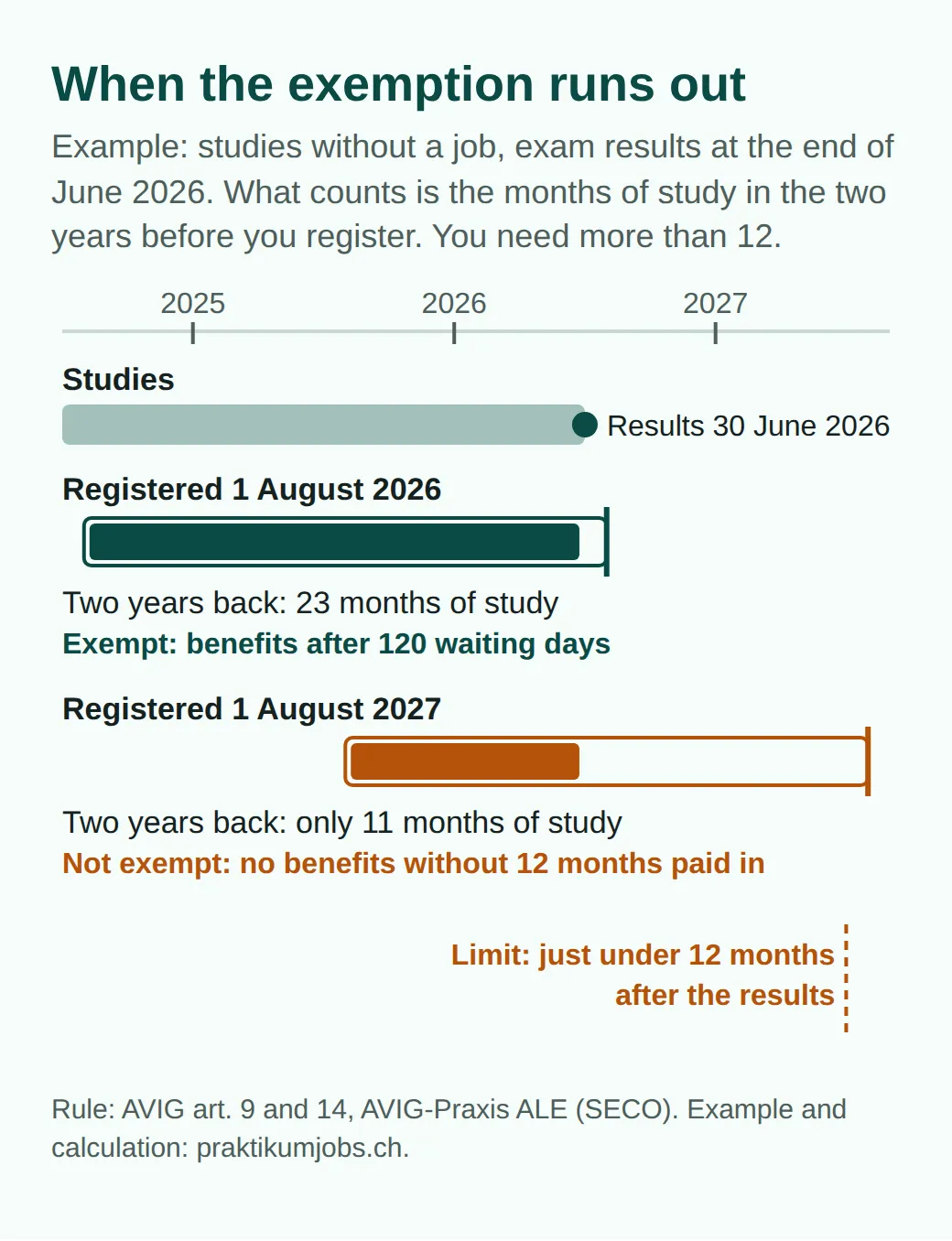
By our calculation, that means registering less than twelve months after your results, and preferably much sooner. After that, you can't rescue it by adding months of education to months of contributions either. SECO's directive rules this out explicitly, with the example of someone with twelve months of further training and eleven months of contributions: no entitlement (margin no. B209). If you want to travel or do odd jobs for a few months before you start looking properly, this is the deadline that matters most.
Apprenticeship, degree, student job: who waits how long
How much you get, and when, depends on whether you've paid contributions. Normally you need twelve months of contributions in the two years before you register. If you studied without a job on the side, you're exempt, with three catches: you must have lived in Switzerland for ten years, you get at most 90 daily allowances (AVIG art. 27), and you have a special waiting period of 120 days (AVIV art. 6). If you only came to Switzerland to study, on a B permit, you often won't reach the ten years and will need actual months of contributions. There's more on permits in our post on internships for foreigners.
| Your situation | Waiting days | Max. daily allowances |
|---|---|---|
| Apprenticeship completed, under 25, no children | none | 200 |
| Degree, no job while studying, under 25 | 120 | 90 |
| Degree, no job while studying, 25 or over | 125 | 90 |
| Studied with a job, 12 months of contributions, under 25 | no special ones | 200 |
These figures assume you have no children. Apprenticeship leavers paid contributions during their apprenticeship and so meet the contribution period, which means the special waiting period doesn't apply to them. According to SECO's directive (margin no. C116), the same goes for working students and people with a vocational baccalaureate.
The 125 days from age 25 come from the general waiting period, which is added to the 120. It depends on your insured earnings and also applies to flat rates: up to CHF 36,000 a year there's none, and between CHF 36,001 and 60,000 it's five days if you have no children. The full flat rate for graduates, CHF 3,320 a month, puts you just above that line, and SECO's directive explicitly gives five days for this case (margin no. C108b). The halved flat rate for under-25s keeps you well below it. The canton of Fribourg gives a flat five waiting days for apprenticeship leavers. Under the federal table, it's zero with the halved flat rate; what counts is your fund's decision.
If you worked part-time while studying, the fund combines the two. SECO shows how with an example in its directive (margin no. B211): 12 hours a week for CHF 1,200 a month, plus 28 of the 40 hours of the CHF 3,320 flat rate, which comes to CHF 2,324. That puts your insured earnings at CHF 3,524, and there are no waiting days because of education. So a student job pays off twice; read more in our post on student jobs in Switzerland.
What the 120 waiting days mean
Waiting days aren't calendar days; they count like daily allowances. SECO's directive requires the special waiting days to be served «wertmässig» (margin no. C117), in other words counted in daily allowances, and there are five of those a week, Monday to Friday. By our calculation, 120 waiting days are therefore 24 weeks, about five and a half months. Only then does money arrive, and then for at most 90 daily allowances, another 18 weeks.
On top of that, a day only counts as a waiting day if you meet all the conditions on it. So you must already be registered with the RAV during the waiting period, prove your applications, turn up to meetings and be available for a job. If you deregister or go travelling, the waiting period gets longer.
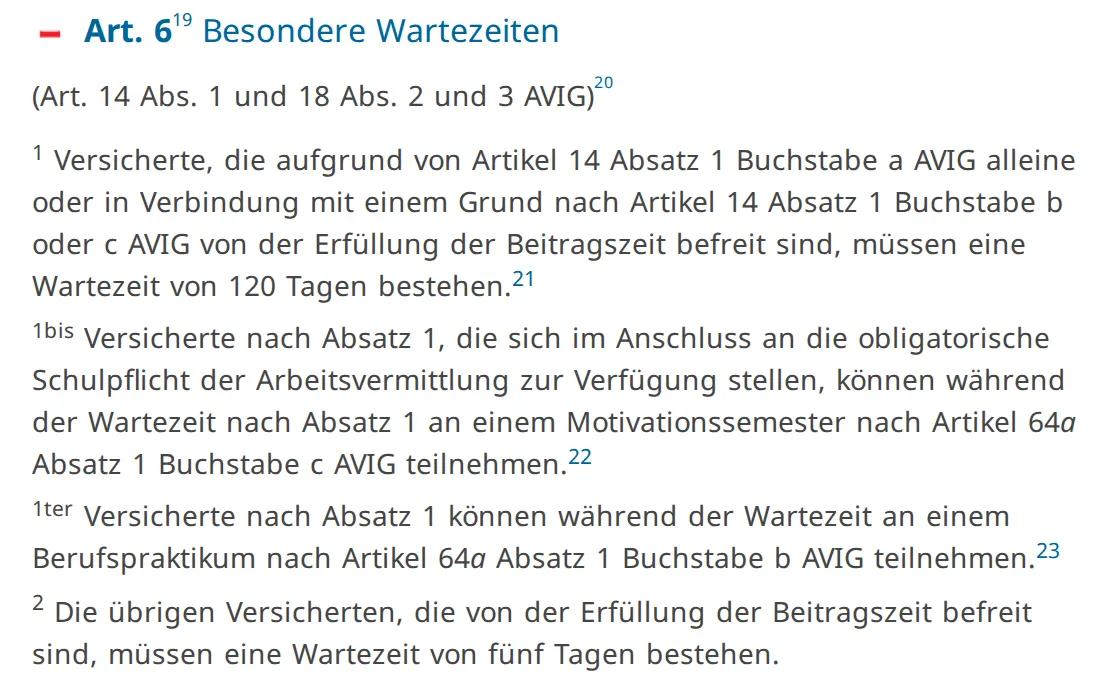
Five days instead of 120 only apply if you're exempt for another reason, such as long illness, maternity, separation, or coming back after more than a year of work outside the EU and EFTA. As soon as education is part of the picture, even together with another reason, it stays at 120 days.
How much is the daily allowance after graduating?
Without a contribution period, the fund doesn't calculate from a salary but from a flat rate per day (AVIV art. 41). It's CHF 153 with a qualification from a university, a university of applied sciences, a university of teacher education, a college of higher education or a federal professional examination. It's CHF 127 with an apprenticeship, a vocational baccalaureate or an academic Matura, and CHF 102 for everyone else aged 20 or over. You get 80 percent of that.
If you're under 25 and have no children, the fund halves the flat rate when you're exempt because of education or come straight from an apprenticeship. If your apprentice wage was higher than the flat rate, your apprentice wage counts instead.
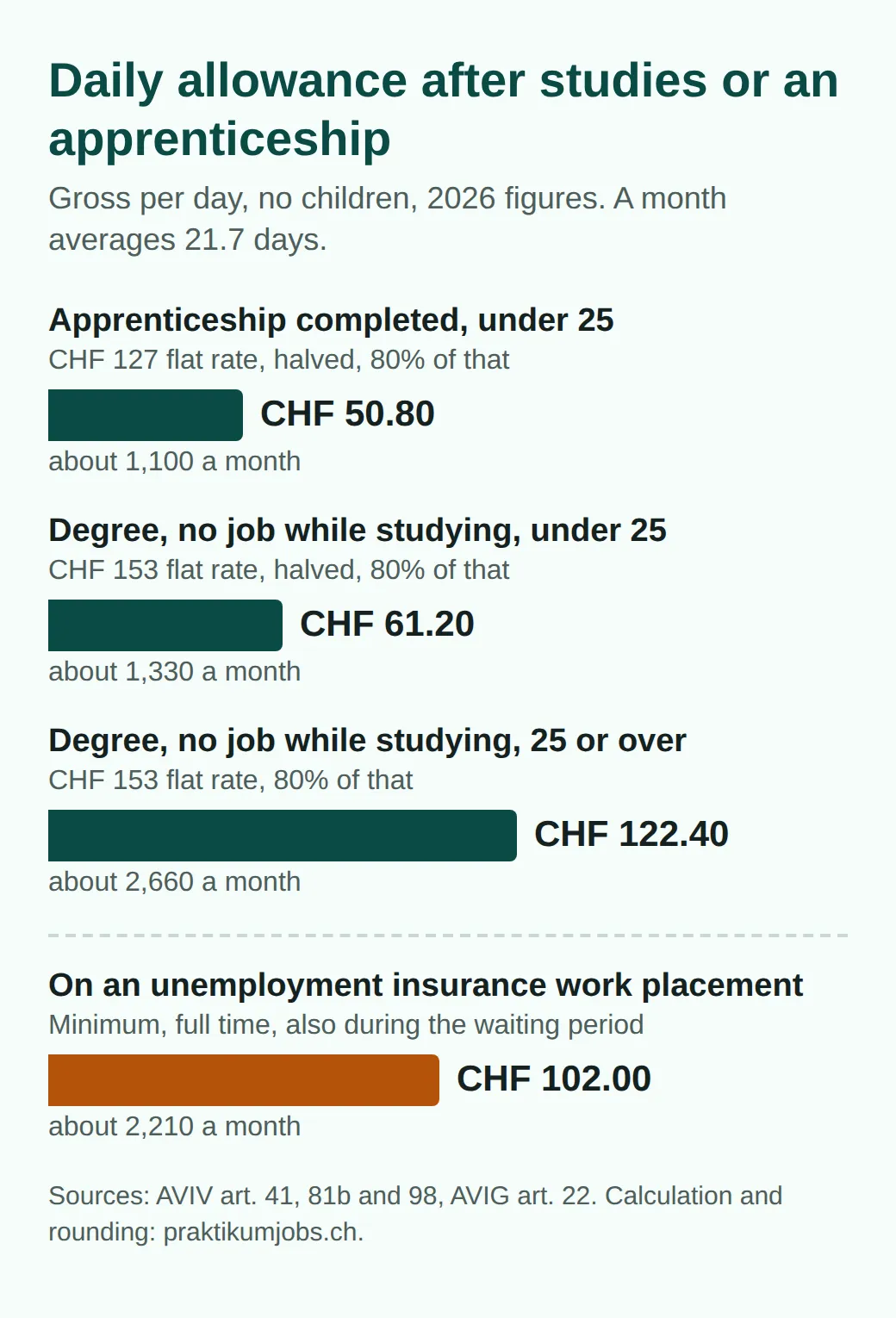
The fund works with an average of 21.7 working days a month; depending on the month, it's 20 to 23. Payment usually arrives during the following month, after deductions for AHV, IV and EO (old-age, disability and loss-of-earnings insurance), non-occupational accident insurance and the occupational pension. Under 25, by our calculation, that comes to about CHF 1,100 to 1,330 gross a month, and after a degree only after a wait of about five and a half months. This is exactly where the work placement gets interesting.
The unemployment insurance work placement
A work placement (Berufspraktikum) is one of the measures run by unemployment insurance: you work for up to six months at a company or in public administration, gain experience in your field and stay registered with the RAV (work.swiss). The daily allowance replaces a salary. On a full-time placement with at most 40 percent of the time spent on training, it's at least CHF 102 a day (AVIV art. 81b). If you're on the halved flat rate, that's a lot more: CHF 102 instead of 50.80 or 61.20.
What's new since 1 January 2026 is that you can do the placement during the 120 waiting days as well, whatever the unemployment rate (AVIV art. 6 para. 1ter, amended by AS 2025 814). During that time you receive a support payment equal to the minimum daily allowance, so CHF 102 a day too (AVIV art. 98). Until the end of 2025, this was only possible if Switzerland's unemployment rate had averaged more than 3.3 percent over the previous six months. According to the change log of SECO's directives, the change goes back to a Federal Council report on the Jositsch postulate.
Even so, you aren't entitled to a placement. The cantonal authority decides based on the labour market and your chances, and the placement only starts once it has been approved by a formal decision. Before that, the company, you and the authority sign a target agreement with a programme of activities. The directive on labour market measures generally rules out the company where you did your apprenticeship. You keep applying during the placement, and it ends at any time if a suitable job comes up. At the end, you're entitled to a reference.
The company pays its share: at least 25 percent of the daily allowance, but no less than CHF 500 a month for a full-time placement (AVIV art. 97a). Cantons can ask for more. Three cantons show how differently the placement is described from one place to the next.
Aargau: six months, 25 percent
On its page on youth unemployment, the canton of Aargau describes the work placement as a six-month assignment for anyone who has finished their education and lacks experience. Unemployment insurance covers most of the cost and the company 25 percent, at least CHF 500 a month. Your contact is your adviser at the RAV.
Graubünden: 30 percent and at most 42 hours
Graubünden asks more of the company: 30 percent of the gross daily allowance, again at least CHF 500. According to the 2022 fact sheet from the cantonal labour office, a placement lasts one to six months per company, and full time means at most 42 hours a week, classes included. For every 60 working days, you earn five days off on which you don't have to search or be available.
Solothurn: a leaflet with the old rules
The canton of Solothurn's website still carries a SECO flyer saying a placement during the waiting period is only possible if you're under 30 and unemployment is high. SECO's brochure on labour market measures, 2021 edition, also still mentions high unemployment. The ordinance has no age limit, and the high-unemployment condition was dropped on 1 January 2026. If the RAV quotes the old rules to you, politely point to article 6 paragraph 1ter AVIV.
How to find a placement
You don't have to wait for the RAV to offer you a place. A company that would take you registers the placement with the RAV using a one-page form, which is available on work.swiss. Ask specifically at firms in your field that train apprentices or can supervise you properly, as the directives require. For the company, the deal is cheap, and you're allowed to say so:
Dear Sir or Madam, I completed my bachelor's degree in business administration in June and am registered with the RAV. Unemployment insurance pays for work placements of up to six months, with the company contributing at least 25 percent of the daily allowance, but no less than CHF 500 a month. I would like to join your controlling team and learn on the job. May I send you my application documents? I would arrange the details with my RAV. Kind regards
What helps in any cover letter helps here too: concrete examples rather than a list of qualities, as in our post on the cover letter for an internship.
Induction grants: open to career starters since September 2026
If you find a proper job instead of a placement, unemployment insurance can pay part of your salary to the employer. This induction grant (Einarbeitungszuschuss) covers at most 60 percent of the normal salary, for six months at most, and goes down after each third of that time (AVIG art. 66). When the reason is a lack of work experience, it's only available when unemployment is high. From February to July 2026, the rate averaged 3.0 percent, above the 2.8 percent threshold. According to SECO directive 2026/01, the grant has therefore been available since 1 September 2026, until SECO replaces or withdraws the directive. Mention it if a company hesitates because you lack experience.
Your duties while you're registered
You hand in proof of your applications every month, by the fifth day of the following month at the latest (AVIV art. 26). Anything later no longer counts unless you have a valid excuse. Until you're 30, you also have to accept a job that doesn't match your education (AVIG art. 16). So apply widely, including in related industries and other regions.
Your salary expectations count too. Under SECO's directive (margin no. B315), asking for too much can be treated as not trying hard enough. The Federal Statistical Office figures in our post on starting salaries after university show what's realistic after graduating. A part-time job while you're unemployed is allowed, and it's offset against the daily allowance as interim earnings. Declare it every month on the form «Angaben der versicherten Person», the insured person's monthly statement.
What to do now
Once you have your results, register rather than wait, and keep every application from that day on. If you haven't paid any contributions, ask about a work placement at your first meeting: it pays CHF 102 a day even during the waiting period, instead of nothing. Better still, bring along a company that's willing to take part. If you're more likely heading for a regular entry-level programme, look at the deadlines for trainee programmes. For an internship on normal terms, the rules in our post on internship pay and rights apply. You'll find open internships with us in Zurich, Bern and Basel, among other places.
Common questions
- Do I lose unemployment benefits if I do an unpaid internship after my master's?
- Possibly. An internship after your degree that is barely paid and wasn't required for your degree doesn't count as education. If it's unpaid, it doesn't give you any contribution months either. If it lasts a long time, your months of study slip out of the two-year window and you lose the exemption.
- Can I travel during the 120 waiting days?
- A day only counts as a waiting day if you meet all the conditions on it, which includes being available for a job. Days spent travelling therefore make the waiting period longer. Days off with no obligation to look for work or be available only start after 60 days of registered unemployment, five at a time, and you have to report them to the RAV two weeks in advance.
- Can I get unemployment benefits in Switzerland after studying on a B permit?
- The exemption for education requires at least ten years of residence in Switzerland, continuous or not. If you don't reach that, you need twelve months of contributions in the last two years, for example from a student job or a paid internship. Without them, there's no daily allowance.
- What happens if I quit an RAV work placement early?
- If you and the company end it by mutual agreement because the work isn't right for you or is too demanding, there's no penalty. If you leave without good reason, the cantonal authority imposes suspension days on which you get no money. The placement ends at any time if you find a suitable permanent job.
More posts
All posts
Student health insurance in Switzerland 2027: what you pay
Swiss health insurance for students and apprentices in 2027: what you pay at 19 to 25, which deductible fits, premium reductions and the 30 November deadline.

Daycare (Kita) internship in Switzerland: pay, length, rules
A daycare internship before the FaBe apprenticeship: what it usually pays, which cantons cap it at six months and what to get in writing first.

Graduate starting salary in Switzerland 2026, by field
Starting salary after university in Switzerland: median pay one year after a university, UAS or teaching degree, by field and region, and what to ask for.